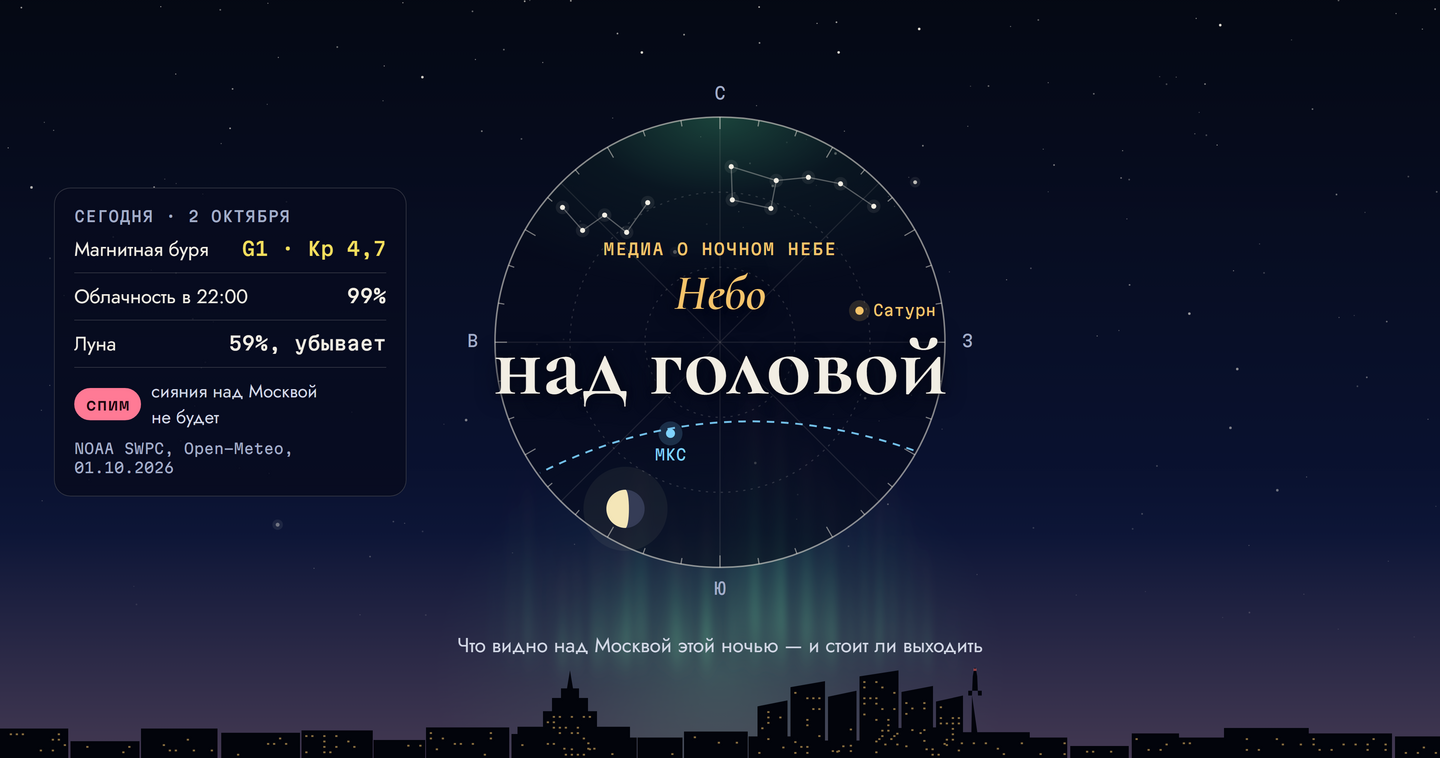
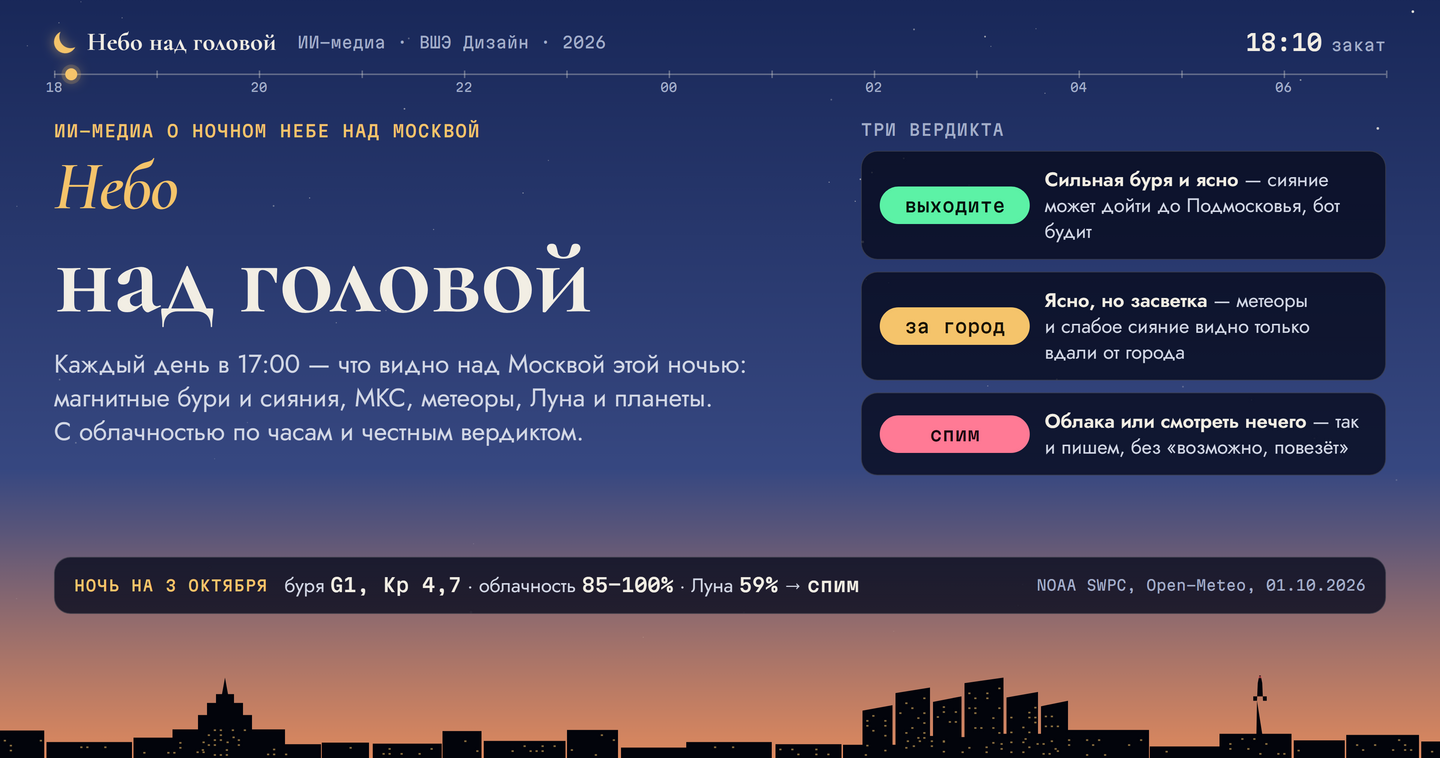
«Sky Above Us"—an AI media project about the night sky over Moscow. Every day at 5:00 PM, we answer one question: is it worth looking up today? The bot compiles forecasts for geomagnetic storms, hourly cloud cover, moon phase, ISS passes, and meteor shower calendars. The AI transforms this data into a brief summary with a verdict—"go out,» «go to the countryside,» or «sleep"—while a human verifies every aurora concern. The media is published on MAX, VKontakte, and Telegram, and the «Aurora Alarm» bot notifies subscribers when an aurora is genuinely possible over the Moscow region.
Example using real data: For the night of October 3, 2026, NOAA forecasts a G1 weak storm (Kp 4.7), Open-Meteo shows 85–100% cloud cover, and the Moon is 59% illuminated. Verdict—sleep.
1. Media Goal
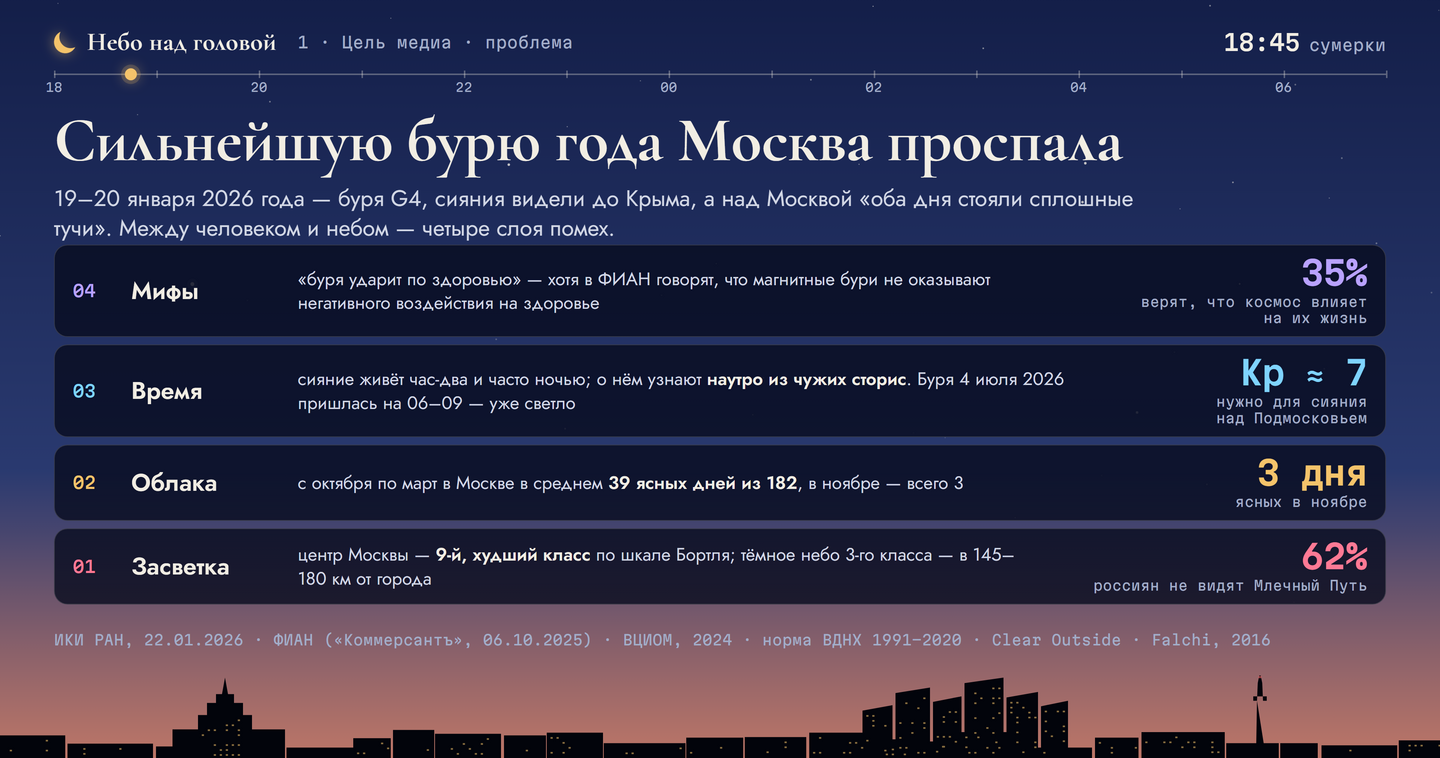
Moscow slept through the strongest geomagnetic storm of 2026. The storm, rated G4 (Kp 9–), along with an S4 radiation storm, occurred on January 19–20—a phenomenon not seen since October 2003. Auroras were visible as far as Crimea, but according to the Institute of Space Research of the Russian Academy of Sciences (IKI RAS), «both days… the sky was completely overcast» over Moscow. Between the Moscow residents and the sky were four layers of interference.
Light Pollution: Central Moscow is a Class 9 area on the Bortle scale, and Class 3 skies only begin 145–180 km from the city (Clear Outside). In Russia, 61,8% of the population cannot see the Milky Way (Falchi et al., Science Advances, 2016). Clouds: From October to March, Moscow averages 39 clear days out of 182, with only 3 in November (VDNKh norm, 1991–2020).
Time: the glow lasts for an hour or two and often happens at night—people learn about it the next morning from others' Stories. The July 4, 2026, storm occurred between 6 and 9 AM, when it was already light outside. For the glow to reach the Moscow Region, an Ap index of around 7 (a G3 storm) is needed—this is our conclusion based on observations from 2024–2026; there is no official threshold for Moscow.
Myths: 35% of Russians believe that space events affect their lives (VTsIOM, 04/05/2024), although FIAN states that geomagnetic storms do not have a negative impact on health («Kommersant», 10/06/2025).
The media’s goal is to make Moscow residents stop overlooking the sky: over the first season, from October to March, the reader should at least check in to see our verdict—and see what they came out to see.
Tasks:
1. Every evening, report «view or sleep”—for Moscow and the surrounding region, broken down by hour, including cloud cover and lunar phase.
2. Provide alerts only when necessary: a glare alert is issued when a storm is severe and the sky is clear.
3. Explain phenomena without myth: storms, the G1–G5 scale, and „Mercury retrograde”—using data from the Institute of Space Research of the Russian Academy of Sciences and NOAA.
4. Collect reader observations: a „seen / not seen“ map helps refine the forecast for Moscow.
Milestones for the first 6 months: 15,000 subscribers across MAX, VKontakte, and Telegram combined; 7 out of 10 alerts confirmed by reader photos; 2,000 images on the observation map.
2. Future Media Themes
Segment: science popularization about science and technology. Topic: astronomy and space, subtopic — observing the sky without a telescope. Narrow topic: what is visible over Moscow tonight—and whether it’s worth going out. Geomagnetic storms and aurora borealis, the ISS, meteor showers, the Moon and planets—with a cloud cover forecast for a specific hour. Main reader question: «Is it worth going out onto the balcony or heading outside the city today?» We are not covering: astrology, space launch and cosmonautics news, UFOs, or reviews of expensive telescopes.
Why now. The maximum of solar cycle 25 was reached in October 2024: the smoothed spot count was 160.9, 40% higher than forecast (SILSO; NASA and NOAA announced the «maximum phase» on October 15, 2024). The Sun is currently in decline—in September 2026, there were 60.3 spots. However, the storms during this decline are no less intense: in 2025, there were 69 days with geomagnetic storms compared to 44 in 2024—the highest number since 2016 (IKI RAS and ISZF, RBC, December 24, 2025).
The Institute of Space Research of the Russian Academy of Sciences expects that the risk of powerful solar flares and geomagnetic storms will persist at least until the end of 2027 (RBK, June 11, 2025). Interest is growing: during the 2023/24 season, there were 2.4 million search queries about the aurora borealis—a 25% increase from the previous year («Rossiyskaya Gazeta, ” October 16, 2024). And the phone sees the aurora better than the eye: on the night of October 1, 2025, in the Moscow region, the aurora „was poorly visible to the naked eye but was reliably recorded using phones“ (IKI RAS), so photos immediately flooded social media feeds.
The dark night season runs from October to March. What is visible from Moscow: • October 4 — Saturn in opposition, visible all night in the south; • October 21–22 — Orionids, after 2:00 AM, when the Moon sets; • November 17–18 — Leonids, about 15 meteors per hour; • December 13–15 — Geminids, the main stream of the year: up to 120–150 meteors per hour and about 9 hours of dark sky; • January 4 — Quadrantids, about 120 per hour, peak around 7:00 AM; • February 11 — Jupiter in opposition, February 19–20 — Mars (101.4 million km from Earth); • February 21, 12:12 AM–4:13 AM — penumbral lunar eclipse, the only one visible from Moscow during the season.
Clear days are rare: there are an average of five in October, three in November, four in December, eight in January, nine in February, and ten in March, so a hourly forecast is essential. And as for the auroras—they cannot be predicted a month in advance, so the robot monitors Kp daily. Sources: timeanddate, RMG, AKM, Espenak Almanac, JPL Horizons; clear days—VDNKh standard 1991–2020.
Sections — the weekly almanac, each addressing a reader’s question:
• Daily at 5:00 PM — «Today in the Sky»: KP index, hourly cloud cover, Moon, ISS, and the verdict.
• Event-based — «Alert: Aurora»: a push notification when the storm is strong and the sky over Moscow is clear, including the time and direction.
• Monday at 10:00 AM — «Sky of the Week»: what will be visible in the next 7 nights.
• Wednesday at 7:00 PM — «Myth of the Week»: is it true that storms cause headaches?
• Friday at 6:00 PM — «Dark Sky»: where to go on the weekend to escape light pollution.
• Saturday at 12:00 PM — «How to Shoot»: phone settings for stars and aurora.
• Sunday at 8:00 PM — «Reader Photos»: who saw what and where, a map of submitted images.
• 24/7 — the «Aurora Alarm» bot.
Navigation: category hashtags and the pinned post «How to Use» — KP scale, what G1–G5 means, and why Moscow needs a stronger aurora.
3. Competitors
How we researched. We analyzed over 30 channels, applications, and services covering the sky, storms, and space. For Telegram, subscriber counts were taken from the t.me counter, reach was calculated as the median views of the 100 most recent posts older than two days, and ERR was calculated as the median divided by the number of subscribers. For applications, we used installation numbers from Google Play and RuStore; for weather services, we used their pages concerning magnetic storms. All data is current as of October 1, 2026. Due to anti-bot verification, VK is inaccessible, and we did not bypass this check, so no VK figures are available.
Comparison Criteria (Yes, Partially, or No):
C1 — Audience and Engagement: subscribers, median views, ERR.
C2 — Moscow and the Night: grounding in the city and the hour to observe.
C3 — Clouds and Verdict: cloud cover forecast and the response «watch or sleep.»
C4 — Notifications: bot or push, activation threshold, speed.
C5 — Accuracy and Myths: primary source (IKI, NOAA), honesty regarding storms and health.
C6 — Sky Scope: auroras, ISS, meteors, eclipses, planets.
Direct competitors are channels about space weather and the sky. They report on storms, but not on Moscow. 1. XRAS — The Laboratory of Solar Astronomy of the Institute of Space Research of the Russian Academy of Sciences (@lpixras): 48,176 subscribers, median of 22,750 views, ERR of 47,2%. A daily summary titled «Space Weather, ” maintaining a calm, scientific tone, and free of advertising. However, it lacks mention of Moscow, a specific night, or cloud cover. 2. AstroAlert (@astroalert): 46,600 subscribers, median of 13,700, ERR of 29,4%. Features „What’s in the sky today“: storms, meteors, eclipses, ISS; it generates income from astronomical tours. Its scope is tied to the „European part of Russia, ” rather than a specific city, and mentions cloud cover only sporadically.