INDEX
1. Concept 2. When Mickey Creates Chaos Himself 3. Can the Mouse Keep Being a Mischief-Maker? 4. Transforming into a Fairy Tale Hero 5. The Language of Comedy 6. Conclusion 7. List of Sources and Literature
CONCEPT
What transformation did Mickey Mouse undergo at the start of his journey, and how did his fame influence it? If you look at the early Mickey Mouse cartoons, you might be surprised by how much his character differs from what we know about the hero today.
In this study, I will compare short animated films featuring Mickey Mouse from the 1920s and 1930s—specifically Plane Crazy (1928), Steamboat Willie (1928), On Ice (1935), Mickey’s Rival (1936), Brave Little Tailor (1938), and The Pointer (1939)—and analyze when and why the character reached a pivotal moment that changed Mickey Mouse forever.
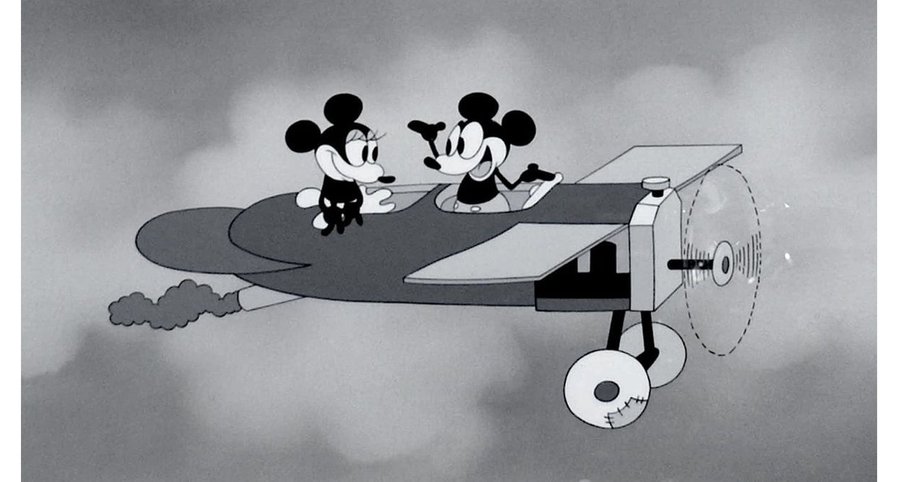
Mickey and Minnie Mouse in the cartoon «Crazy Plane,» 1928
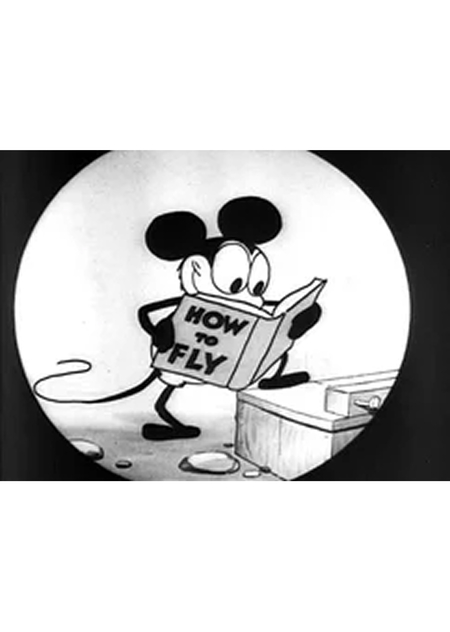
If you place several Mickey Mouse cartoons side-by-side, starting with the very first one in 1928 (Plane Crazy) and going through the end of the 1930s, you might initially notice only changes in the drawing style: early Mickey has thin arms and legs, large black eyes, and a very agile, almost rubbery body. In his first films, he also lacks his signature white gloves and even large boots. Over time, his facial features become softer, his movements more composed, and his reactions more complex. But if you look not just at his appearance, but at what the character actually does, a much more interesting shift becomes apparent. Mickey, who initially delights in crossing boundaries and actively engaging with others, gradually transforms into a character from whom the viewer expects assistance, nobility, and the right course of action. In just one decade, it is not so much the mouse himself who changes, but the very conception of what a cartoon protagonist should be.
In the early films, the mouse appears to the viewer as audacious, mischievous, willful, and even toxic—a depiction that stands in stark contrast to its later versions.
In some stories, Mickey creates his own troubles; in others, he has to deal with the consequences of someone else’s behavior; and in a third, the viewer watches his fear and his attempts to overcome difficulties. Furthermore, change cannot be depicted as instant reform. Across different years, he remains stubborn, clumsy, and overconfident. Rather, it is the focus of the viewer’s sympathy that changes gradually.
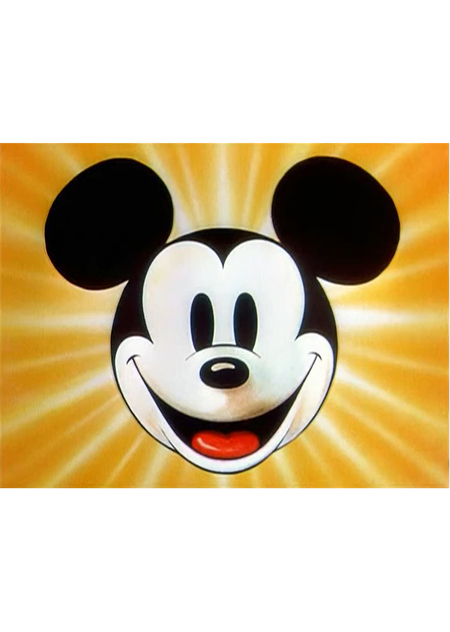
Ultimately, it turns out that the same figure, the same character, elicits radically different reactions over time: initially, they provoke laughter with their antics, but after several years, they inspire sympathy due to their insecurity. This change, while not abrupt, can still be tracked through the films.
Mickey Mouse in «The Band Concert,» 1935
WHEN MICKEY CREATES CHAOS HIMSELF
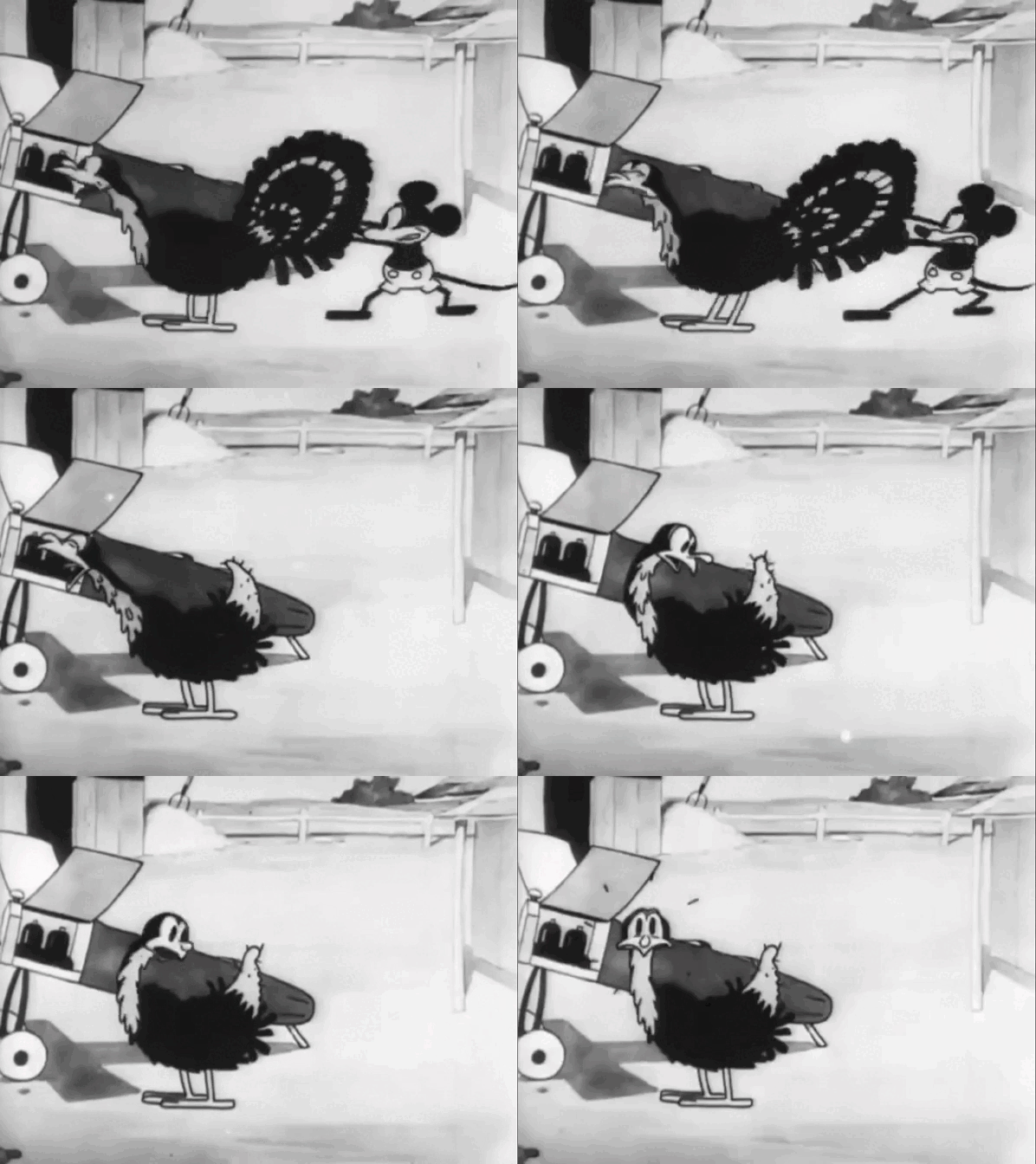
In Plane Crazy (1928), the first Mickey Mouse cartoon, the character looks nothing like the flawlessly polite mouse we imagine from later Disney works. He attempts to replicate the feat of a famous aviator, assembles an airplane from whatever he can find, and draws the surrounding animals into his endeavor. All the animals around him «dance to his tune,» and right from the start, it’s clear that his drive to achieve a result outweighs any concern for those who help him. He behaves with incredible confidence despite knowing almost nothing. It is precisely this overconfidence that makes the character humorous: the viewer anticipates that everything will inevitably end in disaster, yet Mickey doesn’t allow himself even the thought of failure.
Mickey initiates jokes, creates chaos, laughs at other characters, and causes mischief. His character is much freer than in later films, and the mouse from the late 1920s can get away with much more. This forms the foundation of all the humor in the cartoon.
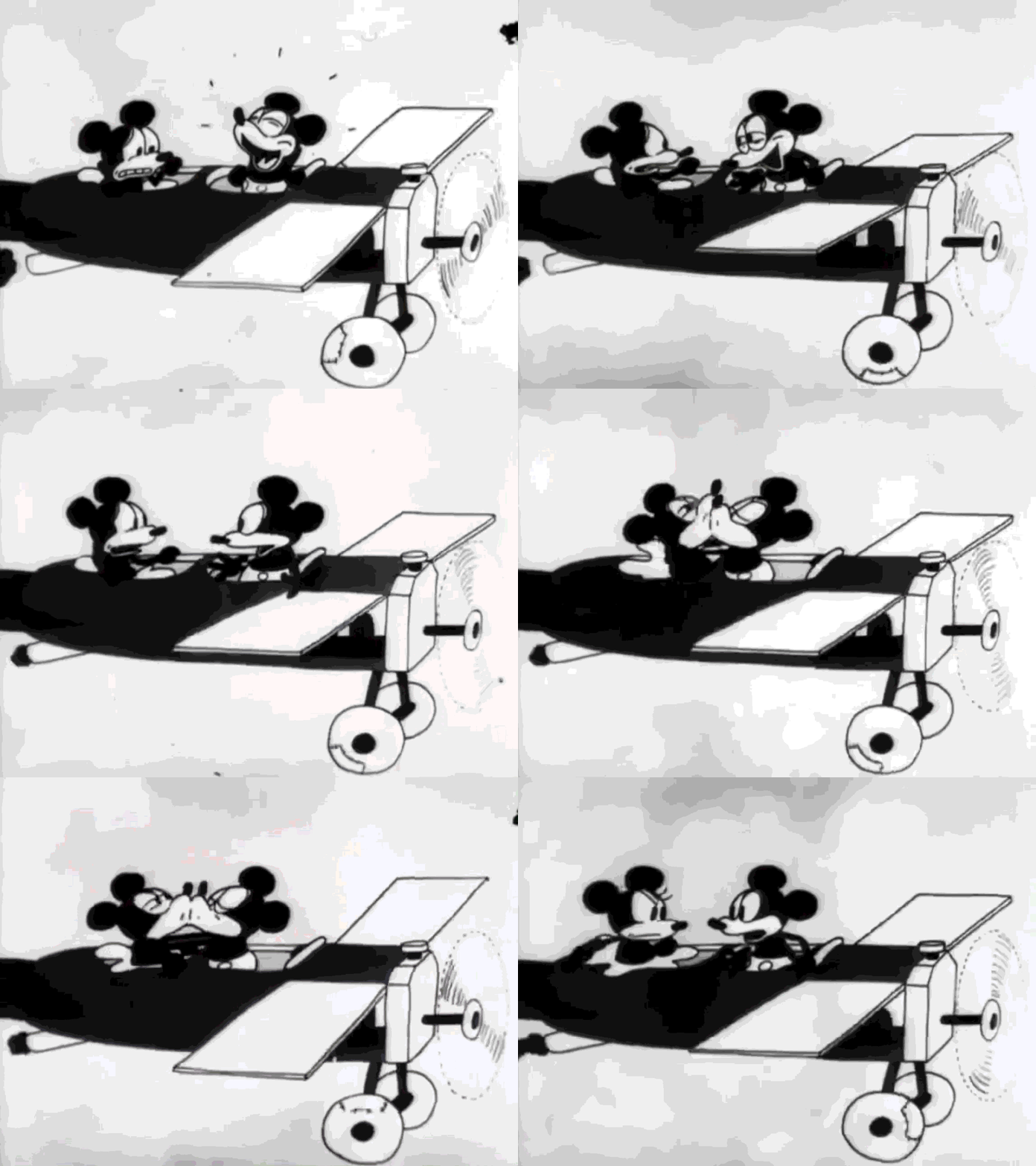
In «Crazy Plane, ” the sequence involving Minnie is particularly telling. Mickey attempts to kiss her—despite her repeated refusals—followed by a series of daring maneuvers, and he ends up kissing her anyway. At the end, Minnie leaves the plane, using her clothing as a parachute. Today, this sequence feels rather abrupt: it’s difficult to envision such a scene in a cartoon where Mickey is meant to be a role model for good behavior. But here, the directors aren’t trying to mold him into a moral compass; he acts as a comedic adventurer, like a silent film hero who is permitted to be selfish if it results in a spectacular stunt. It is also important that the viewer is not obligated to approve of his actions in order to laugh at what is happening. The humor arises from Mickey’s overconfidence and the inevitable collapse of his plans.
«Mad Airplane, ” 1928
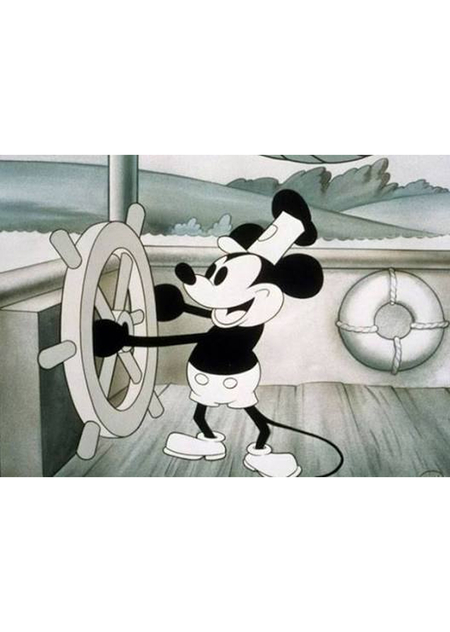
In Steamboat Willie (1928), this principle becomes even more evident. Mickey works on a steamboat under the command of a rough captain, yet he does not appear to be a helpless victim in the slightest. As opportunities arise, he begins staging an entire musical performance using the surrounding objects and animals. Suddenly, a cow transforms into a xylophone, a duck resembles a musical instrument, and the vessel itself seems to conform to the rhythm. Visually, it is all very comical: bodies stretch and compress, sounds match movements, and the space around the protagonist comes alive. But, if one thinks about it, what is happening is based on Mickey’s complete indifference to how the others feel. The animals are needed by him primarily as a source of sound. This creates a strange effect: we delight in the character’s musical ingenuity while simultaneously noticing how cruel he can be toward others.
«The S.S. Willie», 1928
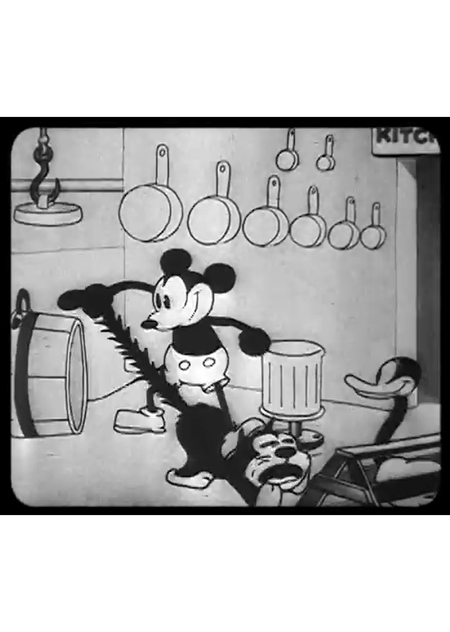
The important detail is that this was the first sound cartoon featuring Mickey Mouse, and therefore, it was created as a demonstration of synchronous sound capabilities. Because of this, some of the character’s actions are not entirely intended to reveal his personality but rather to be spectacles for their own sake: if a sound can be extracted from a cow, a goat, or a kitchen item, the creators will certainly utilize it. In early animation, movement and musical gags often take precedence over psychological and physical realism. Mickey did not yet need to behave consistently from one film to the next; it was enough for him to be recognizable, energetic, and funny. Perhaps this is why the early cartoons feel freer—his actions, which later might seem completely out of place, were acceptable.
Walt Disney’s appetite for experimentation is fully reflected in Mickey Mouse’s behavior. During that period, the director actively tested the possibilities of animation in his work and developed its principles to make the character feel more alive. In his works, he caricatures and grotesquely depicts the characters' emotions and reactions, compressing and expanding them for comedic effect. Mickey Mouse was no exception, and in the early films featuring the little mouse, we see Disney’s tendency toward unreality, including in «Steamboat Willie,» where the director experimented not only with form but also with sound. It is for this reason that the psychological portrait of the character is not as important for cartoons of the 1920s: comedy, visual impact, and unrealistic movement are the priorities.
«The S.S. Willie,» 1928
CAN WE LET MISHONKO KEEP BEING A TROUBLEMAKER?
«On Ice,» 1935
By the mid-1930s, attitudes toward Mickey were gradually shifting. He became a global sensation, and his image needed to appeal to a significantly broader audience—meaning his range of potential actions had to narrow to a more socially acceptable and approved persona. Around the same time, Walt Disney began releasing the Silly Symphonies series, and all experimental elements migrated there, leaving the mouse to become increasingly polished in service of the massive public he had managed to win over.
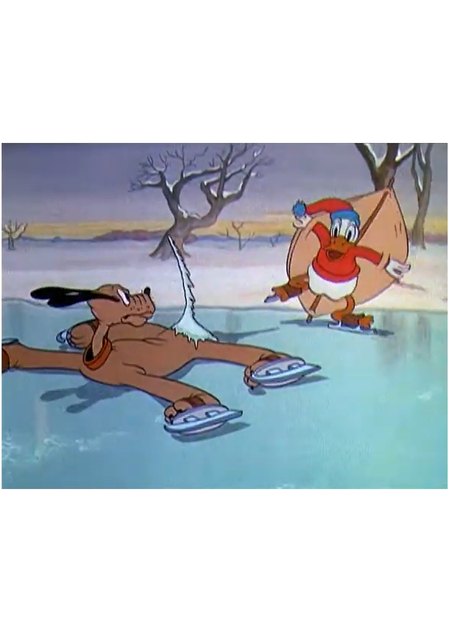
But it’s not just about popularity. Other characters begin to appear around Mickey, who are entrusted with the most unpleasant and absurd mischief. This is especially noticeable in On Ice (1935). Here, Donald teases Pluto, gets him into trouble, and himself becomes a source of rough comedy, while Mickey tries to help Minnie get comfortable on skates. This is a very precise shift in roles: the former Mickey could easily have been the prankster, but now he plays the role of the caring suitor. The humor doesn’t disappear; it is simply redistributed among the characters in a new way. Essentially, Walt Disney offloads the heavy lifting onto other secondary characters to whitewash the main character.
Along with its great popularity, the thought of the mouse also comes with great responsibility, as the main character acquires the duty to convey a specific manner of behavior.
«On Ice,» 1935
Thus, Mickey’s character begins to change: he becomes softer, kinder, and cuter. Along with his behavior, his appearance also shifts, becoming much closer to what we see on screen today—he gains his recognizable, signature features. The experiments in plastic form move to another Disney project, but the humor resulting from these experiments remains in the short films featuring Mickey Mouse, albeit in a different form—through supporting characters. Goofy and Donald Duck handle their roles excellently, allowing the little mouse to remain a positive protagonist.
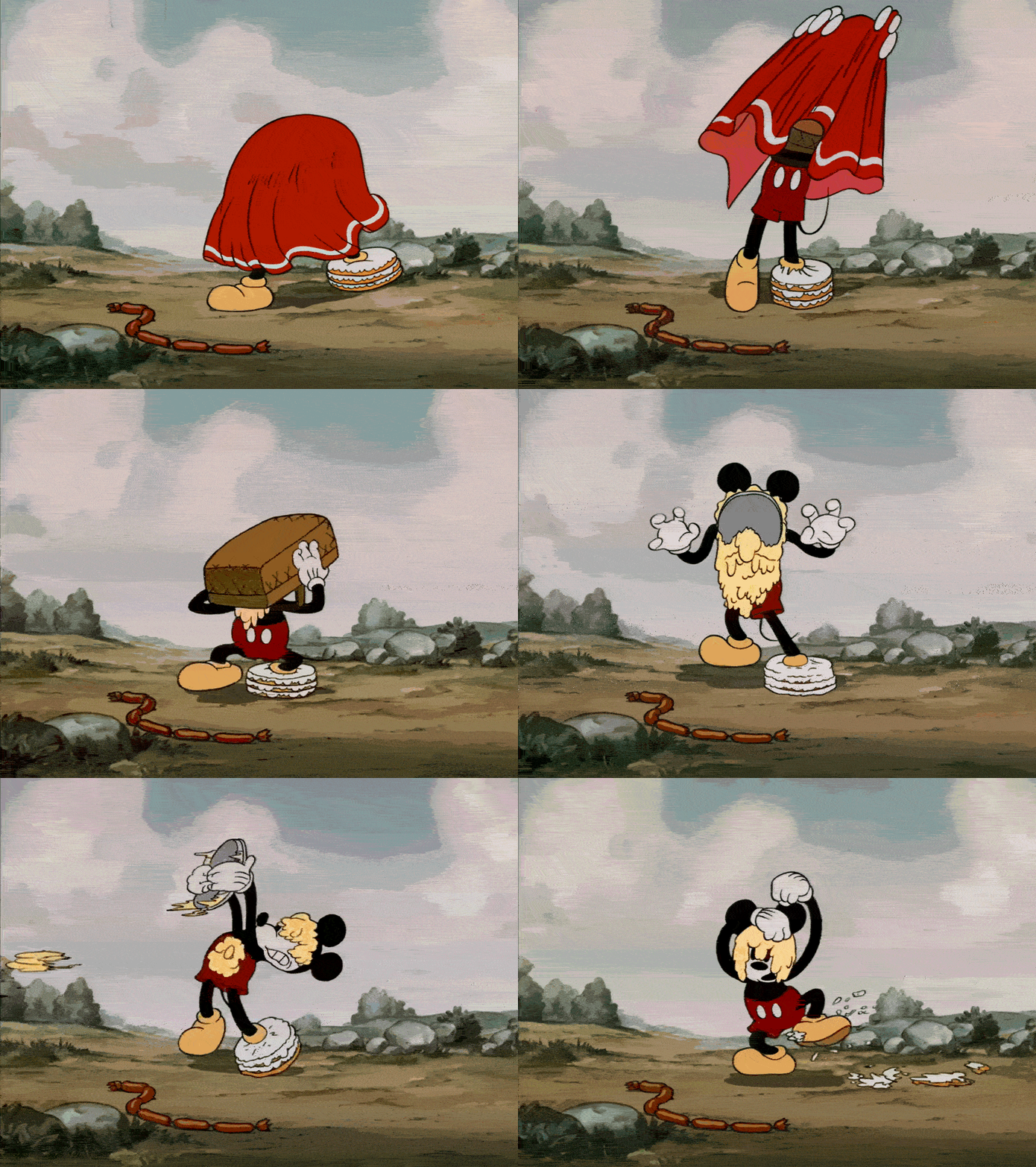
For example, one could look at Mickey’s Rival (1936), where Mortimer appears during a date between Mickey and Minnie. He is arrogant, mocking, loves to show off, and without much hesitation, casts Mickey in an unfavorable light. At first glance, Mortimer is simply a rival necessary for the progression of a romantic story, but if one digs deeper and recalls the early Mickey, there’s a sense that a part of his old character has seemingly transferred into the new character. Mortimer does what the main character could have done himself previously—provokes, boasts, enjoys others' embarrassment—but now the audience is offered a perspective viewing this behavior from the victim’s point of view, rather than from the joker’s.
«Mickey’s Rival,» 1936