Navigation
- Concept of Work
- Historical Context
- Topic Exploration 3.1. Architecture in Fantasy Film 3.2. Architecture in Video Games
- Conclusion
- Bibliography
1. Concept of Work
Architecture in cinema and video games is not merely a method for organizing space and creating visually appealing environments. It functions as one of the most crucial tools of artistic storytelling, capable of conveying the history of a place, cultural nuances, the social structure of a society, the character of an era, and the emotional state of the world in which the events unfold. Buildings, urban spaces, fortresses, temples, and palaces become distinct carriers of information, allowing the viewer or player to better understand their surroundings even without direct explanation from the creators.Architecture plays a particularly prominent role in the fantasy genre, where creators face the necessity of forming an independent visual reality. Since the action in such works often takes place in fictional worlds lacking specific historical ties, architecture becomes a primary way to denote timelines, cultural characteristics, and the nature of the civilization depicted. Through it, authors create a sense of antiquity or prosperity, convey concepts of power and religion, and establish an atmosphere of mystery, grandeur, anxiety, or decline.
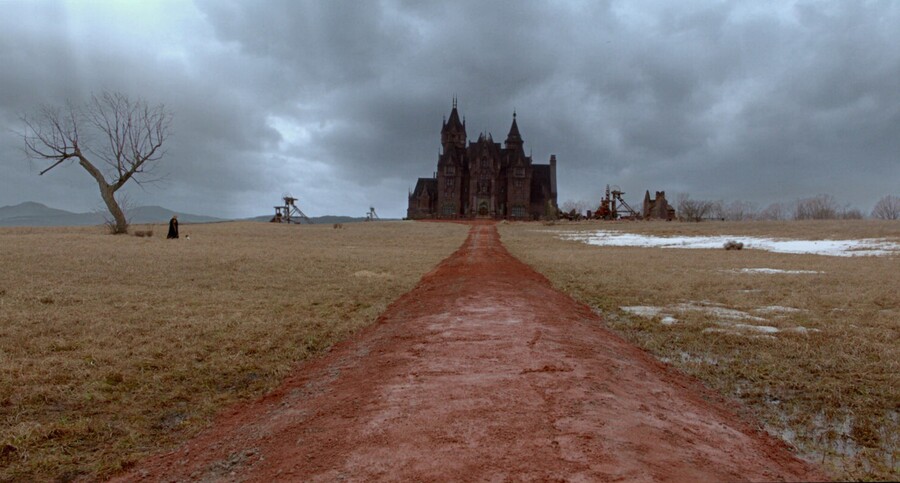
A still from the film «Crimson Peak» by Guillermo del Toro, 2015
The relevance of this topic stems from contemporary mass culture’s enduring interest in medieval aesthetics and its active incorporation into film, video games, and other visual media. Despite the diversity of fantasy worlds and artistic approaches, the architectural imagery of European Middle Ages remains one of the most recognizable visual languages of the fantasy genre.Referencing historical architectural styles allows creators to construct a convincing environment for fictional events by leveraging pre-existing cultural associations. The viewer does not require an in-depth explanation of why a fortress with massive walls is perceived as a defensive structure, or why a majestic cathedral with high vaults evokes associations with religious authority and something sublime. Such visual motifs already possess a certain historical and cultural resonance that creators can utilize, augment, or deliberately reinterpret.Thus, the personal interest in this subject lies in the desire to deeply understand the relationship between architecture and visual storytelling, as well as to determine why historical architectural styles continue to be a sought-after tool for creating fantasy worlds.
Still from the film «The Lord of the Rings: The Return of the King,» Peter Jackson, 2003
The primary methodology of this research will employ a comparative visual-analytical approach, based on selecting and examining works of fantasy cinema and video games that feature the use of Romanesque and Gothic architectural aesthetics. Two films and two video games are proposed as the core material—selections that differ in narrative features, artistic concepts, and the visual composition of their environments. The selection of these works will be based not only on the presence of characteristic architectural elements but also on the work’s overall idea, its storytelling, atmosphere, and the historical context of its fictional world. This approach will allow for the examination of architectural style not in isolation, but in direct relation to the functions it performs within a specific narrative.
The main hypothesis of this research posits that the choice between Romanesque and Gothic architectural aesthetics in fantasy works is determined not only by the creators' visual preferences but also by the need to convey specific meanings, emotional states, and characteristics of the fictional world. It is suggested that architectural styles possess distinct expressive potential, allowing authors to shape a particular perception of space even before the viewer or player encounters its history. Therefore, the core hypothesis is that Romanesque and Gothic architecture in fantasy serve not merely as historical stylistic references, but as complete tools for visual storytelling.
2. Historical Context
Before analyzing architecture in film and video games, it is necessary to turn to the historical origins of the Romanesque and Gothic styles. Medieval European architecture became one of the primary sources of visual inspiration for creators of fantasy worlds. Its forms, structural features, and symbolic language allow for the creation of spaces that are associated with a specific era, culture, and social structure.
For this study, it is important to consider these styles not only from the perspective of architectural history but also as two distinct methods of spatial organization, each possessing its own visual and emotional potential. Understanding their historical context will later allow us to trace how individual architectural elements are reinterpreted in contemporary films and video games.
Romanesque Architecture
Castle Rising, William de Obiny II, England, 1138
The Romanesque style developed in Western Europe approximately during the 10th–12th centuries and became one of the primary architectural movements of the medieval period. Its evolution was closely tied to the strengthening of the Christian Church, the spread of monastic orders, the growth of pilgrimage, and the formation of new political centers following the collapse of the Carolingian Empire. During this time, monasteries and churches became not only religious institutions but also vital centers for community life, education, and the preservation of cultural heritage.One of the defining characteristics of Romanesque architecture was the visual massiveness of its structures. It is characterized by thick stone walls, small window openings, powerful supports, semi-circular arches, and heavy vaulted ceilings. The interior space was often organized through a succession of arcades and massive columns or pillars, which created a rhythmic and quite rigid composition.
These structural solutions were driven, in part, by the need to withstand significant loads from stone vaults. The walls and supports bore the majority of the structure’s weight, which prevented architects from freely enlarging window openings without additional engineering solutions. As a result, the interiors of Romanesque churches often featured subdued lighting, and the massive walls visually emphasized the stability and enclosure of the space.Semicircular arches and cylindrical vaults held particular significance in Romanesque architecture. They became crucial elements of the architectural composition and defined the characteristic appearance of many medieval sanctuaries. Along with them, groin vaults were utilized, which allowed for the spanning of more complex spaces and the distribution of load among the supports.
Abbey of Lesse, France, 1056
As one of the most expressive examples of Romanesque architecture, the Speyer Cathedral (Speyer Cathedral) can be examined, construction of which began in 1030 on the initiative of Emperor Conrad II. The cathedral became one of the most important monuments of Romanesque architecture of the Holy Roman Empire. Its scale, symmetrical composition, four towers, and massive stone volumes demonstrated not only the religious significance of the structure but also the political might of imperial power. For nearly three centuries, the cathedral served as the burial place for German emperors.
Speyer Cathedral, Germany, 1030
Speyer Cathedral, Germany, 1030
Examining the Romanesque style from the perspective of visual perception, several characteristic features can be identified. Foremost among these is a sense of heaviness, solidity, and stability. The architectural forms seem to emphasize the structure’s connection to the earth, while the limited amount of light creates an atmosphere of solitude and focus. However, these characteristics should not be interpreted solely as the architects' artistic intent; in many ways, they emerged from the structural and functional aspects of the buildings.
Gothic Architecture
Gothic architecture emerged in France in the first half of the 12th century and gradually spread throughout Western Europe. Its appearance was the result of the prolonged development of medieval construction technologies, as well as changes in the religious, cultural, and social life of European cities.Unlike Romanesque architecture, which relied heavily on the massiveness of load-bearing structures, Gothic sought to create taller and brighter spaces. The development of engineering solutions played a crucial role in this process, allowing for the redistribution of the building’s load and reducing the structure’s dependence on solid, massive walls.
Chartres Cathedral, France, 1194–1260
One of the defining features of Gothic architecture was the pointed arch. Unlike the semicircular arch characteristic of the Romanesque style, the pointed arch allowed for the construction of taller and more varied structures in proportion. Combined with ribbed vaults and a system of external supports, this opened up new possibilities for organizing architectural space.
Ribbed vaults were a system of intersecting stone ribs that formed the frame of the ceiling and helped distribute the load onto specific supports. External arched structures played an additional role, channeling the thrust of the vaults onto exterior buttresses. Thanks to this, walls could become thinner, and window openings could become significantly larger.
Rib Vault Example
Example of exterior arched structures
A key example is Notre-Dame Cathedral in Paris, construction of which began in 1163. Its architecture demonstrates the fundamental principles of Early Gothic: pointed arches, soaring vaults, large stained-glass windows, and a developed system of external supports. Over time, the building has undergone numerous reconstructions, yet it has retained the characteristic features of the Gothic architectural language, becoming one of the most recognizable symbols of medieval Paris.
Notre Dame Cathedral, Paris, France, 1163–1345
From the perspective of visual perception, Gothic architecture imparts an entirely different character to a space. Vertical lines draw the eye upward, intricate vaults create a sense of grandeur, and stained glass and large windows make the interior brighter and visually richer. The architecture seems to strive to transcend its own materiality, creating an impression of lightness and aspiration beyond earthly space.
This is precisely why Gothic aesthetics offers vast possibilities for artistic reinterpretation within the fantasy genre. Tall towers, sharp spires, majestic cathedrals, and complex architectural compositions can be employed to create imagery of powerful religious institutions, ancient magical centers, mysterious cities, and civilizations existing on the boundary between the real and the supernatural.