Introduction
Death is one of the few themes that unites people regardless of time, status, or origin. However, attitudes toward it have never been static. In different eras, artists have depicted the finitude of human life in varied ways: as a divine reminder, an inevitable fate, social satire, or philosophical reflection. In medieval art, death often took the form of a skeleton that appeared alongside people from various social classes. It did not merely symbolize the end of life; it served as a reminder of the equality of all before death.
Concept
Memento mori — «Remember death.»
The concept of Memento mori has become one of the core motifs of European artistic culture. It serves as a reminder of the finite nature of human life and invites us to view conventional notions of wealth, power, beauty, and earthly achievement through the lens of inevitable death. This idea was particularly vivid in the medieval theme of the Dance of Death (Danse Macabre). In such depictions, death appears as a skeleton leading participants from various social strata in a symbolic dance: from the Pope and the Emperor to the peasant, merchant, and child. Before death, the usual distinctions between people fade away, and the social hierarchy loses its power. My interest lies not only in the image of death itself but also in how its artistic function changes when transitioning between different art forms. Why does death become a participant in a grand public spectacle in medieval frescoes, transform into a sequence of small scenes in engravings, and gradually shift toward the symbolic language of objects and details in painting? This visual investigation examines the evolution of the Memento mori theme through three primary artistic mediums: monumental painting, graphic printmaking, and easel painting. This approach allows us to trace not only the changing appearance of death but also the transformation in the very way human mortality is discussed. The study begins by examining medieval concepts of death related to Christian tradition, epidemics, and social upheaval. Subsequently, the research turns to monumental depictions of the Dance of Death, where death acts as an active character, sequentially addressing people of different classes. Special attention is paid to the transition of this narrative into 15th–16th-century graphic printmaking, when the engraving allowed the image to become reproducible and disseminated beyond a specific church or public space.
A dedicated section is devoted to the engraving series by Hans Holbein the Younger, where a traditional subject takes on a more complex character: death appears not only in solemn processions but also in everyday circumstances, disrupting the established order of human life. The concluding part focuses on Northern Renaissance painting and the vanitas still life, where the reminder of death becomes less direct and is increasingly expressed through symbolic objects. The core principle for selecting visual material is the sequential juxtaposition of works, allowing one to observe how the same motif transforms according to historical context, artistic technique, and viewer perception. The study includes the most illustrative works, in which the image of death fulfills not only an illustrative but also a semantic function.
Primary research question: How does the artistic depiction of death change when transitioning from medieval monumental frescoes to printmaking and easel painting?
The hypothesis is that the evolution of the death motif reflects a change in the distance between humanity and the awareness of its own mortality. If the medieval «Dance of Death» addressed society as a whole, emphasizing an inescapable communal fate, death in the Renaissance increasingly becomes a personal reminder woven into the fabric of daily life. It gradually transforms from a public moralizing image into an individual symbolic language. Thus, this research traces the journey from death as a participant in a universal dance to death as a subtle presence in the surrounding world.
Death in the Medieval Worldview
The medieval person perceived death not only as a biological end but also as a transition to another form of existence. Earthly life was viewed as a temporary stage, after which the soul was expected to face divine judgment.
Art became a means to visually explain complex religious concepts. Death could be depicted as a skeleton, a demon, a rider, or a figure accompanying a person on the journey to the afterlife.
Medieval miniature featuring the personification of death.
The Plague and Collective Fear
The Black Death of the 14th century became one of the most profound upheavals in European society. Mass mortality transformed daily life, religious practices, and perceptions of human vulnerability. Death was no longer perceived as a distant prospect; it became an immediate aspect of everyday experience, affecting entire cities and social groups. Against this backdrop, images depicting death as a force that makes no distinctions among people gained particular prominence. This very idea would become the basis of the plot for «The Dance of Death.»
Pieter Bruegel the Elder. «The Triumph of Death» 1562–1563.
«Three Living and Three Dead»
The plot of «The Three Living and the Three Dead» gained traction in medieval European culture. Three young men encounter three decomposing bodies, which serve as a memento mori for their own futures. The contrast between the beauty, youth, and earthly prosperity of the living and the physical decay of the dead underscores the inevitability of human fate. This theme became one of the important precursors to the visual tradition of the «Dance of Death.»
«The Three Living and the Dead.»
What is the «Dance of Death»?
«Danse Macabre» (Dance of Death) is an artistic and literary motif in which personified Death sequentially addresses representatives from different social strata, drawing them into a symbolic dance.
The composition is typically structured as a procession, where figures of the living alternate with skeletons. Death acts as a kind of equalizer, a force before which power, wealth, and social status lose their significance.
The dance becomes a metaphor for humanity’s inevitable journey toward death.
Bernhard Nothke, workshop. «Dance of Death, ” a fragment with Father and Death.
The Cemetery of the Innocents in Paris
One of the most famous examples of the medieval «Dance of Death» is the fresco of the Innocents Cemetery in Paris, created between 1424 and 1425.
It consisted of a sequence of figures unified by the motif of death and was situated in the public space of the cemetery. The fresco became an important example of the visual embodiment of the idea that all people are equal before death.
The original fresco has not survived. Its composition is known through subsequent printed reproductions, notably the 1485 edition by Guy Marchand.
Guillaume de Morvan. «The Dance of Death» (La Danse macabre). Date of publication: September 28, 1485.
Social hierarchy in «Dance of Death»
In medieval depictions, a procession often begins with representatives of the highest spiritual and secular authority: the Pope, the Emperor, and the King. Merchants, artisans, and peasants follow. Clothing and attributes allow one to determine the social standing of the characters, yet before death, they are all equal. Thus, the theme acquires not only a religious but also a satirical meaning, criticizing human pride and attachment to earthly status.
Hans Holbein the Younger. «The Pope.»
Hans Holbein the Younger. «The Emperor.»
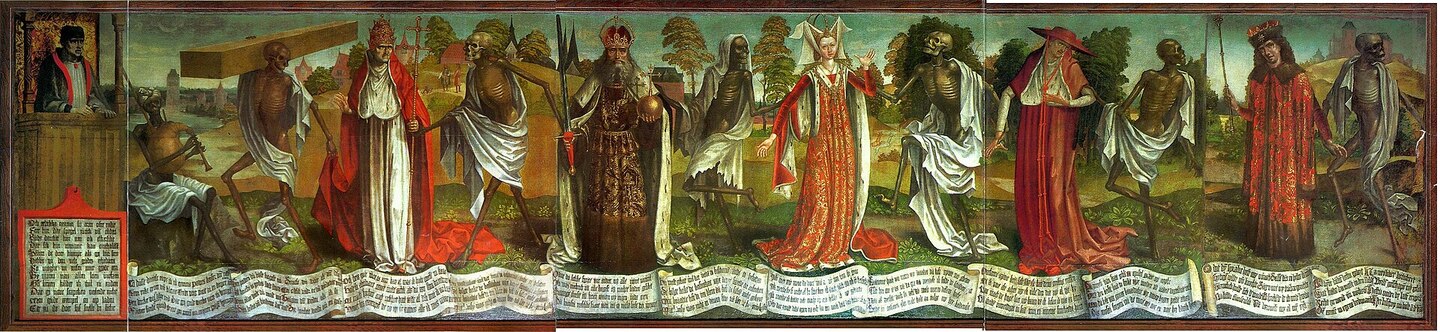
Bernnt Nottke. «Dance of Death»
One of the most famous surviving monuments of this subject is the «Dance of Death» in St. Nicholas Church in Tallinn, created by the Bert Notke workshop in the late 15th century.
The preserved fragment depicts thirteen figures. The procession begins with a preacher, followed by personified death and representatives of the upper classes.
The unique aspect of the work lies in the combination of image and text. Dialogues between death and the people transform the composition into a peculiar visual spectacle.
Bernhard Nottke, workshop. «Dance of Death.»