I. Concept and Topic Selection
Melancholy—one of the most ambiguous states of the human psyche—has received diverse philosophical, medical, and artistic interpretations throughout history. In European culture, it was perceived simultaneously as an illness, spiritual despondency, an intellectual trait, and a sign of creative giftedness.
In ancient medicine, melancholy was linked to an excess of black bile—one of the four bodily humors. During the Middle Ages, the concept of melancholy became closely associated with feelings of gloom and spiritual crisis. However, in the Renaissance, the attitude toward this state gradually shifted: melancholy began to be associated with exceptional intellectual ability, imagination, and creative genius.
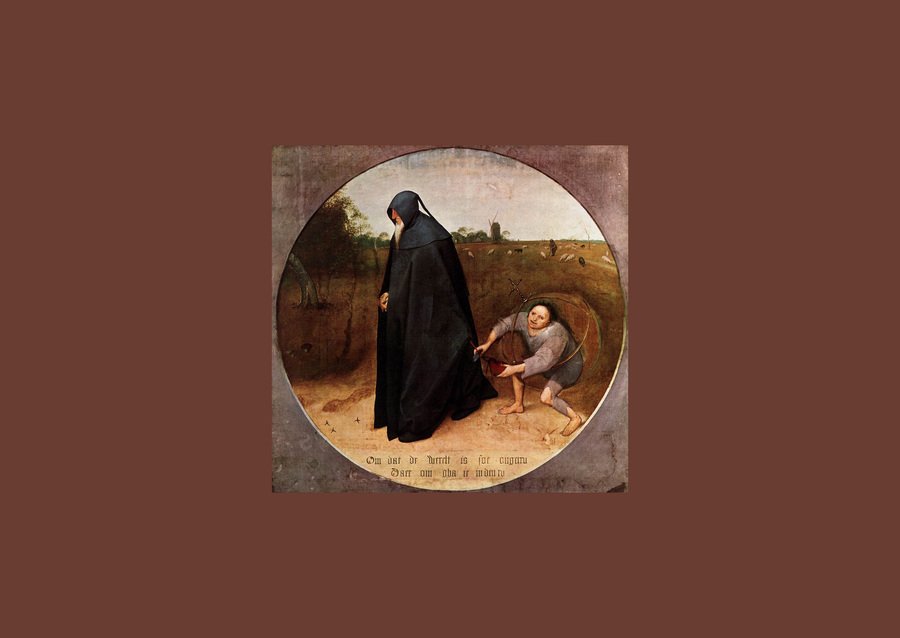
«Misanthrope» by Pieter Bruegel the Elder, 1568.
The contradiction between a person’s inner potential and their inability to act becomes particularly interesting. A melancholic hero may possess knowledge, talent, and a yearning for understanding, yet remain static, immersed in their own thoughts. In the 15th–17th centuries, artists gradually developed a recognizable visual language for melancholia. This manifests not only in the character’s facial expression but also in body posture, gestures, the direction of gaze, spatial organization, and the selection of surrounding objects.
The objective of this research is to trace the artistic means by which European masters of the 15th–17th centuries conveyed the state of melancholy in graphic arts, painting, and sculpture.
Navigation
I. Concept and Topic Selection
II. Melancholy as Allegory
III. Melancholy and Intellectual Labor
IV. Melancholy as a Psychological State
V. The Plasticity of Melancholy
VI. Conclusion and Bibliography
I decided on this categorization because it allows us to examine the works not only chronologically but also through the gradual unfolding of different facets of a single state—from a conceptual symbolic image to an individual psychological experience.
II. Melancholy as an Allegory
Forming the image of melancholy through personification, mythological narratives, and symbolic details.
During the Renaissance, melancholy gained independent artistic expression. Instead of depicting sadness directly, artists turned to allegory—creating an image where a specific human state is conveyed through figures, objects, and symbols.
Albrecht Dürer. «Melencolia I,» 1514. Engraving on copper.
One of the most significant works on this theme is Albrecht Dürer’s engraving, «Melencolia I, ” from 1514.
Dominating the composition is a winged female figure embodying melancholy. She sits, resting her head on her hand while holding a compass. Her gaze is directed into the distance, yet the character seems focused on nothing in her surroundings.
Surrounding the figure are numerous tools and objects: geometric instruments, scales, an hourglass, a bell, a magic square, and a large polyhedron. Most of these are connected to measurement, construction, mathematics, and knowledge.
The contrast between the multitude of tools and the complete immobility of the central figure is particularly salient. All objects suggest the potential for action and creation, yet the character remains detached from them. The composition is built upon the opposition between the densely populated foreground and the open expanse of the background. The horizon line, the sea, and the sky evoke a sense of infinity, while the melancholic figure seems confined within its own internal state. Thus, Dürer portrays not merely sadness, but a more complex condition of the creative individual—one who possesses knowledge and ability but experiences an internal impediment to action.
Lucas Cranach the Elder. «Melancholy, ” 1532. Wood painting.
In Cranach’s work, the theme of melancholy takes on a more fantastic and narrative interpretation. At the center of the composition is a winged woman, seated in a thoughtful pose, engaged in crafting a ring. In the background, playing children are depicted, and fantastical characters appear in the upper section of the composition.
Unlike Dürer, Cranach places the allegorical figure in a more open and eventful space. The central character is not entirely detached from the surrounding world; he is engaged in a specific action, yet his posture and facial expression retain a sense of contemplation.
Particular attention is drawn to the contrast between the stillness of the adult figure and the activity of the children. Their movement and play stand in opposition to the concentration of the melancholic character.
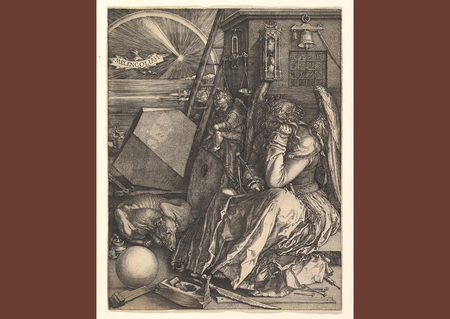
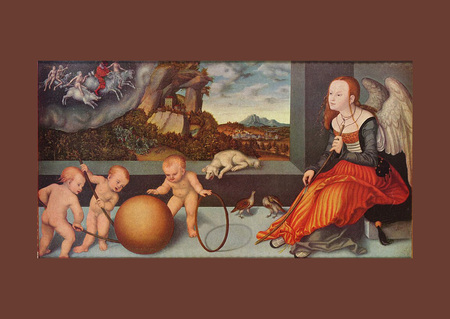
If Dürer’s melancholia is linked to an intellectual crisis and the inability to act, then in Cranach, it becomes part of a more complex allegorical composition that combines play, fantasy, and thoughtfulness. Comparing the two works reveals that by the first half of the 16th century, a stable visual archetype of melancholia was forming—a winged female figure, a bowed head, support upon an arm, and detachment from the surrounding space.
III. Melancholy and Intellectual Labor
The link between contemplation, knowledge, creativity, and the inability to realize one’s own potential. In the Renaissance era, melancholy gradually acquired a positive meaning. It began to be perceived not only as a painful state but also as a trait of a person inclined toward deep reflection and knowledge.
Albrecht Dürer. «Saint Jerome in His Cell, ” 1514. Engraving on copper.
This idea is particularly vividly realized in the works of Albrecht Dürer, which focus on the image of the scholar and intellectual labor.
The engraving depicts Saint Jerome working in a secluded space. The area is filled with objects related to intellectual and spiritual pursuits: books, writing implements, and furniture.
Unlike the engraving «Melencolia I, ” contemplation does not lead to inaction here. The protagonist is focused on his work, and the surrounding space is organized to emphasize the harmony between the individual and their inner world.
Light filtering through the window is distributed evenly throughout the interior, creating a sense of tranquility and security. Pets placed in the foreground enhance the atmosphere of silence and solitude.
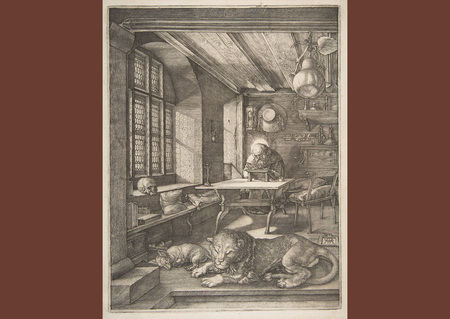
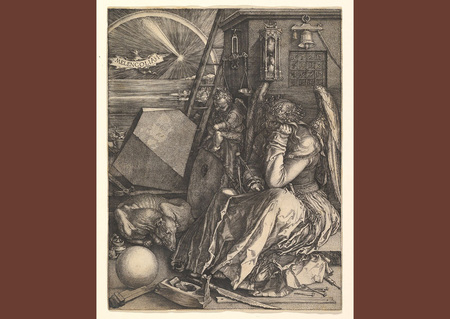
It is particularly interesting to compare these two engravings created by Dürer in the same year. Both works feature intellectual activity, solitude, and objects of knowledge, yet the characters' emotional states differ. St. Jerome is in a state of productive focus, whereas the figure of melancholy is paralyzed by an excess of possibilities.
This contrast allows us to view melancholy as a state that arises on the boundary between the drive for knowledge and the impossibility of achieving the desired outcome.
IV. Melancholy as a Psychological State