Как художники управляют нашим взглядом: перспектива в европейской живописи от Джотто до Мантеньи
INDEX
- Concept2. Objective3. Research Question4. Hypothesis5. Research Methodology6. Introduction7. Block I — «Before the Rule: The Space of Inquiry» Giotto {→} Gentile da Fabriano {→} Masolino.8. Block II — «The Rule Emerges» Brunelleschi {→} Alberti {→} Mazaccio.9. Block III — «The Rule Begins to Govern the Gaze» Mazaccio {→} Piero della Francesca {→} Melozzo da Forlì.10. Block IV — «The Rule Can Be Altered»Andrea Mantegna: «Dead Christ» {→} Camera degli Sposi.11. Conclusion and Findings
CONCEPT
VI examines the development of perspective in European painting, from Giotto to Mantegna, as a gradual shift in the artist’s relationship with the rules of pictorial space.
In this study, perspective is considered not only as a technical means to convey depth on a flat surface. It becomes a way to define how the viewer will relate to the image: where they are looking from, how far away they mentally stand from the events, and along which directions their gaze travels.
At the beginning of the period under review, a unified system of linear perspective does not yet exist. Artists already employ numerous methods for creating spatial depth—changing the scale of figures, overlapping forms, architecture, the arrangement of objects on different planes, the reduction of shapes, and converging lines. However, these techniques have not yet been unified by a universal geometric rule. [1]
Therefore, early space in painting should be viewed not as «incorrect» in relation to later perspective, but as a space of inquiry. Each artist solves the spatial problem using their own means.
The emergence and systematization of linear perspective change this dynamic. Space becomes measurable and reproducible: the artist gains a system that allows them to coordinate the placement of various objects relative to a single viewpoint. Along with the system comes a new possibility—not just to follow the rule, but to consciously utilize it for artistic purposes. [2]
This is where the central concept of the study arises—conscious deviation.
If the artist has not yet established a formed norm, they cannot consciously violate it; their actions are exploratory. But when the system becomes known, deviation from it takes on a different meaning. The artist can alter the perspective, reduce a form, shift the viewpoint, or break the expected geometry of the space not due to ignorance, but because this particular solution is necessary for their impact on the viewer.
GOAL
Show how the development of perspective in European painting gradually transforms it from a means of creating spatial illusion into a tool for controlling viewer perception, and how mastering the perspective system offers the artist the ability to consciously alter it for a specific visual and emotional effect.
RESEARCH QUESTION
How does perspective—as a method of rendering space—transform into a means of directing the viewer’s gaze?Additional Question:What changes in the role of the artist when a rule already exists and can not only be followed but also consciously altered?
HYPOTHESIS
The development of linear perspective changed not only how space was depicted but also the artist’s ability to influence the viewer. The systematization of perspective gave the artist the capacity to predetermine the viewer’s position relative to the depicted space, guide their gaze, and alter the sense of distance.
This knowledge of perspective rules did not limit the artist’s freedom; rather, it expanded it. Having mastered the system, the artist gained the ability to intentionally deviate from it when altering the spatial construction allowed for a stronger visual or emotional effect.
Therefore, the evolution of perspective can be viewed not as the gradual elimination of errors, but as a transition from seeking a spatial solution to the conscious management and subsequent modification of the system.
METHOD
The primary method of study is a sequential visual analysis of the works. For each piece, the following are examined: • the structure of the depicted space; • the placement of architecture and figures; • perspective lines; • vanishing point (s); • the presumed viewer position; • the direction of the gaze; • the relationship of the perspective construction to the work’s semantic center.
Perspective diagrams will be used not only as illustration but as evidence for the visual thesis. Horizon lines, vanishing directions, and vanishing points will be added to the works where it helps uncover the spatial construction.
This approach aligns with the national tradition of perspective study. A. V. Bakushinsky viewed linear perspective as a system through which the artist organizes illusory three-dimensional space and successively reveals it to the viewer. [3] B. V. Rauschenbach, in turn, emphasized that spatial constructions in painting cannot be reduced solely to geometry, yet geometric analysis allows for the exploration of methods for constructing space and perspective systems. [4]
INTRODUCTION
When a viewer looks at a painting, they often do not realize that their position before the image has already been largely determined by the artist. Architectural lines can guide the eye into the depth. The scale of figures can create a sense of distance. Strong linear perspective can bring an object close to the viewer or, conversely, make it appear distant. A low or high viewpoint alters the physical feeling of presence before the depicted event. Therefore, perspective works not only with the question, «How to render space?» but also with the question, «How should the viewer perceive this space?»
II. THE RULE APPEARS
Perspective ceases to be merely a collection of observations and isolated artistic techniques. It introduces a viewpoint, a horizon line, a vanishing point, and a system of converging lines—elements that allow the image to be linked to the observer’s specific position. [11][12]
Filippo Brunelleschi «Reconstruction of the First Perspective Board» Original—circa 1420s
Before Brunelleschi, artists had already employed various methods to convey depth. However, his experiment is significant because perspective begins to be viewed as a verifiable geometric construction tied to a specific viewpoint.
According to Antonio Manetti’s description, Brunelleschi created a small panel depicting the Florence Baptistery. The viewer looked at the image through an opening in the panel, using a mirror, which allowed them to correlate the depicted building with the real one. [11][13]
This introduces a principle crucial to our study: the image is dependent on where it is viewed from.
Perspective begins to connect:
THE VIEWPOINT and THE GEOMETRY OF THE IMAGE
This is not yet controlling the gaze, but it is the ability to establish the viewer’s position relative to the image.
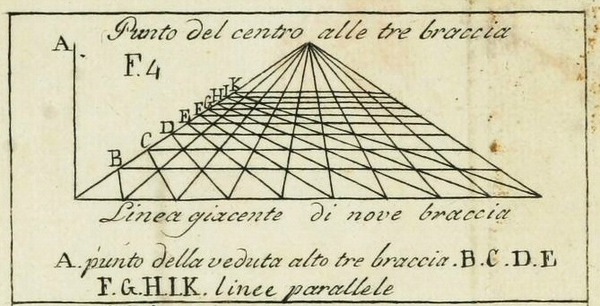
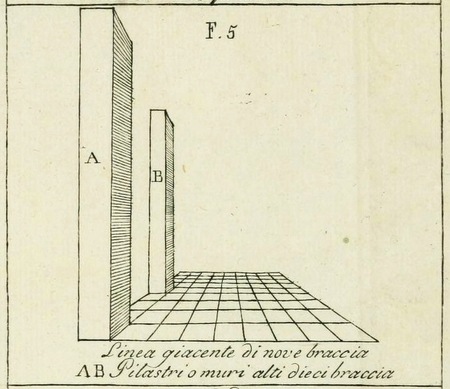
Leon Battista Alberti «On Pilasters or Walls Ten Cubits High» and «On the Center Point at a Distance of Three Cubits» c. 1435 (year of treatise composition)
If Brunelleschi demonstrated that perspective imagery could be correlated with real space, Alberti took the next step: he formulated the principle of its construction. In his treatise De pictura, Alberti describes the painting as the intersection of lines of sight traveling from the viewer’s eye to the object. The picture plane becomes a kind of «window» through which the viewer perceives space. [14][15] For our study, the significance lies not in the theory of the treatise itself, but in how it transforms the artist’s practice. Perspective evolves from a set of practical observations into a method that can be studied and reproduced. Therefore, Alberti should not be called the «inventor of perspective”—Brunelleschi’s experiments occurred earlier. His role was in systematizing and theoretically describing the perspective method. [14][16] This leads to the following progression: OBSERVATION → RULE → REPRODUCIBLE SYSTEM. This now makes possible the next step—to use this system not only for creating depth but also for organizing the viewer’s perception.
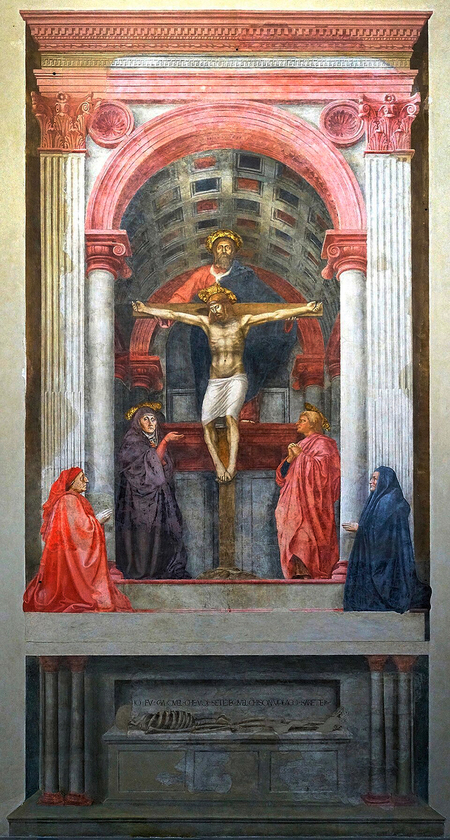
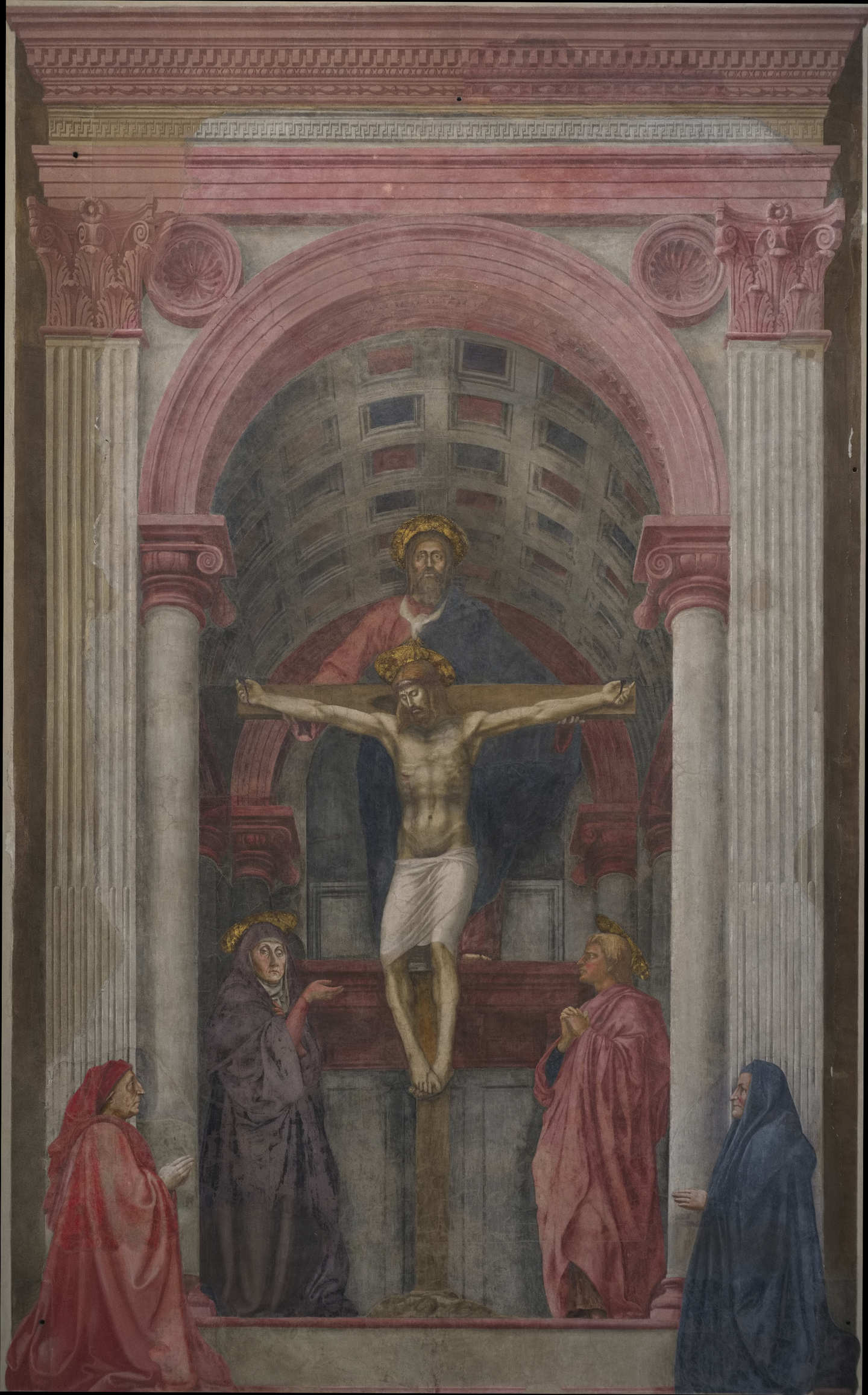
While Brunelleschi viewed perspective as an experiment and Alberti treated it as a theoretical system, Masaccio elevated it into a complete construction of artistic space.
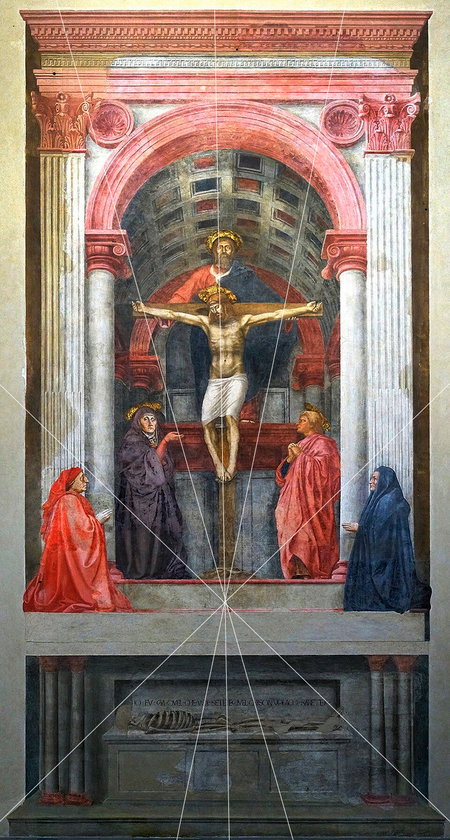
In «The Holy Trinity,» the architecture creates the illusion of a real chapel situated immediately behind the wall plane. Columns, pilasters, coffered vaults, and other architectural elements are unified by a common perspectival system. [17][18]
Crucially, this system is linked to the viewer’s position. The architectural orthogonals converge at a point located roughly at eye level, and the composition implies a specific viewing distance and height. [17][19]
As a result, the depicted architecture is not merely a decoration surrounding the figures.
It becomes a space into which the viewer can seemingly step with their gaze.
This is where perspective begins to perform a new function:
it not only shows WHERE objects are, but also defines WHERE THE VIEWER IS.
Furthermore, the perspective establishes a specific sequence of perception. The viewer does not encounter the image randomly: their gaze first registers the geometric construction of the space and the converging architectural lines, which guide the viewer toward the central area of the composition. From this point, the gaze naturally moves upward—to the figure of Christ, and then to God the Father supporting the crucifixion. Thus, perspective operates not only with depth but also with the viewing path: the geometry of the space dictates the order in which the viewer discovers the image.
Moreover, the composition itself is structured as a hierarchy of multiple spatial and semantic levels. At the center is Christ on the cross, behind him is the figure of God the Father, and between them is the Holy Spirit in the form of a dove. On either side of the cross are the Virgin Mary and John the Evangelist, while lower down, at the boundary of the illusionistic space, are the donors. Even lower is a skeleton in a sarcophagus, serving as a reminder of human mortality. Perspective connects these levels into a single vertical structure: the viewer moves with their gaze from their own space to the depicted space, from the human to the divine, and from death to the crucifixion and salvation.
If an artist can calculate the viewer’s position, they can also begin to calculate what the viewer will see first—what will appear closest, and what will be pushed into the background. It is on this basis that perspective transforms from a tool for constructing space into a tool for directing the gaze.
First