Navigation
- Concept
- The Afterlife in Ancient Civilizations
- From Sheol to the Last Judgment
- Hell on the Façade
- Dante Alighieri: The Poem That Became a Map
- Depicting Hell: The Renaissance
- The Concept of the Last Judgment in Asia
- The Enlightenment: Hell Within Humanity
- Conclusion
- Image Sources
- Bibliography
Concept
This piece explores how people depicted places that no one had ever seen. Hell, the realm of the dead, the judgment after death, demons, and torment—none of it can be seen with the eyes or photographed. And yet, almost every one of us has a pre-existing mental image. Fire, cauldrons, horned devils with pitchforks, a massive maw into which sinners fall, a boat with a grim ferryman. I became curious about the origin of this image. No single person invented it, and it doesn’t exist in this form within sacred texts either.
So, the vision of the afterlife was gradually pieced together by artists, sculptors, and miniature painters over several millennia.
Chronological Scope of Study: From Ancient Egypt and Greece through the end of the 18th century. By the close of the 18th century, hell ceased to be a «place» and became more of a state of mind—a nightmare, or a vehicle for political satire. What is depicted is no longer the afterlife realm, but what occurs within the human psyche.
It is interesting that our «standard» depiction of hell is quite young compared to the very concept of the afterlife, and that almost all its details first appeared in imagery before they became taken for granted. Artists from various cultures and eras, unaware of one another, frequently arrived at similar conclusions: tribunals, scales or mirrors, a guard with monstrous features, or the division of space into hierarchical levels.
In my research, I collected and studied key images from each era, cross-referenced them with the texts they referenced, and observed where the artwork derived directly from the text and where the artists made their own additions. I also identified recurring motifs that transitioned from one master to another.
Key Research Questions
How has the depiction of the afterlife evolved across different eras, and what elements have remained constant? What visual techniques did artists employ to render the invisible and the terrifying, and why did some techniques persist while others faded? Who influenced whom—did artists merely illustrate what people believed, or did people begin to believe what they saw on church walls and in books?
Based on these questions, I formulated the objective of this work as follows: to trace how the visual image of the afterlife developed and changed in art from antiquity through the end of the 18th century. Furthermore, to investigate whether images were, in fact, the primary factor in shaping people’s conceptions of the afterlife.
Hypothesis
People’s conceptions of the afterlife have shifted and been shaped by art. Art didn’t merely illustrate what people already thought about death; it actively created a specific image of the afterlife, and that image subsequently began to be perceived as an authentic depiction of how things truly are. Texts provided the concept—judgment, punishment, reward—while images provided the form: what the devil looks like, where the entrance is located, and what kinds of torture exist.
The Afterlife of Ancient Civilizations
Egypt
The most famous ancient depiction of the afterlife judgment is the Egyptian one. It is Chapter 125 of the Book of the Dead, a collection of texts placed in the tomb to help the deceased navigate the dangerous journey. The Book of the Dead is interesting because the text and imagery work together, much like a comic strip.
Papyrus of Hunefer. Book of the Dead. Egypt, c. 1275 BCE.
On the funerary papyrus of Hunefru, a scribe of the 19th Dynasty, the scene is read from left to right. Jackal-headed Anubis guides the deceased toward the scales. In one pan rests the heart, and in the other, the feather of the goddess Maat, the symbol of truth and order. Anubis oversees the scales, and ibis-headed Thoth records the result. If the heart is not heavier than the feather, Osiris’s throne guides the deceased. If it is heavier—Ammit, the «devourer of the dead, ” consumes it. She was depicted as a hybrid: a crocodile head, a lion’s forequarters, and a hippopotamus hindquarters. In essence, she was a combination of the three most dangerous animals known to the Egyptian.
Papyrus of Hunefer, fragment. Book of the Dead. Egypt, circa 1275 BCE.
I find it very significant that Ammit is barely frightening. She is small, seated by the scales like a domestic animal. The Egyptian court is more akin to a bureaucratic procedure than to torture. There is no eternal fire or torment here: if you fail the test, you simply vanish. The punishment is that you cease to exist. Before the scales, the deceased uttered a «negative confession, ” enumerating sins they had not committed before forty-two judging deities. On the Egyptian papyrus, the image and text were born together, and it is difficult to say which came first. But the very idea of depicting the weighing proved incredibly enduring—thousands of years later, the scales would appear in the hands of the Archangel Michael.
Greece
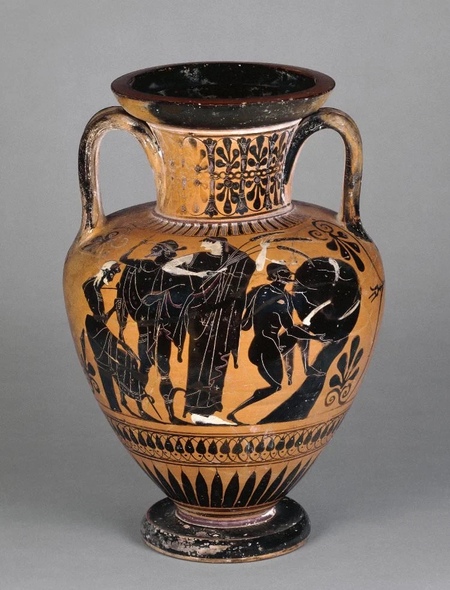
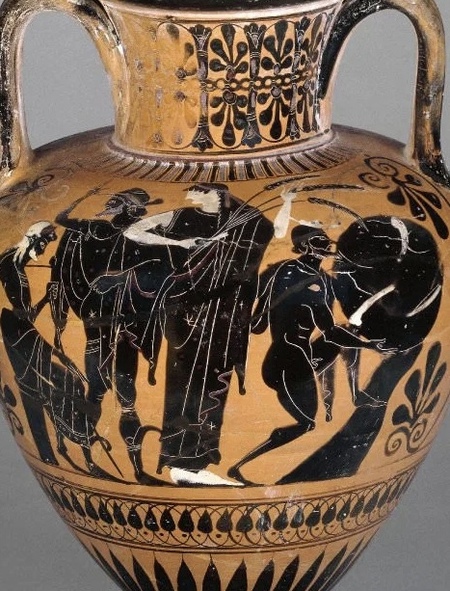
Black-figure amphora. The Punishment of Sisyphus. 510–500 BCE.
On the black-figure amphora, which depicts the punishment of Sisyphus—the endless act of pushing a massive boulder up a hill—he is shown precisely in the moment of labor: a bent figure bracing against the enormous stone. Three figures to the left are Hades, Hermes, and Persephone. The vase painter needed to convey the infinity of the punishment within a single scene, and he chose the pose of extreme tension. This technique—punishment as a perpetually repeating action—becomes central to the entire depiction of the underworld: the sinner does not suffer «in general»; he performs the same action again and again.
Rome
Virgil provided the most detailed classical description of the underworld in Book VI of the Aeneid. Aeneas, accompanied by the Cumaean Sibyl, descends with a golden branch in his hand. They see Charon, who ferries souls across the river, and Cerberus, the three-headed dog, whom the Sibyl quiets with a pastry made of honey and soporific herbs, the fields of lamentation, and the crossroads. To the left lies the path to Tartarus, surrounded by the fiery Phlegethon, where the judge Rhadamanthus extracts confessions from sinners. To the right is the Elysian Fields for the virtuous.
Jan Brueghel the Younger, Enceladus and Cybele in the Afterlife, 1630s
For art history, the image of Virgil’s Aeneas is important for two reasons. First, he was the first to clearly delineate the underworld into zones with different fates, and second, he served as Dante’s guide in the Divine Comedy. Through Dante, Virgil’s Charon and Minos were integrated into the Christian Hell, eventually finding their way to Michelangelo’s fresco. Renaissance artists, such as Pieter Bruegel the Younger, painted scenes like «Aeneas and the Sibyl in the Underworld, ” blending ancient characters with Christian pyres and Boschian grotesqueries.
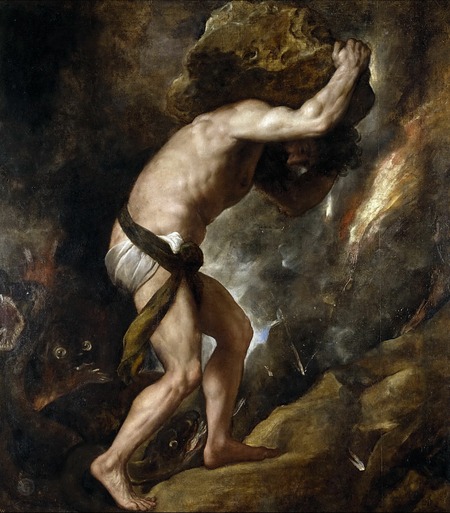
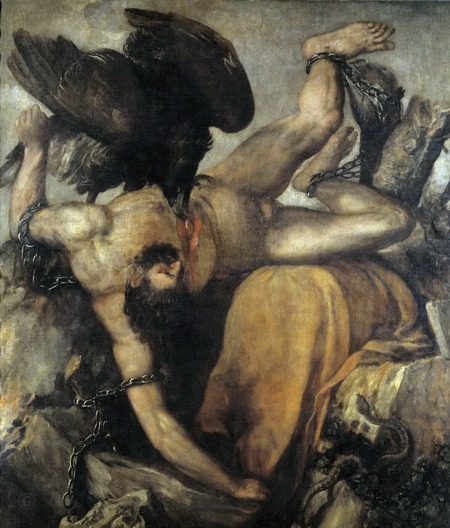
1 — Titian, The Punishment of Sisyphus, 1548–1549 2 — Titian, The Punishment of Tityus, circa 1565
In the sixteenth century, Titian painted the «Furies» series for Maria of Hungary—portraits of great ancient sinners. The paintings «Sisyphus» and «Tityus» survive in Madrid. Here, there are no longer demons or fire. There is a powerful body and endless effort, or endless pain. The ancient sinner, as depicted by Titian, becomes simply a suffering human being. This is an entirely different way of portraying the afterlife: through the body, rather than through decoration.
Joachim Patinir, Crossing the Styx, 1520–1524
In the painting «Crossing the Styx, ” Joachim Patinir transformed the ancient ferry crossing into a vast landscape. Charon rows the boat in the middle of the river. The soul in the boat still has to choose between the shore of Paradise or the shore of Hell. The shore of Paradise is difficult to traverse—marshy and rocky. An angel points to Eden, where the Fountain of Life flows and the righteous wander. To the right is the dark world, the gates of Hell, and Cerberus. The soul in the boat seems to still be deciding where to go.
From the Sheol to the Great Judgment