Navigator
- Concept
- History of the Painting’s Creation
- Triptych Composition
- Left Panel — Paradise
- Central Panel — Garden of Earthly Delights
- Right Panel — Hell
- Conclusion
Concept
Hieronymus Bosch’s «Garden of Earthly Delights» is a work that cannot be read as a single, linear narrative. At first glance, the triptych appears as a complex space filled with human and animal figures, fantastic creatures, and objects. However, the arrangement of the scenes, the recurring motifs, the scale of the figures, and the transitions between the panels form a unique system of visual storytelling. The principle governing this system becomes the starting point for this investigation.
The focus is not solely on the meaning of individual characters and symbols, but also on how the viewer perceives the work as a whole. The triptych consists of three panels, each offering its own space and content. The left panel is connected to the image of Paradise and the creation of the first humans; the central panel presents the space of earthly pleasures; and the right panel reveals the image of Hell. This division sets the direction for reading but does not automatically explain all the connections between the depicted episodes. To understand how the overall meaning of the work is constructed, it is necessary to trace how individual scenes relate to one another, which motifs are repeated, and how the character of the imagery changes from one panel to the next.
Project Research Question
How does Hieronymus Bosch construct a narrative and guide the viewer’s perception in the triptych «The Garden of Earthly Delights» through composition, visual motifs, and the interconnectedness of the three panels?
It is suggested that «The Garden of Earthly Delights» is not merely a collection of three independent scenes, but a single visual system where each panel is connected to the others through composition, recurring motifs, and shifts in color environment. One can hypothesize that the transition from the left panel to the central one and then to the right forms a specific sequence of perception: moving from the image of Paradise, through the space of earthly pleasures, toward the image of Hell.
The abundance of characters, details, and fantastic figures does not disrupt the integrity of the work; rather, it establishes a complex structure that unfolds gradually before the viewer. Thus, it is the interaction among the three panels and the artistic techniques that help Bosch direct the viewer’s attention and shape the overall perception of the triptych.
Artistic Techniques and Visual Language
I am interested in how Bosch constructs the visual sequence within the triptych and which artistic techniques he uses to guide the viewer’s attention. Composition, scale, color relationships, the placement of figures, the interaction between characters and their environment, and the repetition of specific motifs are particularly significant. These elements allow one to view the painting not merely as a collection of independent scenes, but as an interconnected structure in which each part influences the perception of the others.
Principles of Research Design
The research will proceed from a general to a specific perspective. Initially, the triptych is examined as a whole: its format, the structure of its wings, and its overall compositional logic. Subsequently, the left, central, and right wings are analyzed, after which attention shifts to individual details and recurring motifs. In the conclusion, the observations will be synthesized to return to the work as a whole and determine how the interaction of its parts shapes the overall impression. The objective of this research is not to list every depicted object nor to reduce the painting to a single, definitive interpretation. Instead, it is crucial to understand how the work organizes the viewer’s experience: where perception begins, where the gaze moves, and how individual images coalesce into a complex whole.
The History of the Artwork’s Creation
Hieronymus Bosch. «Garden of Earthly Delights.» Exterior view of the triptych, panels closed. Grisaille.
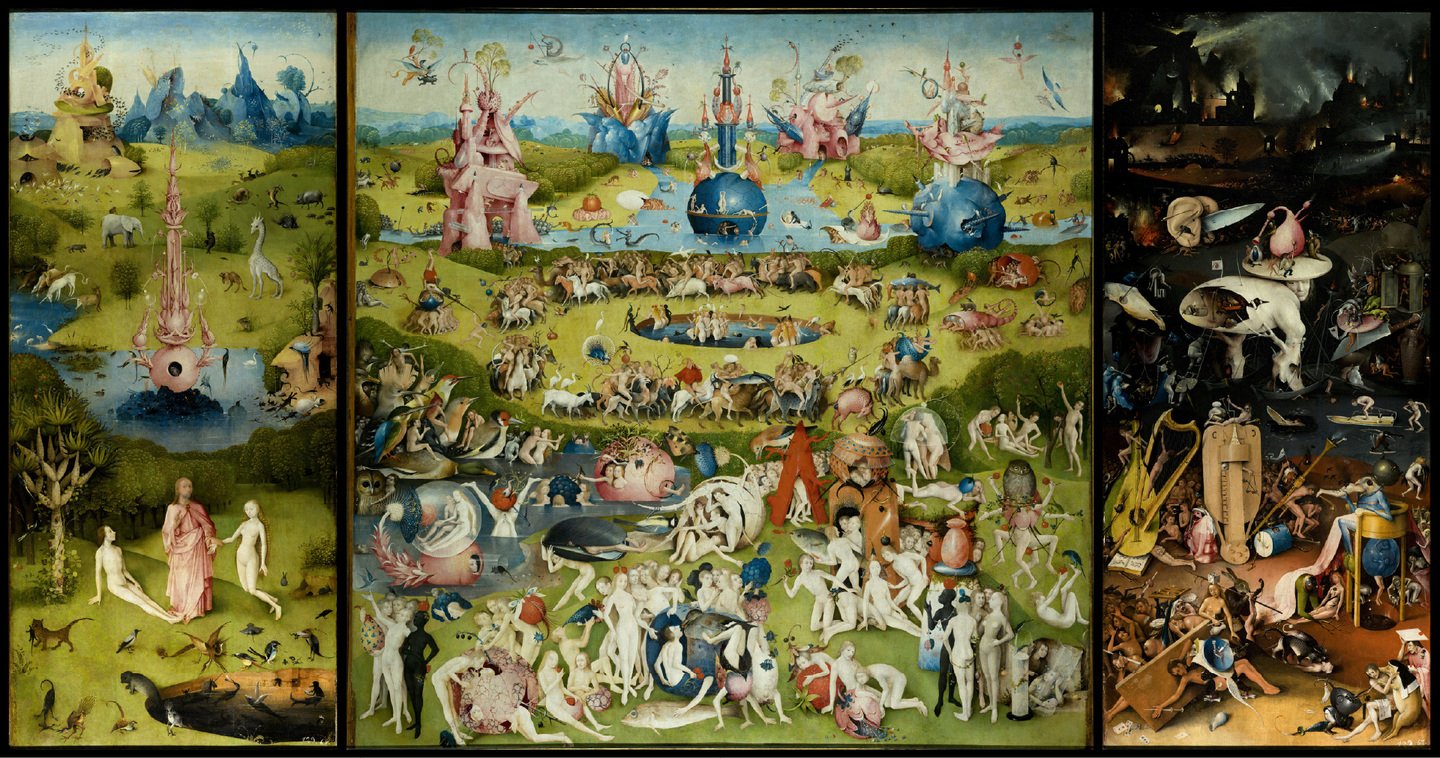
«The Garden of Earthly Delights”—one of the most famous works by the Dutch artist Hieronymus Bosch. The painting was created at the turn of the 15th and 16th centuries. The precise date of its creation remains a subject of debate: in the Prado Museum catalog, the piece is dated 1490–1500.
Bosch utilized the technique of oil painting on wooden panels. The scale of the work (220 cm by 389 cm) and the complexity of its composition allow it to be viewed not merely as a singular painting, but as a cohesive artistic object designed for sequential revelation to the viewer.
The same triptych in its open state.
The work takes the form of a triptych—a composition of three connected wooden panels. The two side wings can be closed, concealing the central section. Because of this, the painting exists in two states: closed and open.
When closed, the exterior features a scene of creation rendered in grisaille—a painting technique using shades of a single color. Once opened, a richly colored image appears before the viewer, divided into three interconnected sections.
One of the earliest known written mentions of the triptych dates back to 1517. The Italian traveler Antonio de Beatis described the work during his stay in Brussels, where it was housed in the Nassau family palace.
Researchers link the creation of the painting to the circle of this influential family, with Engelbert II of Nassau identified as the likely patron. Subsequently, the work entered the collection of the Spanish King Philip II and was moved to the El Escorial monastery in 1593. Today, the triptych is held in the Prado Museum in Madrid.
Triptych Composition
Overall landscape and horizon line uniting the three panels.
The composition «Garden of Earthly Delights» is built upon the interaction of three panels that together form a single panoramic space. Despite the differences in the content of each section, the surrounding landscape visually continues from one panel to the next.
One of the main unifying elements is the shared horizon line. It passes through all three parts of the work, creating a sense of continuity in the depicted world.
Thus, the division of the painting into separate panels does not hinder its holistic perception. On the contrary, each panel becomes a part of a larger composition.
Transition between the left and center panels.
Transition between the central and right panels.
A key feature of the composition is the high horizon line and the unique point of view through which the depicted world is presented to the viewer. We seem to be observing what is happening from slightly above, allowing us to simultaneously see numerous figures, objects, and distinct scenes.
This angle enables the artist to place a large number of elements on a single surface while maintaining a sense of space. The gaze is not limited to a single central scene; rather, it moves freely between the foreground, the depth of the landscape, and distant objects.
The high viewpoint becomes one of the techniques through which the painting is perceived as a vast and richly detailed world.
Foreground. Large figures, animals, and objects situated closer to the viewer.
Medium shot. Water bodies, groups of characters, and the circular movement of riders.
Long shot. Fantastic structures, a water surface, and a distant landscape.
The space within the central panel is organized in such a way that the viewer’s attention is constantly shifted between multiple planes. The foreground is dense with numerous figures and minute details, while larger architectural forms and bodies of water emerge in the depth of the composition.
It is particularly interesting that the saturation of the image gradually changes. The foreground appears nearly chaotic due to the abundance of characters and objects, whereas recurring shapes and geometric organization become more evident in the middle and background.
Through this, Bosch creates a complex space that cannot be grasped in a single glance—it must be viewed gradually.
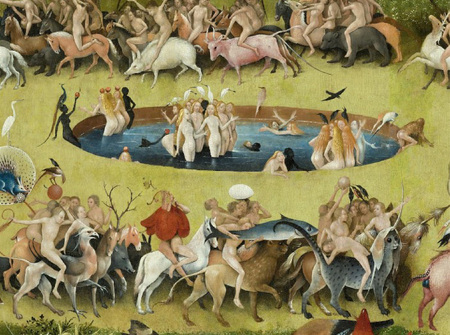
Despite the large number of elements that initially appear disparate, the composition features recurring shapes and rhythmic structures. This is especially evident in the central panel, where figures coalesce into groups, move in circles, and interact with repeating natural and architectural motifs.
The circular forms of the bodies of water, the repetition of figures, and the alternation of large and small elements create a distinct visual rhythm. This rhythm helps organize the rich image and connects the individual episodes.
Thus, Bosch’s composition is built not only on the arrangement of the three panels but also on internal regularities that become apparent upon careful examination of the details.
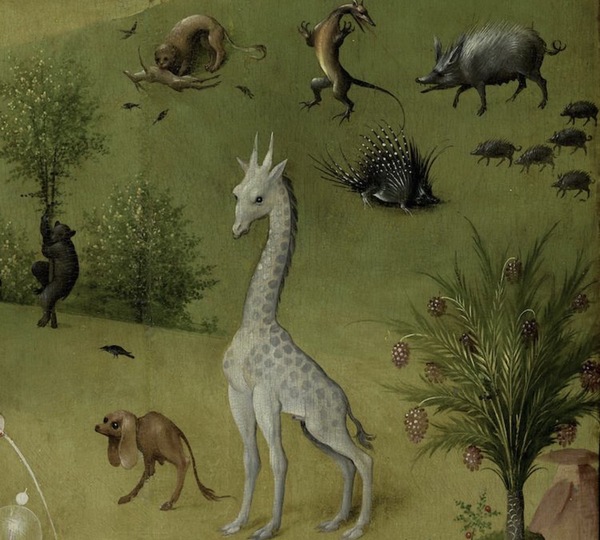
Рай.
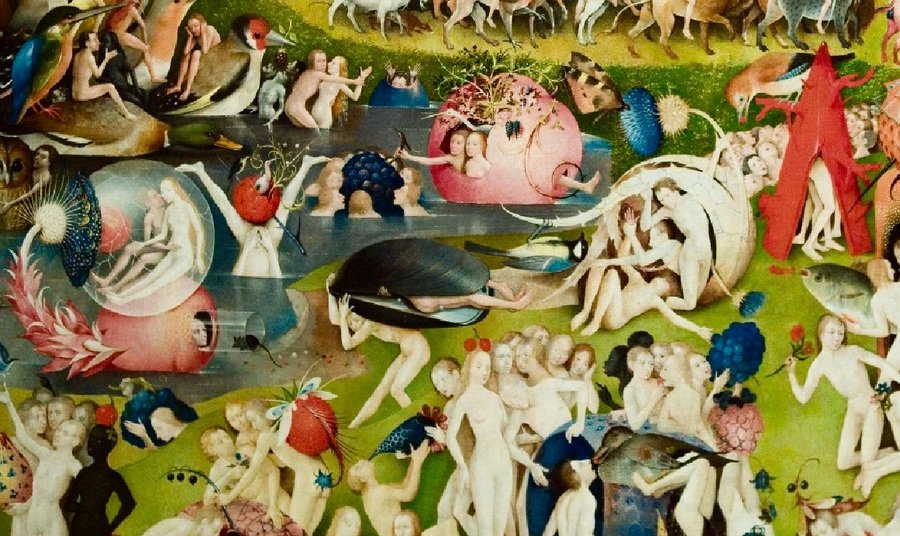
Сад.
Ад.
Examining the composition reveals that «The Garden of Earthly Delights» is unified by several visual principles. A consistent horizon line, the continuity of the landscape, spatial depth, and the repetition of individual forms bind the three panels into a single work.
At the same time, each section retains its distinct character. Differences in image density, figure placement, and spatial organization create a contrast between the individual scenes without disrupting the overall structure.
Thus, the composition of the triptych simultaneously unifies and juxtaposes the three depicted worlds. This observation serves as the first visual confirmation of my hypothesis regarding the existence of an internal system of connections between the panels.