Project Concept
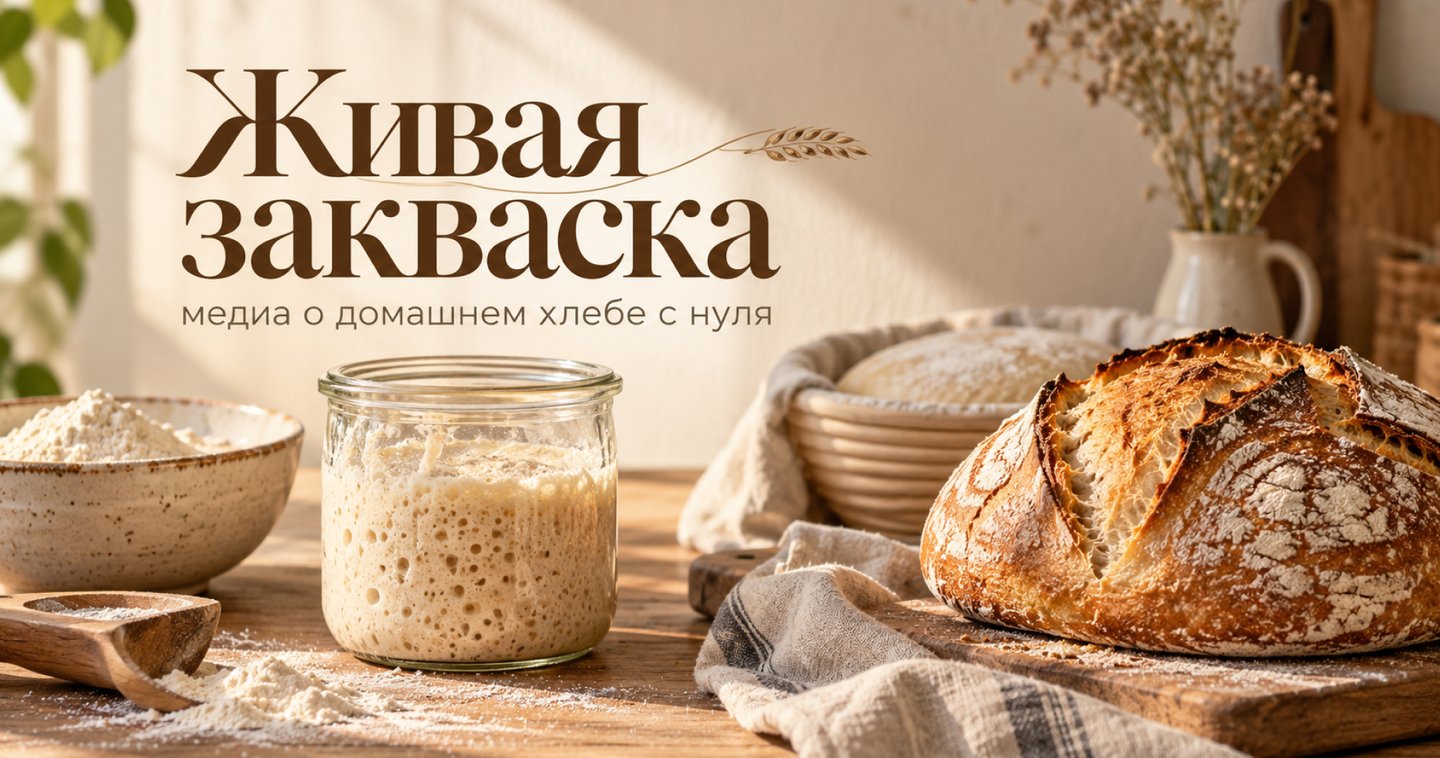
«Living Sourdough» is an educational media resource about home bread baking for beginners. The project is based on the idea of gradually mastering the process, starting with cultivating your own starter and culminating in baking your first loaf.
Primary focus is placed on the continuity of learning. These materials help students grasp unfamiliar topics and learn to independently evaluate results at every stage.
1. Media Goal Description
Sourdough home baking requires a specific amount of knowledge and time. For someone newly interested in this topic, it can be difficult to grasp even the basic steps, as it is often unclear which flour to use, how to properly maintain the starter, why it might stop rising, or when it is appropriate to start baking.
Information on bread making is presented in various formats. While you can find individual recipes and detailed explanations for them, a beginner must independently determine the sequence of actions and understand which recommendations apply to their specific situation.
The goal of the «Live Starter» project is to create an accessible educational space where individuals can progressively master homemade bread baking without prior experience.
Main objectives of the project:
- To introduce beginners to the principles of working with natural bread sourdough starter.
- To explain the process of cultivating and maintaining the starter.
- To help identify common mistakes and methods for correcting them.
- To teach how to bake bread in standard home settings.
- To make the learning process sequential and accessible for self-study.
2. Future Media Themes
Cultivating natural sourdough starters and baking homemade bread from scratch.
Segment: Educational media on culinary arts and home cooking.Niche Specialization: Practical instruction in sourdough bread baking for novices.The materials are structured to mirror the real experience of a beginner baker. The learning process begins with an introduction to the necessary ingredients and tools. It then progresses through sourdough starter cultivation, observing its activity, dough preparation, proofing, shaping, and baking.
2.1 Thematic Sections
Introduction to Sourdough. This section explains what a natural sourdough starter is, how it works, and the role it plays in baking bread.
Sourdough by the Day. A practical section dedicated to cultivating a sourdough starter independently. Each stage is accompanied by photographs, descriptions of possible changes, and recommendations for next steps. It is noted that the development speed of the starter may vary depending on temperature, flour, and other conditions.
Care and Storage. Materials cover regular feeding, refrigeration, preparing the starter for baking, and restoring its activity after a break.
The First Loaf. A step-by-step guide to making your first bread. It covers recipe selection, dough kneading, proofing, shaping, resting, and baking. Visual examples are provided for every stage.
Troubleshooting. This section addresses common situations faced by beginners. For instance, when the starter doesn’t rise, the dough becomes too sticky, the bread doesn’t hold its shape, or the crumb remains dense.
Everyday Baking. Practical tips for those who want to bake bread regularly. This covers time planning, storing finished bread, utilizing leftover starter, and gradually mastering new recipes.
3. Competitors and Their Analysis
To determine the project’s specific features, existing educational resources dedicated to baking were reviewed. The analysis included projects that offer instructions, recipes, and practical materials for individuals with varying levels of skill.
Competitor 1. Khlebomoly
«Khlebomoly» is a thematic resource that combines materials on baking, recipes, ingredient, and equipment information. The project also hosts masterclasses for both beginner and more experienced bakers.
Competitor 1
Competitor Highlights: The website offers practical information on bread making and showcases the experience of its specialists. Added value is created by the ability to purchase necessary supplies and attend in-person classes.
Strengths: The project integrates theoretical knowledge, practical instruction, and baking tools.
Differentiator: «Live Starter» can focus exclusively on the initial stages of learning—when a person still needs detailed explanations even for the simplest actions. Instead of broadly covering the topic, we propose a unified educational sequence with a clear beginning and a concrete outcome.
Competitor 2. The Perfect Loaf
The Perfect Loaf is an English-language educational resource focused on sourdough bread making. The site features detailed recipes, instructions, tutorials, and materials dedicated to specific technical processes. Self-guided resources are provided for beginners.
Competitor 2
Competitor Features: The materials thoroughly detail the bread-making process. Users can study everything from basic recipes to specific aspects related to fermentation, dough temperature, and ingredient characteristics.
Strengths: The large volume of detailed explanations allows users to learn not only the sequence of actions but also the underlying principles of baking. Video materials and photographs supplement the written instructions.
Point of Differentiation: «Living sourdough» could offer a more compact training format in Russian. The primary focus would be on the minimal set of knowledge required to achieve the first result, without mandatory deep dives into all technical nuances.
Competitor 3. Breadtopia
Breadtopia is a resource for home bakers. It features recipes, instructions, video materials, and sourdough-working tips. Special attention is paid to solving practical problems. For example, the sourdough starter guide explains why culture development does not always follow a consistent schedule.
Competitor 3
Competitor Features: The resource treats bread-making as a practical process that requires close observation of ingredient conditions and consideration of cooking parameters. The materials cover everything from initial steps to advanced skill refinement.Strengths: Detailed photographs, step-by-step guidance, and explanations of potential mistakes help users troubleshoot issues independently.Differentiator: In the «Live Starter» project, you can integrate the observation of the sourdough starter with baking instruction into a single guided journey. The user will see which stage is complete and what to prepare for next.
Tabular Analysis Option
4. Distribution Channel
The main platform for distribution will be a Telegram channel. The instruction involves regular, small tasks that need to be completed over several days. For this format, short posts, photos, videos, and reminder messages are ideal. The content is intended to be published in a specific sequence so that the subscriber can gradually go through the training and refer back to previous materials as needed.
For easy navigation, materials will be grouped into thematic collections. A pinned post will allow new readers to find the starting point of their studies and navigate to the relevant stage.
Pinterest is being considered as an auxiliary platform. On it, one can post photos of homemade bread, visual instructions, and small thematic collections designed to draw interested users toward the main educational content.Telegram, however, retains its role as the primary environment through which the entire learning journey takes place.
5. Target Audience Description