Язык жестов во фресках Джотто
I. Concept
At first glance at the fresco, one notices the raised hand before understanding whom it is addressed to. In «Entry into Jerusalem, ” Christ’s palm stands out among the disciples and people by the gates following him. In the scene „Do Not Touch Me, ” the space between the hands captures attention. In the first case, the gesture is integrated into the group’s advance; in the second, it makes visible the possibility of contact and its cessation. These observations allow for an investigation into how a static image conveys human relationships. For art history, this question helps describe the structure of a multi-figure composition. For visual communication, it is important as an example of directing attention through orientation, turn, and distance. The choice of the theme is linked to the ability to verify each observation using a specific detail of the image.
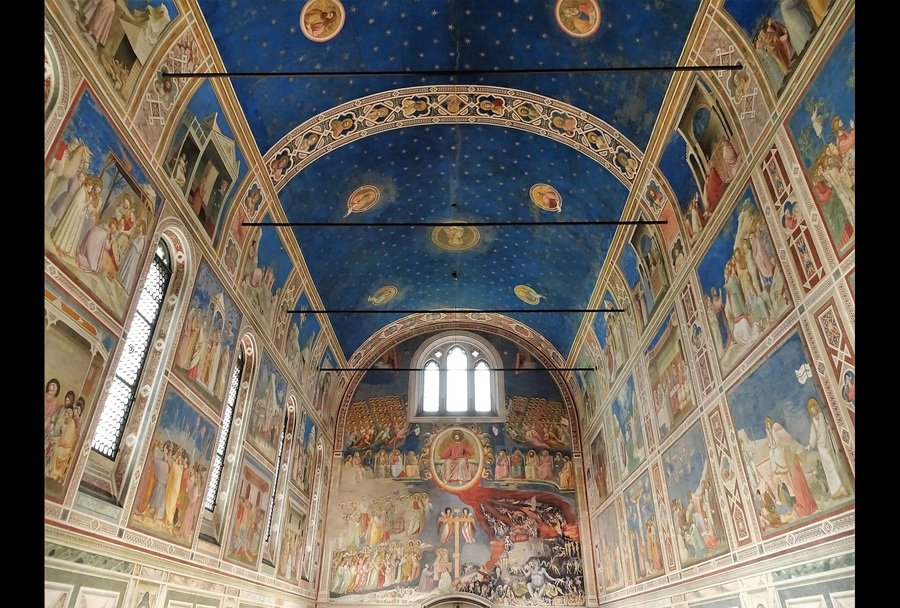
Cappella Scrovegni, Padua. Interior with frescoes by Giotto, 1303–1305. Photo: Hugo DK, 2019. CC BY-SA 4.0.
The research material is Giotto’s frescoes in the Scrovegni Chapel in Padua. The dating for the cycle, 1303–1305, was accepted based on the chapel’s official website [1]. The interior shows that individual scenes form a unified ensemble and are arranged in rows.
Twelve scenes were selected: in eleven, the addressed gesture and the responding figure are clearly discernible; «The Nativity» was included for comparison with «The Lamentation.» Each scene can be described through the visible positions of the hands and bodies and compared with another scene based on the same criterion. The overall view illustrates where a gesture is located and how a fragment is composed.
Stephen Zucker’s and Betty Harris’s analyses on Smarthistory [2], [3] help cross-reference observations with art historians’ judgments. Museum labels for the chapel clarify the participants and actions in «The Flight of Joachim» [4], «The Lamentation» [5], «The Expulsion of the Merchants» [6], «The Washing of the Feet» [7], and the scene before Caiaphas [8]. Differences in color between photographs of various frescoes are not used as an argument.
How did Giotto use the positioning of arms, body turns, and the distance between figures to establish character relationships and direct the viewer’s gaze?
Hypothesis: The expressiveness of a gesture depends on the corresponding posture and the immediate environment surrounding the figure. Close proximity can appear mutual when both characters move toward one another, or forced when the movement originates predominantly from one. The space between the hands also plays a role in the action, depending on whether the body positioning emphasizes approach or recession.The hypothesis is tested by comparing scenes. For each pair, the primary movement is determined first, followed by an examination of the responsive figure and the surrounding group. Factors considered include the direction of the arm, torso tilt, head rotation, distance to the other character, and the reaction of nearby figures. Observations regarding figure placement are separated from assumptions about the characters' emotions.
Navigation
The chapters are structured according to the gestures employed in the composition: from the touch between two people to a connection across distance and a halted approach, then to a group of mourning and conflicting figures, and finally, to a restrained, reciprocal posture.
- II. Touch. Two ways to bring figures closer
- III. Direction. How gesture connects figures across distance
- IV. Distance. Where the approach ends
- V. Grief. Different movements around a single figure
- VI. Collision. Repulsion and close proximity
- VII. Action and response. How a restrained pose functions
- VIII. Conclusion
II. The Touch
Два способа сблизить фигуры
Giotto. «The Meeting of Joachim and Anna at the Golden Gate.» 1303–1305. Fresco. Cappella Scrovegni, Padua. General view.
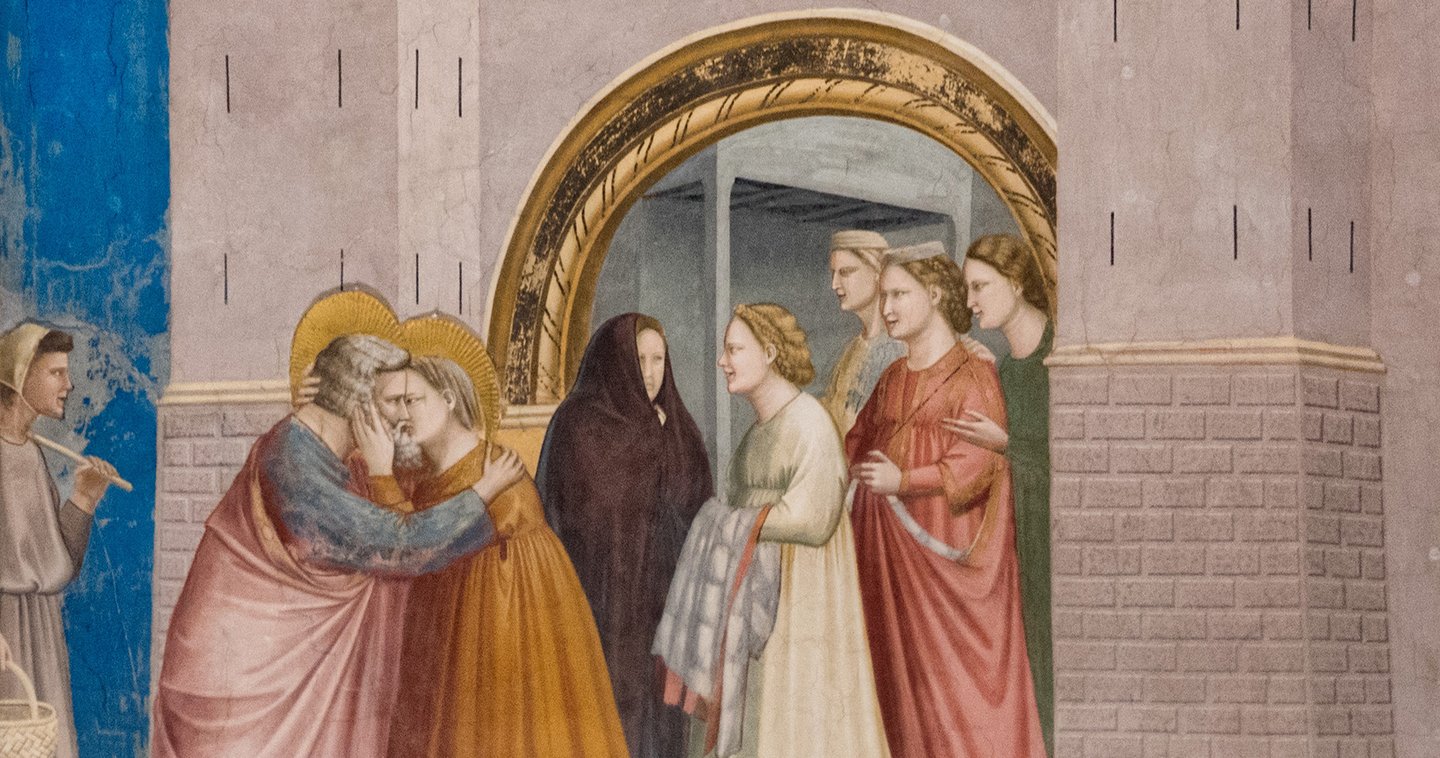
Ioakim and Anna bring their faces close together, and their hands cradle the figures from both sides. Anna’s palm is near Ioakim’s cheek, and his arm wraps around her shoulders. The direction of their hands draws the viewer’s gaze back to their faces.Zucker and Harris note that the couple’s faces almost merge into one [2]. The magnification helps trace this connection from their shoulders and forearms up to their heads.
Giotto. «The Meeting of Joachim and Anne at the Golden Gate.» 1303–1305. Fresco. Scrovegni Chapel, Padua. Fragment featuring Joachim and Anne.
In the overall view, the close embrace occupies only a fraction of the scene. The women at the gates stand close to the couple, but their bodies maintain distinct contours: their presence expands the scene without extending the embrace.Therefore, the density of the group and the mutuality of contact are perceived differently. The center of connection is determined by which figures are truly linked by the movement of hands and heads.
Giotto. «The Meeting of Mary and Elizabeth.» 1303–1305. Fresco. Cappella Scrovegni, Padua. General view.
In «Maria and Elizaveta’s Meeting, ” hands also connect the two characters. Elizaveta leans toward Maria, while Maria holds a more upright posture, and their heads remain at different heights. Two women stand to the left of the pair, and one is positioned near the entrance on the right. The focal point emerges where the hands of the main figures meet. Unlike the embrace by the gate, the contact here maintains a noticeable difference in inclination.
Giotto. Frescoes in the Scrovegni Chapel, Padua. 1303–1305. Left — «The Meeting of Joachim and Anne at the Golden Gate, ” fragment. Right — „The Meeting of Mary and Elizabeth, ” fragment.
Chapter SummaryThe touch highlights a pair within the group. In the case of Ioakim and Anna, their hands and faces meet, while the interaction between Maria and Elizabeth connects figures at different angles. The response posture alters the form of closeness while preserving the principle of mutual movement.
III. Focus Area
Как жест связывает фигуры на расстоянии
Giotto. «The Raising of Lazarus.» 1303–1305. Fresco. Cappella Scrovegni, Padua. General view.
Christ stands on the left, Lazarus on the right, among the people at the tomb. Christ’s raised hand is visible against a blue background, and the turn of his head supports the direction of the hand. The overall view allows us to check at what distance this gesture is effective.
Giotto. «The Raising of Lazarus.» 1303–1305. Fresco. Scrovegni Chapel, Padua. Fragments: on the left — Christ, on the right — Lazarus and the nearest figures.
Between the two figures, participants are positioned with various inclines and turns. Their movements complicate the scene, but Christ’s gesture connects precisely two distant poles: the outstretched hand and the vertical figure of Lazarus.
Giotto. «Entry into Jerusalem.» 1303–1305. Fresco. Scrovegni Chapel, Padua. Overall view.
In «The Entry into Jerusalem, ” Christ’s gesture is incorporated into the movement of the procession. Students follow him on the left, while on the right, people face toward him, and figures are positioned in the branches above. According to Zucker and Harris’s observation, those meeting on the right sequentially remove their outer garments, and the last one places them at the donkey’s feet [2]. The response to Christ’s arrival is distributed among several participants and compositional levels.
Giotto. «Entry into Jerusalem.» 1303–1305. Fresco. Scrovegni Chapel, Padua. Fragments: on the left—a figure in a tree; on the right—those meeting at the gates.
Chapter ConclusionThe direction of the arm connects different sections of the composition. In «The Resurrection of Lazarus, ” the gesture links two distant figures. In „Entering Jerusalem, ” a similar gesture directs the viewer’s gaze toward a group whose actions are distributed across the road, the gates, and the tree branches.
IV. Remote Learning
Где заканчивается приближение
Giotto. «The Expulsion of Joachim from the Temple.» 1303–1305. Fresco. Cappella Scrovegni, Padua. General view.
The fence separates the interior of the temple from the space on the right, where Joachim stands. The priest in green approaches him and extends a hand. Joachim presses the sacrificial lamb to his chest and turns his head back [4].