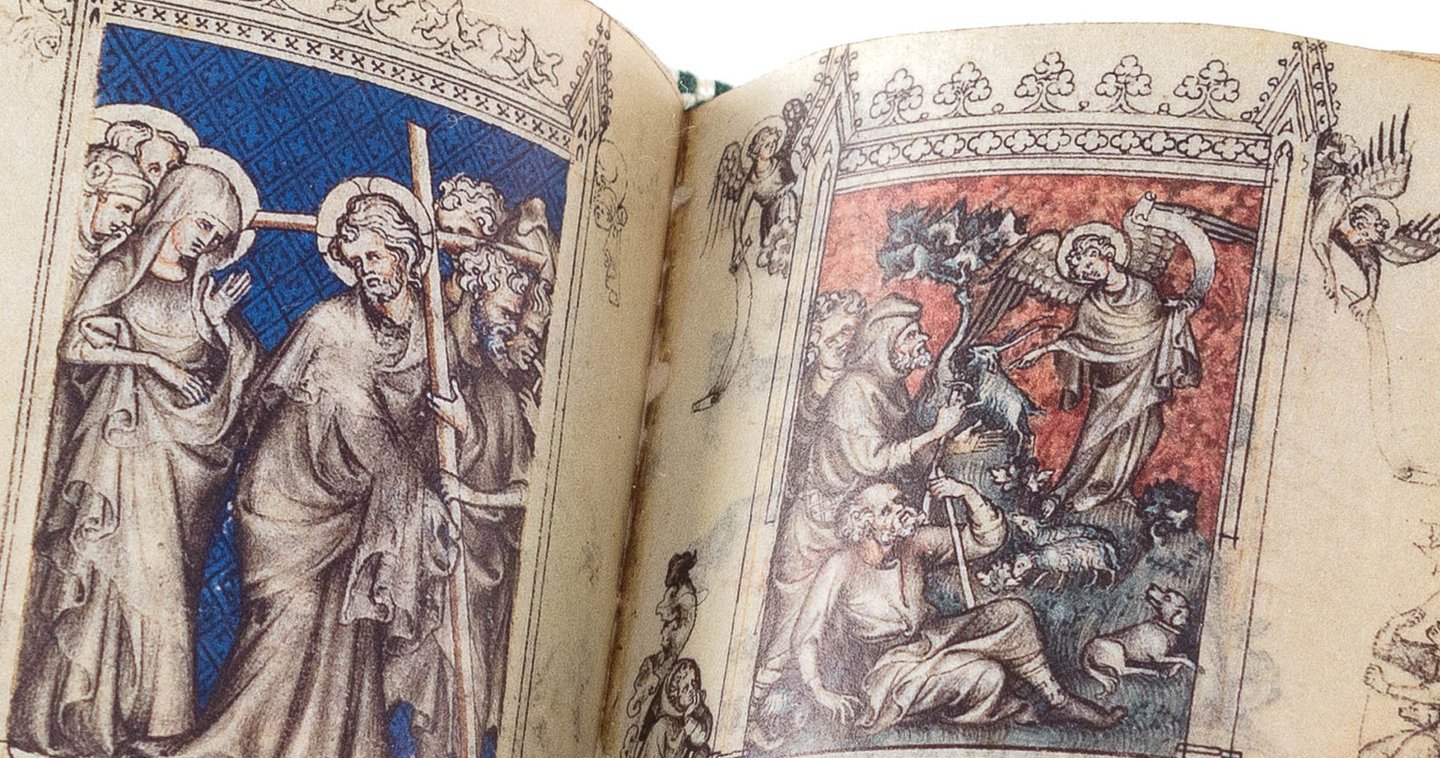
Орнамент и повторяющиеся мотивы в оформлении полей средневековых рукописей XIV–XV веков
Navigation
- Research Concept
- Research Question and Hypothesis
- Ornament Geography: Functional Fields
- Typology of Ornamental Solutions 4.1. Floral Vine: From Intimate to Lush 4.2. Architectural and Courtly Framing 4.3. Carpet Border 4.4. Marginals: Drolleries and Grotesques
- What Repetition Conveys to the Reader
- Conclusion
- Bibliography
Concept
The objective of this research is to examine the structure of the page ornamentation in Western European manuscripts from the 14th and 15th centuries—why it is built upon repetitions and typical formulas, and what these repetitions communicate to the reader. Period. The 14th and 15th centuries were a time of flourishing marginal decoration. During this period, manuscripts were created where the ornamentation, in terms of complexity and richness, began to rival the miniatures themselves: the «Great Hours of Duke Berrier» (1412–1416) and the «Bedford Hours» (Paris, circa 1410–1430). Furthermore, during these centuries, the system of functional page areas that will be discussed below began to take shape. Why the margins? I considered the margins along the perimeter of the page, where they framed the main text. The decoration of the margins in books of that era constitutes a distinct artistic world of repetition: from a small set of basic figures that alternated, masters assembled complex compositions. The choice to favor ornamentation stems from the fact that it is easily displayed—interlacing patterns, the repetition of the same motif across dozens of pages.
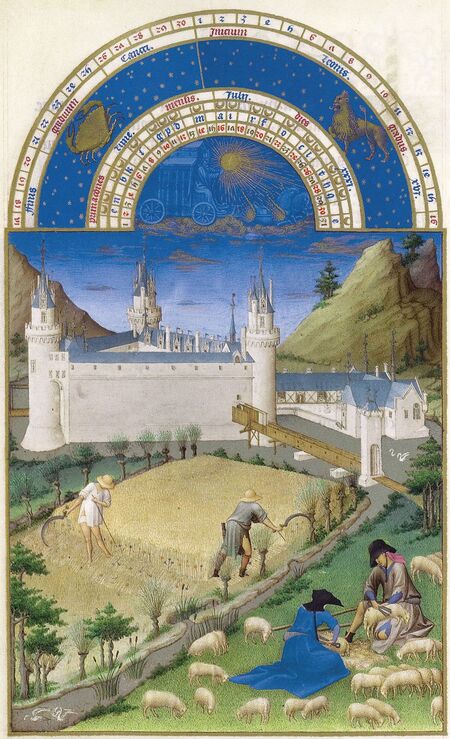
Братья Лимбурги (Поль, Жан и Эрман. «Великолепный часослов герцога Беррийского». 1412–1416 годы.
Анонимный мастер. «Часослов Бедфорда». Около 1410–1430 годов
Research Question and Hypothesis
Why is the ornamentation of fields built on rigid repetitions and typical formulas, and what do these repetitions communicate to the reader?
Hypothesis: The repetition in the field ornaments is not random, nor does it indicate a lack of imagination. Instead, it functions as a system that dictates the rhythm of reading and perception throughout the entire text. By the motifs and their arrangement, people of the 14th–15th centuries could immediately discern the book’s origin and the status of its commissioner. There are few figures in it; they alternate endlessly without blending into one another. There is also a second characteristic: the ornament does not exist in isolation; it is anchored to specific areas of the page. This differentiates it from a narrative miniature, which can be placed anywhere to tell various stories. The field, however, always functions as a frame and operates according to its own set of rules.
The main section was created by the Master Clockmaker Bedford. «Sobecki’s Horology» from 1420–1425.
Ornamental Geography: Functional Fields
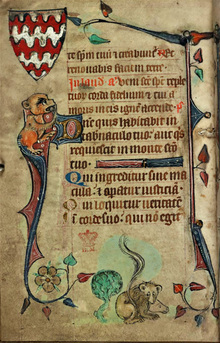
In the 14th–15th centuries, the manuscript page was divided into distinct functional zones. Each type of ornamental solution was assigned to a specific zone. The text block was framed by a border (vine or frame), which established the primary rhythm and prevented the eye from wandering off the page. Accent inserts—large flowers, zoomorphic motifs—were placed in the corners and on open spaces. These inserts often served a navigational function, marking the beginning of new sections or important headings. At the bottom, there might be a line with detailed drawings, which served as the visual foundation of the page. The space in the margins was filled with marginalia—small figures. In addition to what was listed, satirical vignettes might appear here, visually commenting on the text and creating a unique dialogue between the margins and the main content.
Author unknown. «Examples of Book Ornamentation.»
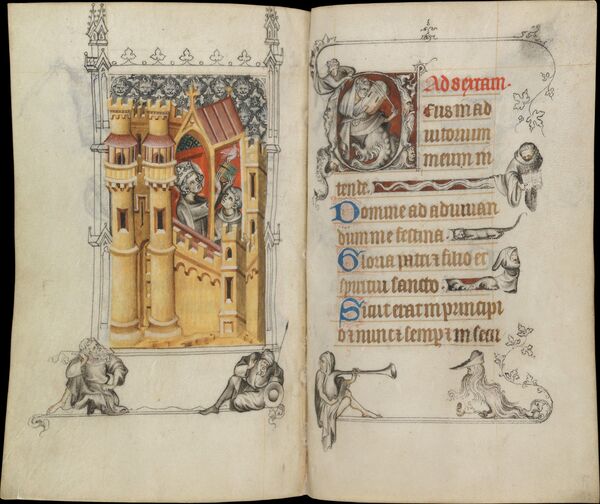
I want to specifically mention marginalia. This is not ornament in the general sense, nor is it a narrative miniature; it is a liminal type. Classic border ornament (vines, architectural frames, carpet borders) does not tell a story: its elements (scrolls, leaves, dots) lack an inherent narrative. A miniature, conversely, is an independent image with its own composition and narrative, not constrained by a frame. Marginalia combines traits of both: they feature characters and action, but they are always integrated into the border and subordinate to its rhythm. Therefore, marginalia should properly be called field drawings and notes, rather than exclusively ornament or subject matter. All types of ornamental solutions are strictly confined to these areas.
Author unknown. «Maastricht Time Piece.» First quarter of the 14th century
Typology of Ornamental Solutions
Vines: From Compact to Lush.There are two closely related types: in both early and late varieties, a vegetative stem with leaves and flowers stretches along the fields. They differ only in the density with which the stem fills the field.
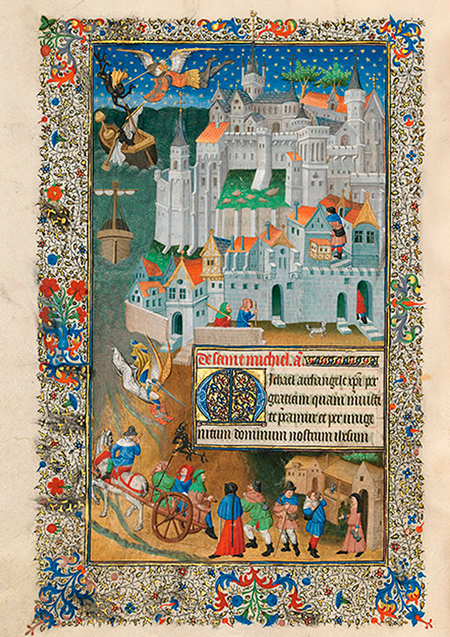
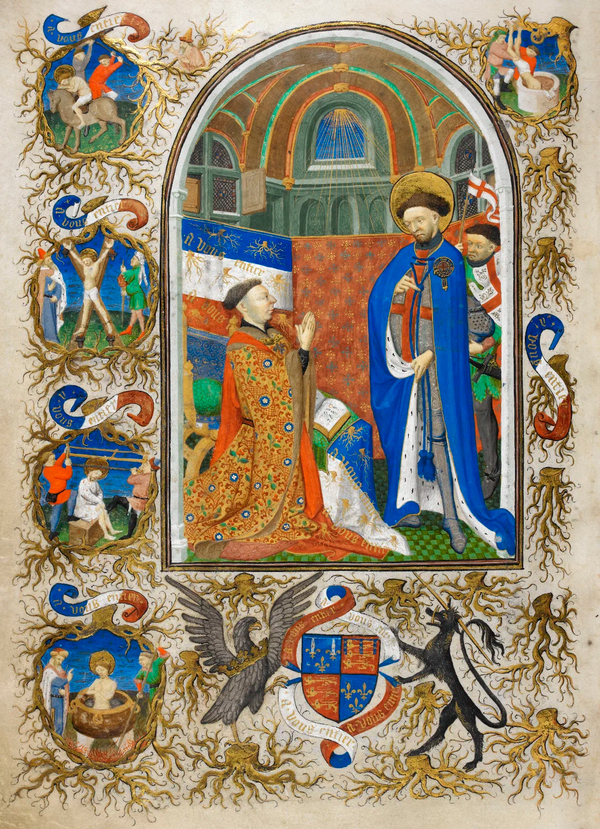
Jean Pucelle, «Jean d'Évre’s Horarium» (c. 1324–1328); The Bedford Master and his workshop. «John, Duke of Bedford, Praying before Saint George.» (1410–1430).
An early example is visible in the hour glass of Jeanne d’Evreux (Jean Pucelle, c. 1324–1328). The fields there are very restrained: thin borders, delicate scrolls, nothing extraneous. The ornament does not impede the reading of the text; rather, it simply defines the boundary. The later version is found in the Sobaenski hour glass (Master of Bedford’s workshop, c. 1410–1430). Here, a golden vine entwined with iris, carnation, and daisy repeats from page to page. The vine is broken into short, intermittent segments, causing the border to look like a chain—it is no longer just a frame, but an embellishment that draws the eye.
Comparison: left—Jean Pucelle’s «Horae of Jeanne d’Evreux» (circa 1324–1328); right—the Bedford Master and his workshop. «John, Duke of Bedford, Praying Before St. George.» (1410–1430)
The plant vine is a fundamental formula for patterns that establishes rhythm. Comparing two options shows how the same principle of repetition functions with different densities of decoration—from modest scrolls to a rich chain of ornament.
Architectural and Courtly Frame. This type differs from vine motifs in that the frame ceases to be merely a vegetal pattern and transforms into architecture. Columns, niches, and statuettes begin to appear along the leaf edges, meaning the border starts to construct an entire space around the text. An example is the Beaufort Calendar (Master of Beaufort and Workshop, Paris, 1415–1430s). Here, the architectural framing repeats as an immutable skeleton, while the scenes within it change.
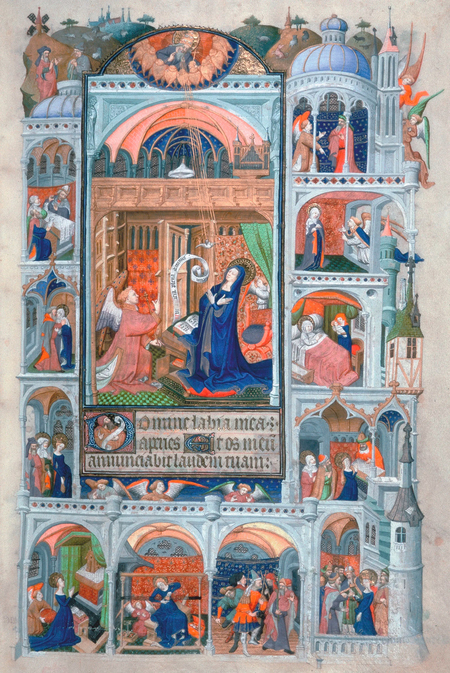
Bedford Master and his Paris workshop. «Bedford Timepiece.» 1415–1430s
Fragment of the «Bedford Hours.» 1415–1430s
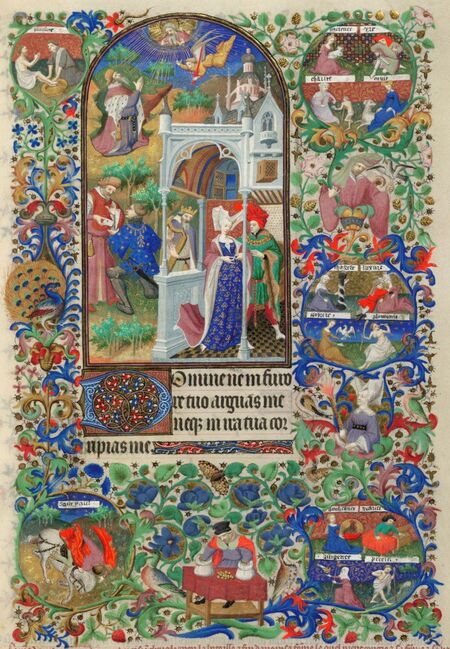
A similar concept is found in the calendar leaves of «The Magnificent Horologer of Duke Berry» (1412–1416). This style of design is typically found in princely commissions; the architectural frame looks luxurious and immediately communicates the book’s status.
The Limburg Brothers (Paul, Jean, and Herman Limburg). «Magnificent Horologium of Duke Berry.» (c. 1412–1416)
Fragment of a calendar page. «The Magnificent Horarium of Duke Berry»
The architectural frame represents the pinnacle of this sequence, where repetition becomes the scaffolding of the page; unlike the vine, it doesn’t merely border the text—it constructs the space around it.
Carpet border. It unites English and Bohemian traditions because they share a common characteristic—density. The border stops being a chain and becomes a solid carpet of intertwined stems, animals, birds, and botanical elements. The English variant is the «Sherborne Missal» (John Sefervas, 1399–1407), which features forty-eight illustrations of British birds with captions, in addition to the botanical interlace.
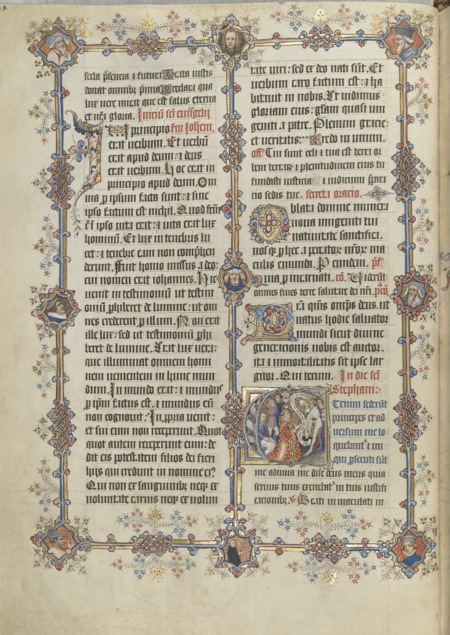
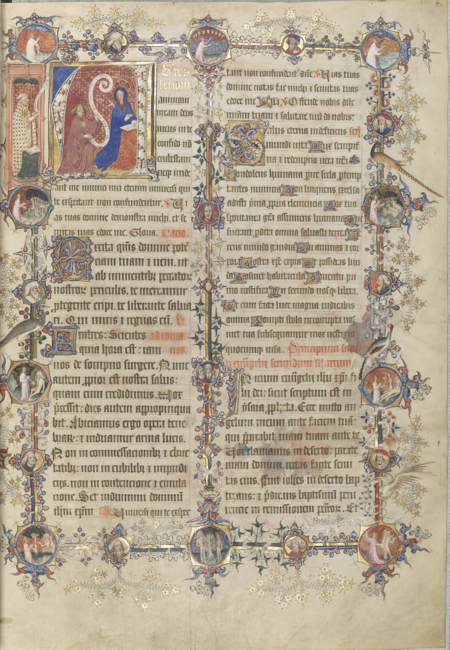
John Cifervas. «Sherborne Missal» 1399–1407.