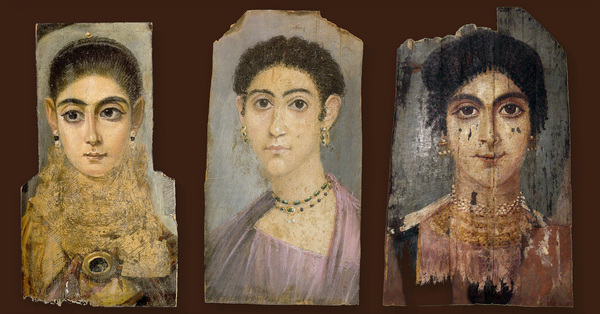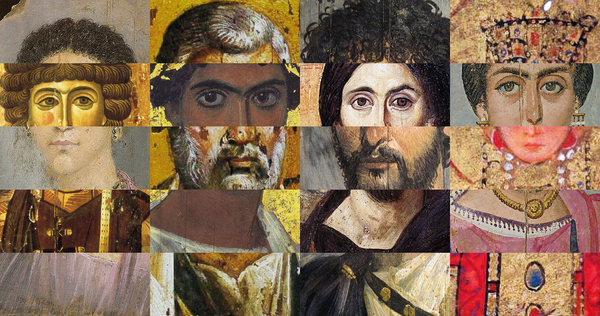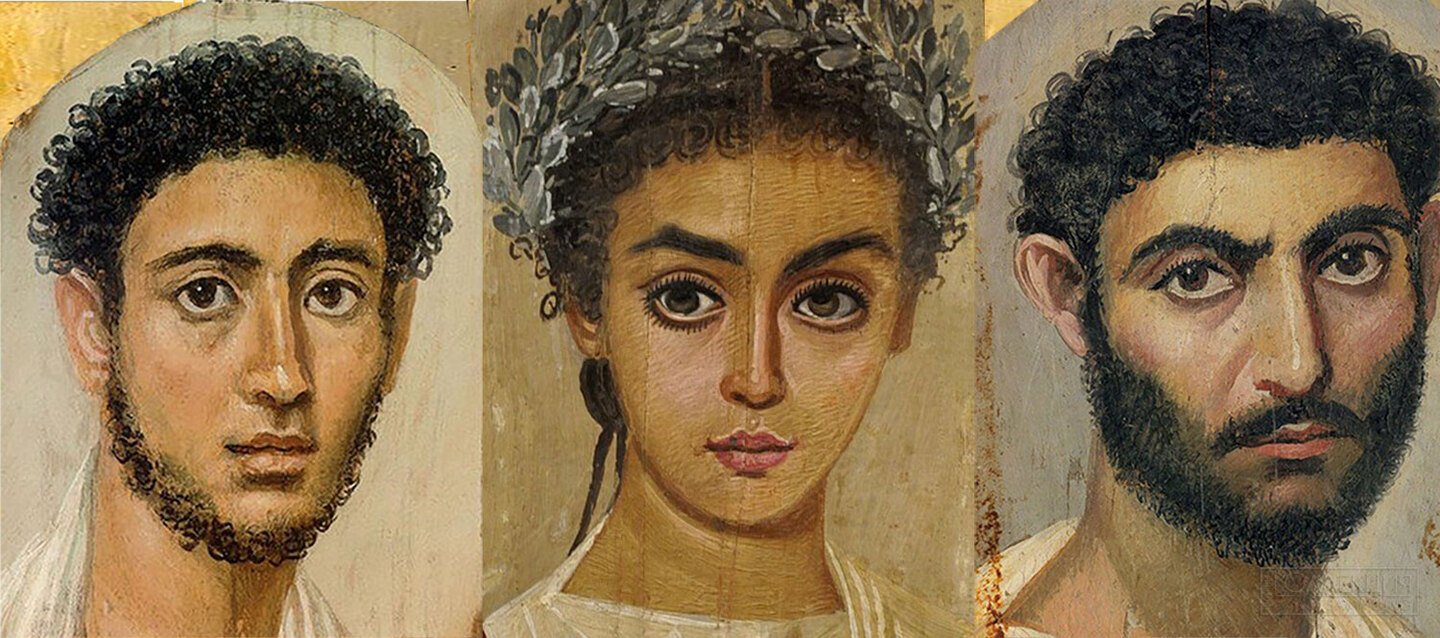
Concept:This visual study explores the artistic means through which the impression of a specific individual is conveyed in funerary portraits from Roman Egypt. These images are captivating because they link individualized facial features with a specific function: the portrait was associated not only with representing a person but also with funerary rites. While many of these panels are now exhibited as standalone works of art, they were originally intended to cover the mummy’s face or form part of the burial wrappings. Therefore, this research examines the portrait simultaneously as an image and as an object embedded within a particular ritual and material context.The theme was chosen due to the compelling contradiction that arises when a viewer encounters these images: before us are the faces of people who lived nearly two thousand years ago, yet their gaze and unique characteristics continue to feel directed toward the contemporary observer. Of particular interest is not only the degree of naturalistic rendering of individual features but also the compositional organization of the image—whether the head is depicted frontally or three-quarter view, the direction of the eyes, the relationship between the eyes and other facial features, the nature of the volumetric modeling, the color transitions, the light accents, hairstyles, and other individual traits. Furthermore, emotionality in this work is understood not as the possibility of accurately determining the depicted person’s internal state, but as the visual effect generated by the observable characteristics of the image and the interaction of those characteristics with the viewer.
The research material comprises selected funerary portraits from Roman Egypt, traditionally grouped under the designation «Fayum portraits.» This term functions as a familiar name for the artistic phenomenon but does not imply that every examined object was found directly in the Fayum region; the portraits originate from various locations across Egypt, and their geographical attribution can, in individual cases, be conjectural. The chronological scope of this research primarily covers the 1st–3rd centuries CE. The corpus includes works for which museum photographs of sufficient quality and catalog information are available, allowing for the establishment or correct designation of the dating, material, technique, inventory number, and, if known, the place of discovery. Selection is also based on visual diversity: it is important to compare portraits with varying head positions, gaze direction, age and individual facial characteristics, color palette, and degree of preservation. The study incorporates both individual wooden panels and portraits preserved within mummies or funerary complexes. This comparison is necessary to avoid separating the visual analysis from the objects’ original function. The selected works are treated as a research sample, not as an exhaustive or statistically representative depiction of all funerary portraits from Roman Egypt.
The structure of the study moves from a general context to a sequential analysis of visual elements. First, the role of the portrait within the funerary complex is examined: its material form, its placement relative to the mummy’s body, and the distinction between the panel that survived separately and the image remaining in its original location. This section is necessary to establish the context in which the portrait existed and why it cannot be studied merely as an autonomous painting. Next, the positioning of the head and the direction of the gaze are analyzed—frontality, three-quarter turn, and the relationship between the facial direction and the direction of the eyes. The following section is dedicated to the eyes as a crucial element of visual contact—their shape, scale, contrast, contour, and highlights. Then, the characteristics of facial expression and modeling are reviewed, allowing for the description of mood without arbitrarily attributing specific emotions to the depicted subjects. A separate section is devoted to individual characteristics—age features, asymmetry, the shape of the nose, lips, chin, hair, and other details. Following this, light, color, and painting technique are analyzed in terms of how they create the sense of volume and materiality of the face. In the concluding part, the findings are compared with the funerary function of the portraits: the study returns to the question of how the individual image functioned within the context of memory and the representation of the deceased.
The research database is compiled from several types of sources. The first group consists of museum collection catalogs and descriptions of specific artworks: these are used to verify titles, inventory numbers, dates, materials, techniques, origin, and the history of the objects' use. The second group comprises scholarly publications on the art and funerary practices of Roman Egypt, which are necessary for understanding the historical context and existing scholarly interpretations. The third group includes studies of ancient painting technology, including materials from the international APPEAR project (Ancient Panel Paintings: Examination, Analysis, and Research), which examines the materials, construction, and methods used to create ancient panel paintings. These sources are not intended to replace original analysis but rather to verify facts and refine what can or cannot be asserted about a specific object. Visual observations are separated from information borrowed from catalogs and scholarly literature; all borrowed claims and images are accompanied by citations in accordance with formatting requirements.
Key research question: What visual means in funerary portraits from Roman Egypt create a sense of presence and eye contact with a specific individual? The hypothesis is that this effect is not formed by a single technique—such as large eyes or a frontal face—but by the interaction of several elements: the direction of gaze, head positioning, individual features, chiaroscuro modeling, color relationships, and the characteristics of the painted surface. The funerary context adds further meaning to this effect: the depiction of the face becomes linked to the deceased’s body and continues to represent their individual likeness within a ritual setting. During the research, the hypothesis will be tested by comparing specific works. The goal of this study is not to reconstruct the feelings or intentions of the depicted people and artists that are inaccessible to us, but rather to determine which features of the visual language allow the contemporary viewer to perceive these portraits as images of distinct, recognizable individuals.
A face positioned between two worlds.
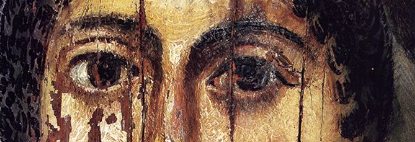
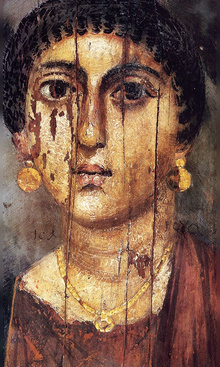
Portrait of Isarous; Early Roman period. The museum does not provide a more precise numerical dating. Petrie Museum of Egyptian Archaeology, UCL. Inventory number: LDUCE-UC19611.
The Fayum portrait is not merely a depiction of a human face; it is a physical object created with consideration for its subsequent use in funerary rites. The form of the wooden panel, its structural features, and traces of its finishing attest that the image was intended to be incorporated into mummification wrappings. Therefore, its original function differed from the conventional function of a standalone painting.Here, it is essential to note the distinction between the modern museum presentation and the object’s original purpose: today the viewer sees a separate panel, although originally it was attached to the body of the mummy.
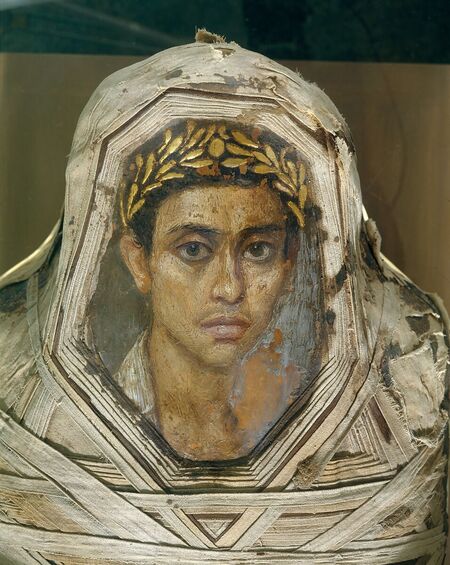
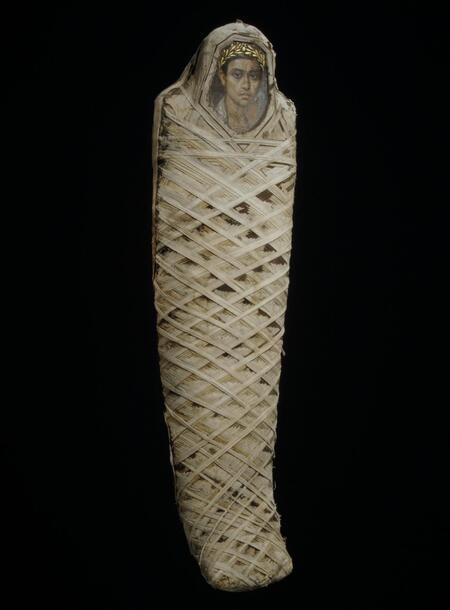
Mummy with an Inserted Panel Portrait of a Youth. 80–100 CE. Museum: The Metropolitan Museum of Art. Inventory Number: 11.139.
The portrait panel and the burial wrappings form a unified material object. Yet, they maintain a distinction between two modes of representing the human: a pictorial depiction of the face and the physical form of the mummified body. The portrait becomes the visual center of the funerary structure, concentrating attention on the individual likeness of the deceased.
Mummy; Mummy portrait (Eudaimonis); 130–150 CE (stylistic attribution of the museum). Museum: Musée du Louvre. Inventory Number: AF 6882.
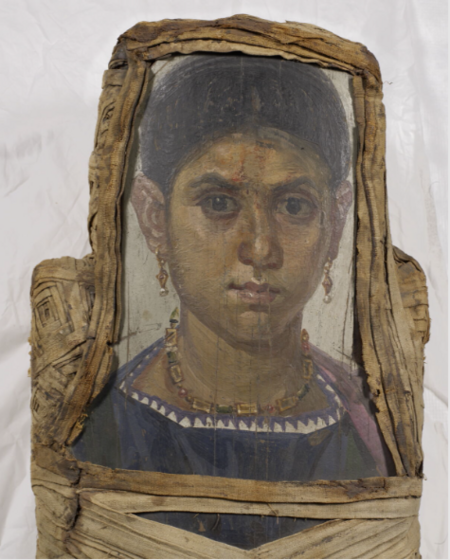
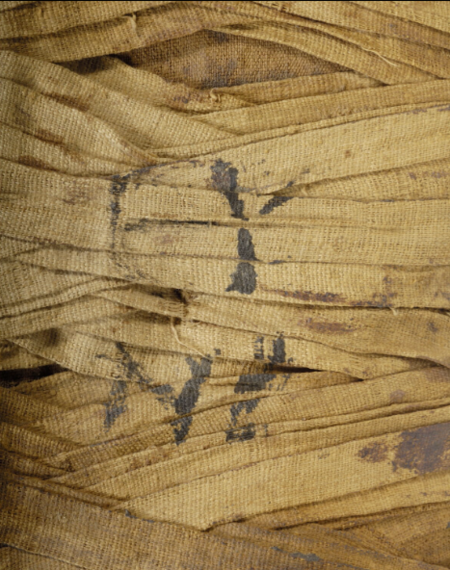
The Evdaimonis Mummy serves as an example of a funerary complex where the facial portrait is supplemented by textual identification. The woman’s name is preserved directly on the burial wrappings, creating a link between the portrait and the specific individual. In this case, the visual representation and the written inscription exist as interrelated elements of a single artifact. The portrait conveys the individual physical characteristics, while the inscription retains the name of the depicted person.
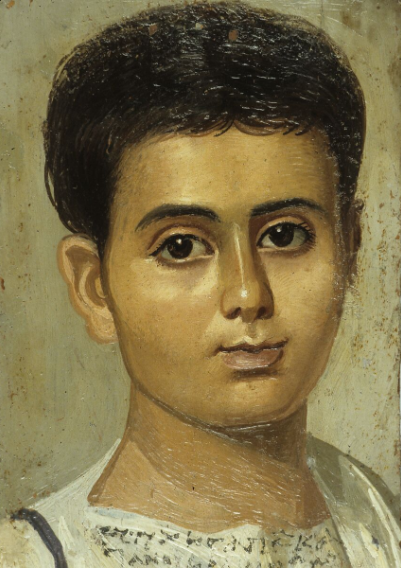
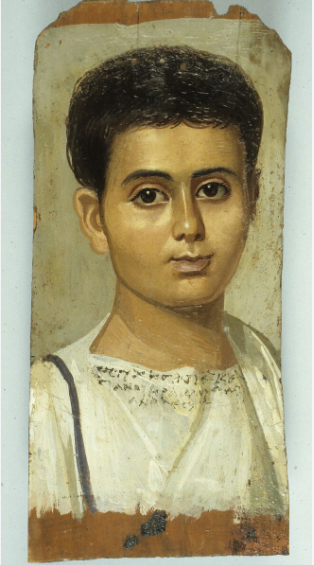
Portrait of the Boy Eutyches; 100–150 AD. Museum: The Metropolitan Museum of Art. Inventory number: 18.9.2.
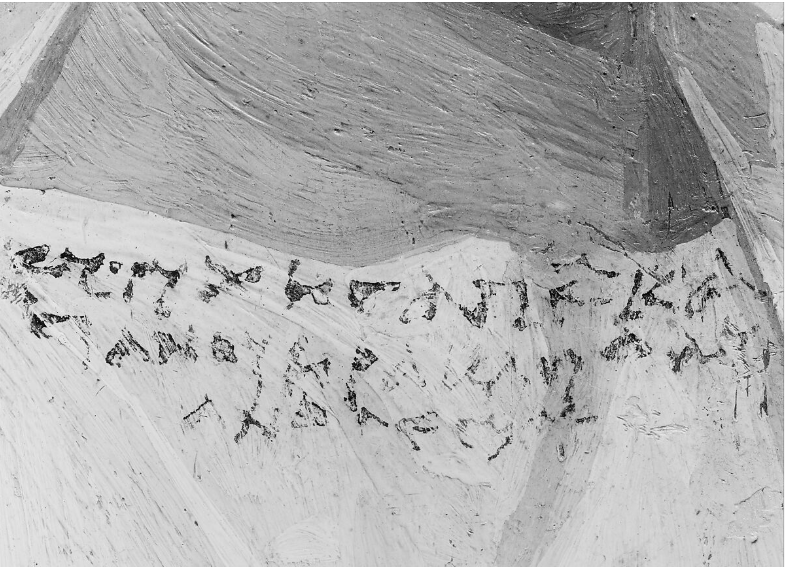
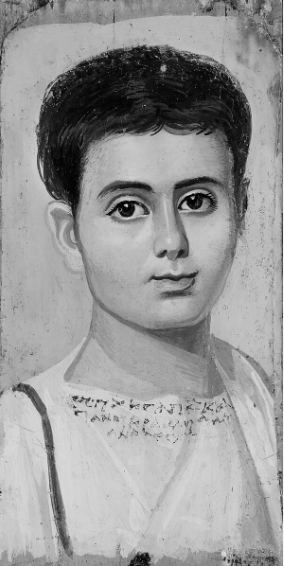
This portrait features a Greek inscription beneath the tunic’s hemline. It identifies the young man as Euthychios and indicates his status as a freedman. The inclusion of a name allows us to view the portrait not merely as a depiction of appearance, but as evidence of the preservation of individual identity. However, the methods of such identification can vary: the name might be inscribed directly onto the portrait panel or preserved in inscriptions on burial wrappings.
Head posture: frontality and gaze direction.
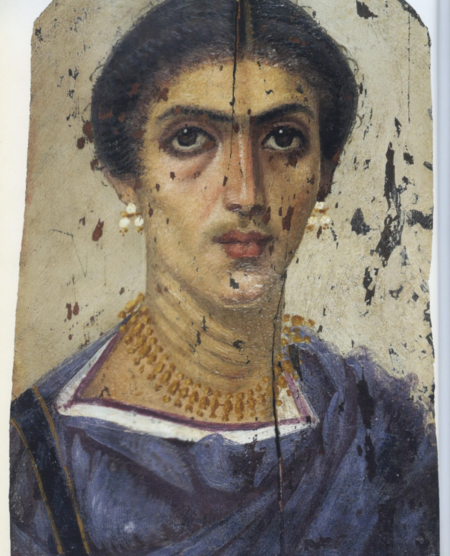
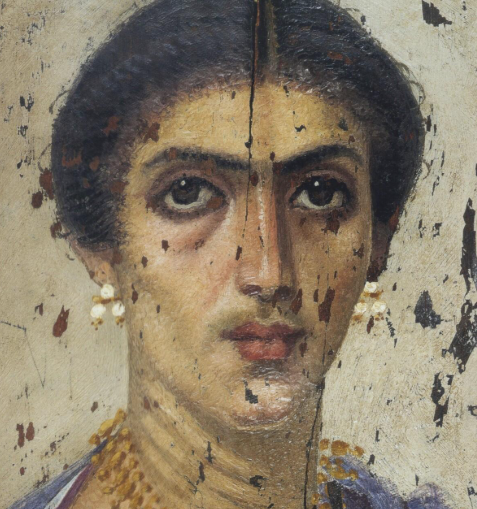
Wooden panel with a portrait of a blue-robed woman; Early Roman period, no precise numerical range in the catalog. Museum: Petrie Museum, UCL. Number: LDUCE-UC14692.
The panel format defines the spatial boundaries of the composition, within which the artist organizes the human image.
Portrait of a young man, facing left; Roman period, precise date range not specified in the card. Museum: Petrie Museum, UCL. Number: LDUCE-UC19612.
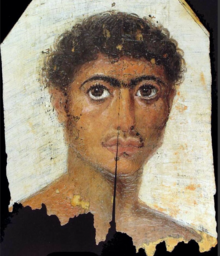
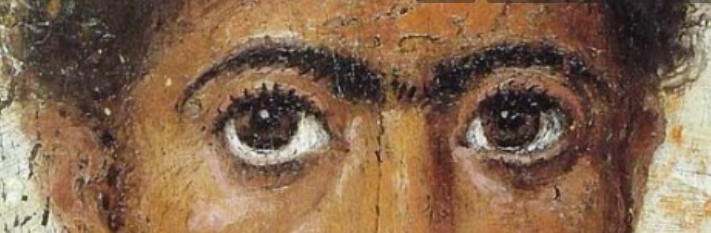
In this portrait, the subject’s face is turned to the left, allowing an examination of the head structure in a partial rotation. Compared to a frontal composition, the visibility of individual facial features changes: one side appears more open while the other partially recedes into perspective foreshortening. The position of the nose relative to the cheeks and the overall contour of the head helps convey the spatial orientation of the image. The hairline and ear take on additional importance, as they are crucial in forming the external silhouette of the head. Extending the image into the shoulder area allows for the rotation of the head to be viewed not in isolation, but in relation to the upper part of the figure. This portrait demonstrates how changing the angle of view affects the visual perception of facial proportions and volume.
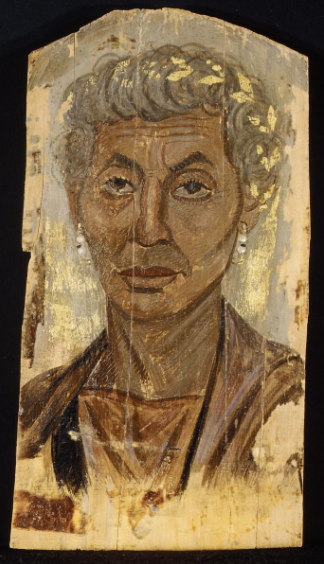
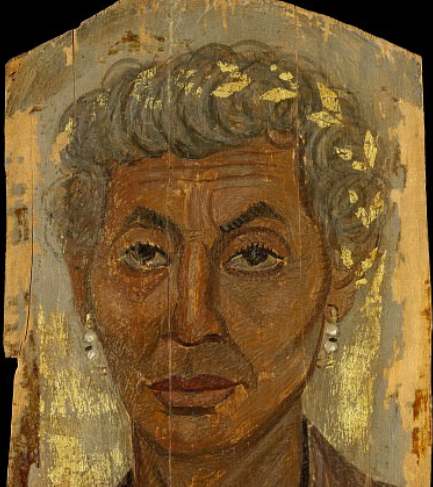
Portrait of an elderly woman wearing a gold wreath. 100–125 CE. Museum: The Metropolitan Museum of Art. Inventory Number: 09.181.5.
In this portrait, the head and shoulder girdle form a single compositional structure, where both parts of the figure possess their own spatial orientation. The shoulders are slightly spread, creating a distinction from an image built upon a strict frontal orientation of the torso. The neck’s position links the head to the shoulder girdle, forming a smooth transition between the figure’s individual parts. Particular attention should be paid to the outer contour: the hair, the oval of the face, and the shoulders create a continuous line that defines the silhouette of the depicted person. The museum notes the use of chiaroscuro and light accents to convey volume, which is especially noticeable in the modeling of the face and neck. As a result, the portrait is perceived not as a flat image of a head, but as a spatially organized upper part of the human figure.
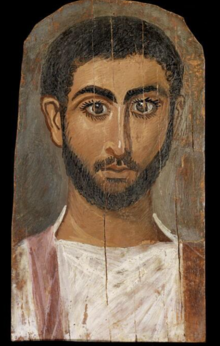
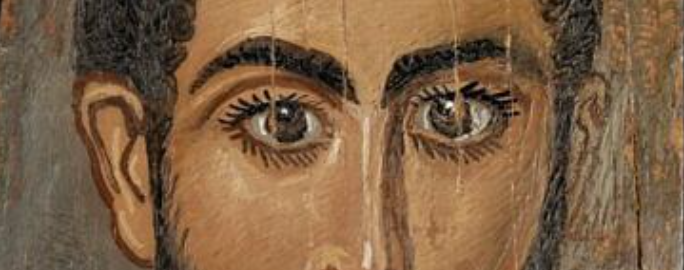
Portrait of a thin-faced, bearded man. 160–180 CE. Museum: The Metropolitan Museum of Art. Inventory number: 09.181.1.
This portrait allows for an examination of the spatial relationship between the head and torso by aligning their directional vectors. According to the Metropolitan Museum’s description, the depicted man’s body is angled more directly toward the viewer, which makes the structure of the upper figure particularly interesting. The elongated face, pronounced cheeks, and dense beard form a complex outer contour of the head. The beard not only completes the subject’s individual appearance but also visually extends the line of the lower face, creating a transition into the neck. The chiaroscuro modeling emphasizes the volume of the distinct areas of the head and neck, helping the viewer perceive them as spatial forms. Therefore, the composition is built through the interaction of the torso, neck, and head, rather than through an isolated depiction of the face.
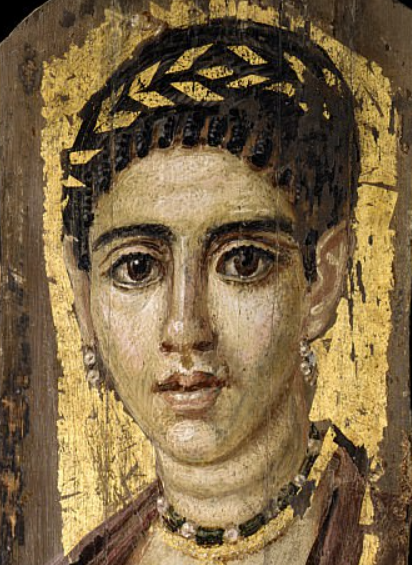
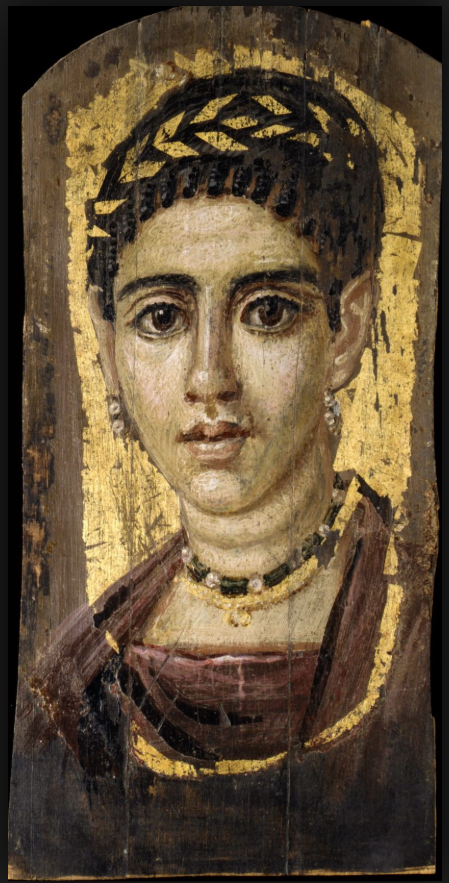
Portrait of a young woman with a gilded wreath. 120–140 AD. Museum: The Metropolitan Museum of Art. Accession number: 09.181.7.
One of the most striking features of this portrait is the oval shape of the face, which is specifically noted in the museum description. The visual structure of this oval can be examined through the relationship between the width of the cheekbones, the line of the cheeks, and the gradually tapering chin. The upper portion of the face is framed by the hair and adorned with a gilded wreath, which forms an additional boundary between the head and the background. The lower part of the face flows into a relatively long neck, causing the head to be perceived as part of a more elongated composition. The dense painterly modeling of the face and neck helps emphasize the main volumetric areas and accentuate their form. This example demonstrates how individual facial proportions become the foundation of its compositional organization.
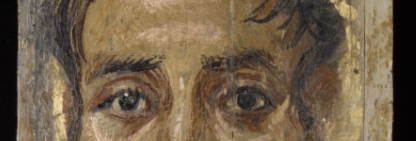
Portrait of a thin-faced man. 140–170 CE. Museum: The Metropolitan Museum of Art. Inventory Number: 09.181.3.