Concept
In many cultures, various hybrid figures of creatures and deities can be found. In Greece, there is the Minotaur—a monster with a human body and a bull’s head. In Mesopotamia, there is the Lamassu—a creature with a human head, a bull’s body, and wings. In India, there is Ganesha—a god with a human body and an elephant’s head with a single tusk. While such hybrid figures sometimes appear strange or comical, they generally carry a specific meaning.
I found the most similar imagery in ancient Egypt. By studying its history, one can observe that religion played a vital role in their lives, art, and architecture, and numerous gods in their culture combine both human and animal characteristics.
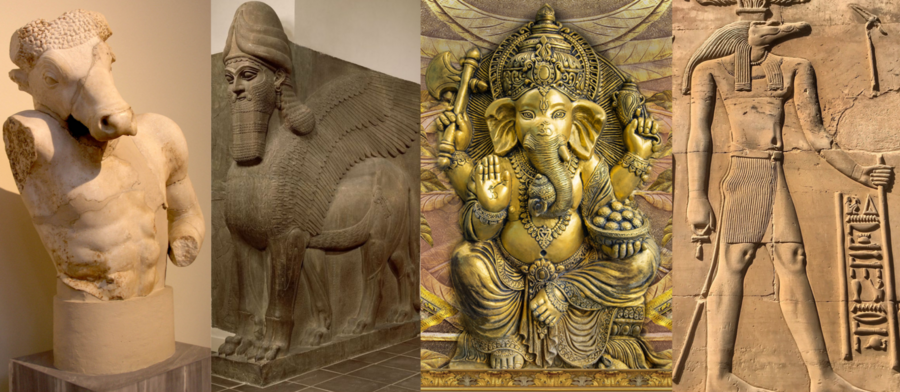
Minotaur, Lamassu, Ganesha, Sobek
Hybrid figures can be divided into two categories: 1. The body of a human and the head of an animal. 2. The body of an animal and the head of a human. Each such figure holds a specific meaning. For example, to imbue a figure with divine qualities, the Egyptians combined human and animal traits. Animal traits could convey specific qualities to the figure, such as: wisdom, strength, or power.
In my visual research, I will examine both groups of images. This will allow me to delve more deeply into the study of the symbolism of these hybrid creatures and gods to understand why the ancient Egyptians depicted them in this particular manner.
The human body and the animal head
Many gods in ancient Egypt are depicted with human bodies and the heads of various animals; therefore, I decided to begin my research with this group.
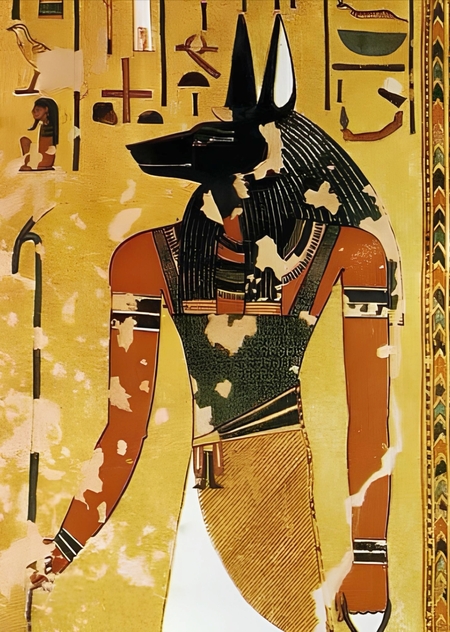
Anubis—a god with the head of a jackal, responsible for funerary rites and mummification. He was assigned the jackal head due to the animal’s connection to cemeteries. Jackals lived around necropolises and the burial sites of the dead, leading to this associative link. The black color of Anubis’s head further connects the image to the symbolism of burial and rebirth in the afterlife.
Statue of a deity with a jackal head, likely Anubis. 332–30 BCE.
Anubis was often depicted in action: conducting rituals or standing near mummies and the dead.
«Anubis Caring for the Mummy of Sennejem» Tomb TT1. 1292–1189 BCE.
The Papyrus of Hunefer. 1310–1275 BCE.
Papyrus of Hunefer. 1310–1275 BCE
The god, depicted with the head of an ibis, was easily recognizable by his long, curved beak. His image symbolized knowledge, wisdom, and writing, so he could be portrayed holding writing implements or other ritual objects. Ibises in ancient Egypt were considered sacred animals and were connected to the cult of Thoth.
Cornice block depicting the purification of a pharaoh. Roman period, 41–68 CE.
Papyrus of Hunefer. 1310–1275 BCE
Fragment of a stele depicting Thoth, Horus, Osiris, and Isis, c. 1292–1075 BCE.
Statue of Thoth with an ibis head, 1539–1292 BCE, ivory. Walking Thoth, 664–332 BCE.
Ra-Horakhty—a deity combining the attributes of the gods Ra and Horus—is most often depicted with the head of a falcon and a solar disk above it. In his iconography, the solar disk is as significant as the bird’s head, as it most clearly signifies his connection to the sun. In ancient Egypt, the falcon was associated with the sky and royal power, which is why this animal reflected Ra-Horakhty’s connection to Horus.
Papyrus of Seshaf, principal devotee of Amun, god Ra-Horakhty, 945–720 BCE.
Statue of Ra-Horakhty, 332–30 BCE
It can also be noted that he was frequently depicted sitting on a throne, holding an ankh and the was scepter, symbols of life and power.
Relief depicting Ra or Ra-Horakhty, with the goddess Imentet seated behind him. From the tomb of Nefertari in the Valley of the Queens. 1292–1186 BCE.
Scene of the Divine Offering; Nets of I and Ra-Horakhty, 1290–1279 BCE
Sekhmet—the goddess of war, destruction, and protection, a woman with a lion’s head and a solar disk above her. In ancient Egypt, the lioness was an extremely dangerous predator, so Sekhmet’s head symbolized power, strength, and the ability to defend her territories, while the solar disk above her head reflected her connection to the god Ra.
Sekhmet, the Goddess. Relief on the column of the Kom Ombo Temple. Presumably 2nd–1st centuries BCE.
Her image is most often seen in statues where she is depicted seated on a throne. This posture symbolized her power and majesty.
Statue of the goddess Sekhmet, 1386–1347 BCE
Goddess Sekhmet, seated, 724–332 BCE