Concept
The female image belongs to the most mass-reproduced and socially significant visual constructs of contemporary culture: it is constantly reproduced in advertising, film, media, and social networks, shaping perceptions of appearance, gender roles, and socially desirable behavior. Feminist art intervenes in this flow, attempting to rewrite the rules by which the female body and female experience become visible. Studying it allows us to better understand the mechanism through which imagery distributes the right to speak.
Material selection is based on five filters. The first and most crucial filter is the distinction between «women’s art» and «feminist art.» The research database does not include everything created by a female artist, only works that convey a conscious reflection on the status of women. Works of «woman about woman» without this reflection are excluded from the research database. The second filter is the chronological scope, spanning from the 1960s to the 2020s, with a primary focus on the 1970s–1990s. Media diversity is also important. We study painting, photography, video, performance, installation, printmaking, and poster art. Limiting the scope to a single medium would skew the results, as performance, posters, and painting offer different levels of documentary fidelity. Another filter is geography. The study includes works from the Western canon (U.S., United Kingdom, Europe) to form a detailed conclusion about a single region. In addition to the above, the work must be available in good quality.
Five substantive themes—"Woman in Society,» «Woman in the Workplace,» «Woman in Politics,» «Woman at Home,» and «The Female Body"—are examined not as mere thematic categories, but as five institutionally defined spaces where women are assigned a prescribed role. The order follows a progression from the most public to the most private: the «Woman in Society» theme establishes the baseline distribution of visibility; «Woman in the Workplace» denotes the sphere of acquiring economic subjectivity; «Woman in Politics» represents the space for asserting that subjectivity as a right; «Woman at Home» is the zone where that right is nullified; and «The Female Body» shows the final boundary beyond which any role ceases to exist.Textual sources for the study are selected based on three key criteria: historical representativeness, significance, and accessibility. Priority is given to primary texts published in authoritative sources.The central research question is formulated as follows: through what visual means does Western feminist art transform woman from an object of the gaze into a subject of expression?The hypothesis posits that Western feminist art shifts the depiction of woman from a mode of «image for viewing» to a mode of «testimony of experience»: the focus moves from how the woman looks to what she experiences. The viewer, in this process, transforms from an observer into a participant. The rejection of idealization is achieved not so much through the realism of the imagery, but through other means: relocating a recognizable image into an unfamiliar context, employing documentary style, using the body as a carrier of ideas, irony, quotation, and direct address to the viewer.
Woman in Society
In Western feminist art, the image of women is examined in relation to the social norms and institutions that define their position, opportunities, and visibility. Artists address gender stereotypes, the exclusion of women from history and culture, as well as differences related to class, race, and social experience. They reinterpret conventional imagery and create new forms of presence—ranging from personal testimony to collective discourse. Women are presented not only as subjects affected by societal rules but also as participants capable of challenging and transforming those rules.
Judy Chicago The Dinner Party, 1974–1979
The Dinner Party (1974–1979) — an installation by Judy Chicago dedicated to women whose names and achievements have often been omitted from history. At the center of the work is a large triangular table set with thirty-nine place settings. Scattered on the floor around it are the names of another 999 women. Through this piece, the artist demonstrates that what matters is not just individual famous figures, but the memory of women as a whole.The installation conveys its message through the principle of historical placement and the ritual of memory. The primary technique is the absence of faces: thirty-nine place settings, yet no portraits. Identity is expressed not through the face, but through the textiles and inscriptions: embroidery on fabric panels individualizes the participants using symbols and dates, while the porcelain repeats their motifs, transforming the individual into a sign that can be read as an archive or an emblem. The number of seats—thirty-nine, with thirteen at each of the three sides of the triangular table—as well as the goblets at each spot, all reference the biblical motif of the Last Supper, one of the most recognizable images of male societies. Thus, the artist transplants this traditionally masculine image into the world of women, women who deserve to be remembered just as much as men.Chicago uses materials traditionally associated with domestic and manual labor: embroidery, ceramics, and porcelain painting. In the work, these crafts occupy the space of museum art. The triangular form of the table and its division into historical periods help present the work as a narrative about women of the past. The viewer walks around the table and reads the names on the floor; therefore, they are not merely looking at the installation, but are situated within the memory space the piece has created. «The Dinner Party» transforms the space at the table and the name into signs of recognition, even though the women do not speak in the first person—their histories are presented through the composition created by the artist.
Mary Beth Edelson Some Living American Women Artists, 1972
In the work Some Living American Women Artists (1972), Mary Beth Edelson utilizes a reproduction of Leonardo da Vinci’s famous «The Last Supper, ” replacing the characters' heads with photographs of female artists. Through this intervention, the familiar religious scene transforms into an image of a community of contemporary creators, with women occupying roles traditionally assigned to male figures. The labels bearing the artists' names surrounding the image emphasize that this is not about isolated exceptions, but about an entire cohort whose participants deserve to be named and seen. By appropriating a canonical composition, the work questions who is granted the authority to enter art history and embody its principal figures. The piece merges a recognizable quote with direct visual alteration: the viewer recognizes the customary scene, but its transformed faces compel a re-evaluation of the established order. The artists' voice emerges here primarily through their presence and names, rather than through a first-person narrative.
Woman at work
Feminist artists investigate how gender expectations influence career choices, working conditions, compensation, and recognition—and who’s efforts are deemed worthy of attention. Employing artistic techniques and various forms of visual creation, they make the labor process itself visible and question the boundary between art and work. The woman in these pieces is presented not merely as a worker, but as an author who can exhibit, contemplate, and redefine the value of her own labor.
Mierle Laderman Ukeles, Hartford Wash: Washing, Tracks, Maintenance (Outside), 1973
In «Maintenance Art Manifesto» (1969) [https://queensmuseum.org/wp-content/uploads/2016/04/Ukeles-Manifesto-for-Maintenance-Art-1969.pdf], Maryl Prather Ukeles draws attention to the labor that sustains daily life—work that is usually unnoticed and undervalued. She contrasts the creation of something new—"development"—with the continuous labor of care, cleaning, and maintenance. In «Hartford Wash: Washing, Tracks, Maintenance—Outside» (1973), this idea becomes action: the artist washes the museum’s exterior steps and documents the process with photographs. Mundane cleaning, often perceived as a female duty or low-wage work, is transplanted into the sphere of art and becomes a subject of public attention. The repetitive motions, the traces of water and dirt, and the systematic photo documentation reveal that maintaining order requires time and effort, even if the labor’s result quickly vanishes. Ukeles does not portray a worker from the outside; she performs the work herself, making her and her actions part of the statement. Thus, the manifesto and the performance question the boundary between art and service labor, demanding recognition for the work upon which daily life depends.
Guerrilla Girls Women In America Earn Only 2/3 Of What Men Do, 1985
In the poster «Women in America Earn Only 2/3 of What Men Do» (1985), the Guerrilla Girls employ the language of statistics and advertising to draw attention to wage inequality. The image of an American banknote links the value of money to the value of women’s labor, and the large text frames the issue into a simple, easily memorable thesis. The artists then refine this point: if women in America earn two-thirds of what men earn, then female artists earn only one-third of what male artists earn. This comparison demonstrates that inequality in art is part of a broader issue, not an isolated exception. The poster speaks directly to the viewer, urging them to perceive statistics not as abstract figures, but as evidence of the unfair distribution of professional recognition and material compensation.
Woman in Politics
In Western feminist art, politics is understood not just as women’s participation in state institutions, but also as a fight for the right to be visible, to speak for oneself, and to influence public decisions. Artists address the exclusion of women from political history, inequality, and violence, as well as forms of protest and collective action. Performance, posters, photography, and direct address to the viewer transform personal experience into a public statement, presenting women not merely as subjects of political decisions, but as active participants. Through these practices, art raises the question of who has the right to speak and whose voices are deemed significant in the public sphere.
Suzanne Lacy and Leslie Labowitz In Mourning and In Rage, 1977
In the performance «In Mourning and In Rage» (1977), Suzanne Lacy and Leslie Labovitz transformed the public expression of grief into a political statement. The work was created in response to the murders of women by the so-called «Hillside Strangler» and to the way the media covered these crimes. The participants, dressed in identical black garments adorned with red ribbons, gathered in front of the Los Angeles City Hall—a space associated with civic authority. The restrained, almost ritualistic formation and the collective presence stand in sharp contrast to the sensationalized image of individual victims: the women act not only as those threatened by violence but also as a group capable of speaking out and demanding accountability. By adopting the form of a press conference and addressing journalists, the artists direct their statement straight into the media landscape. Grief, here, does not remain a private emotion; it becomes a public action and the foundation for a political demand for safety and responsibility.
Barbara Kruger: RAGE + WOMEN = POWER Ms. January/February 1992 Cover
In the poster «Rage + Women = Power» (1992), Barbara Kruger transforms anger into a symbol of collective political strength. This concise formula, structured like a simple equation, links emotion to the unification of women and alters its conventional perception: anger is presented not as personal weakness or an inappropriate reaction, but as a response to inequality and the potential for action. The large typography and high-contrast graphic presentation make the slogan striking and memorable. Women here are not depicted as individual subjects but as a collective capable of asserting itself and influencing public life. The poster does not depict a specific political event; rather, it proposes a universal principle—that collective protest can become a source of strength and change.
Woman at home
In depicting the home of a Western feminist artist, references are made to domestic labor, caretaking, and daily duties, illustrating how these tasks demand time and effort even though they are often perceived as a natural part of female life and remain invisible. The home can be presented as a space of intimacy and creativity, but also as an arena of restriction, repetition, and dependence. By utilizing everyday objects, familiar interior imagery, performance, and irony, these artists elevate the mundane to a subject of critical reflection, demonstrating how personal experience intersects with broader social norms.
Martha Rosler Semiotics of the Kitchen, 1975
In Marta Rosler’s video «Semiotics of the Kitchen» (1975), she parodies cooking television shows. Standing before a kitchen table, she displays kitchen utensils in alphabetical order and demonstrates how they are used. However, her movements gradually become sharp and threatening: the familiar tools cease to appear as neutral domestic objects and transform into expressive gestures of protest. The static camera, the black-and-white imagery, and the artist’s direct gaze create the impression of an ordinary instructional program, which contrasts sharply with the tension in her actions. Rosler demonstrates that the kitchen is not merely a private space, but a location where roles and expectations associated with women’s labor are codified. Instead of a calm presentation of domestic skill, the viewer witnesses irritation and a refusal to silently fulfill a prescribed role.
Birgit Jürgenssen Ich möchte hier raus! / I Want Out of Here! , 1976
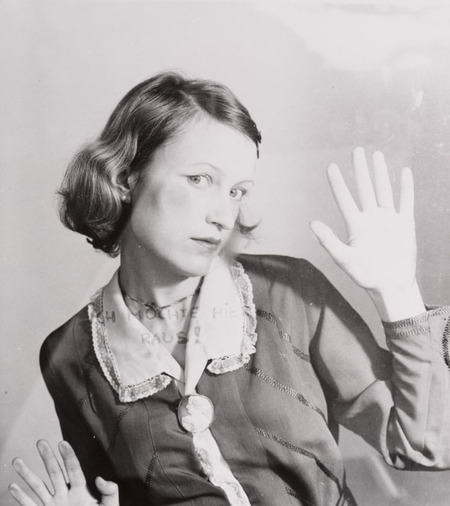
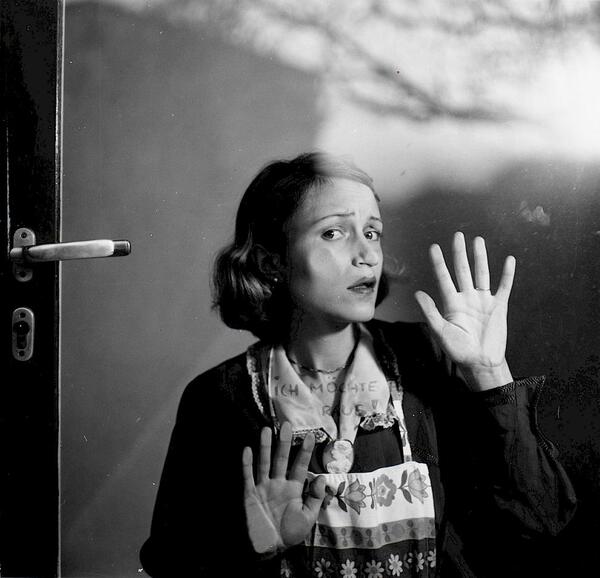
In Birgit Jürgensen’s photograph, «Ich möchte hier raus!» («I Want to Get Out!»), from 1976, the domestic space is transformed into a representation of confinement. The woman’s figure is positioned behind a partition, and her outstretched hand, along with the work’s title, conveys a desire to escape. The black-and-white photography and staged composition lend the scene the quality of a frozen episode, wherein the familiar home appears not as a cozy refuge, but as a restricting environment. Significant is the contrast between the image’s stillness and the insistence of the first-person phrase: the woman is not simply depicted within a domestic setting, but actively defines her position and proclaims her aspiration to change it. The work illustrates how domestic roles can be experienced as a trap, transforming a private feeling of unfreedom into a compelling public statement.
The Female Body