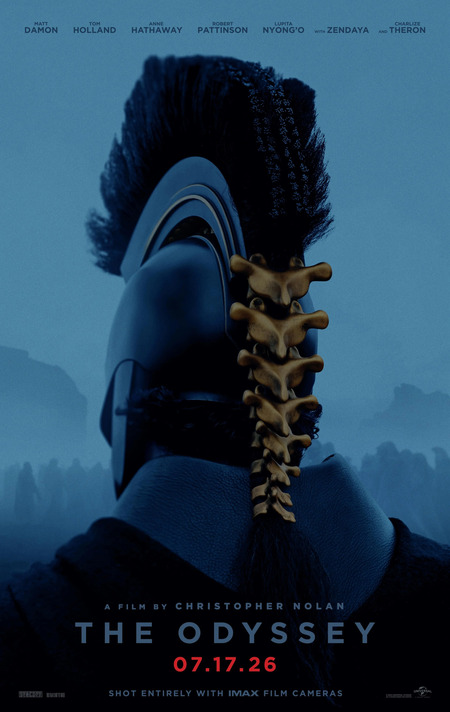
The film Odyssey, directed by Christopher Nolan and released on July 17, 2026, generated considerable debate—both regarding its auteur interpretation and the visual choices employed. The film, as the title suggests, is based on Homer’s epic poem The Odyssey. However, director and production designer Ruth de Jong stated early in the process that they «did not feel bound by historical or textual conventions» [1]. In an interview, Ruth de Jong remarked, «From the very beginning, we knew that Chris’s vision was to make it ‘An Odyssey’—our ‘Odyssey’» [1]. This meant the director’s initial goal was not to faithfully recreate Homer’s conception in the film. Rather, her aim was to reinterpret the work anew, finding timely themes and meanings within it that resonate with the spirit of the average modern viewer.
«We didn’t follow a historical period. We aimed for a timeless era.» [2]
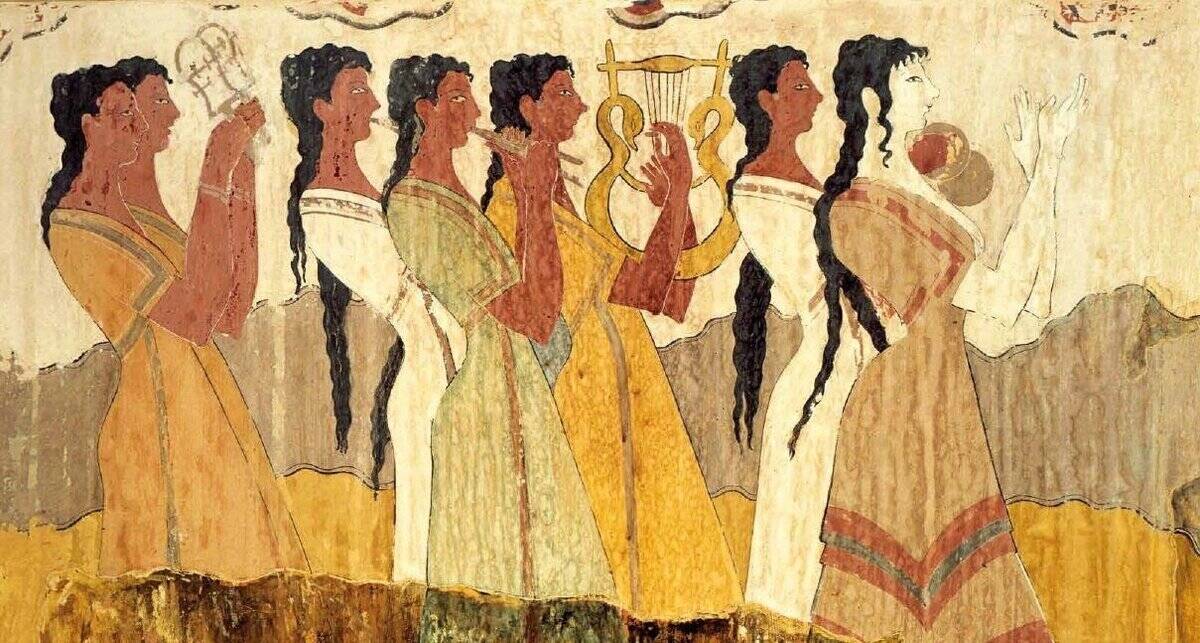
Nevertheless, the artists could not entirely abandon the historical period described in Homer’s work, even though Nolan deliberately avoided «cinematic clichés about antiquity» [2]. Although the plot of The Odyssey is rooted in ancient Greek mythology, the director and his team did not limit themselves to conventional depictions of Classical Greece. Many of the artistic decisions are based on materials and imagery from the Late Bronze Age Aegean world, particularly Mycenaean culture. Furthermore, Nolan wanted the film to remain timely for its era, and his drive to merge history with modernity made this film visually fascinating.
How does Christopher Nolan and his team reimagine the visual world of Ancient Greece in «Odyssey, ” and how do they use allusions to historical periods to serve their vision?
My hypothesis is that in creating the visual world of «Odyssey,» the artists drew upon the most expressive features of Cretan-Minoan material culture and art, selecting and transforming them in accordance with the film’s artistic goals. The film constructs an image of the ancient world not through historical reconstruction, but through the transformation of the visual characteristics of a specific era. The creators are not striving for an accurate reproduction of the historical period; rather, they use its visual heritage as a foundation to build an independent and compelling myth. I would like to find allusions to this era and trace how the director reinterprets and alters them, and what his intentions are behind those choices.
This film was only recently released, and there isn’t a large body of research on it yet—which is precisely why this study is relevant right now. Furthermore, as Dr. Anthony Macrinos, Associate Professor in the Department of Classical Philology and Homer expert, noted, «the story of the Trojan War is so archetypal that it always serves as an endless source of inspiration for artists’ imaginations, creating countless works in theater, opera, film, painting, literature, and so on» [3]. This shows that the ancient Greek narrative continues to influence contemporary culture and remains relevant to this day.
Having read the interview with costume designer Ellen Mirojnick, I discovered that she, along with other artists, primarily drew inspiration from Mycenaean Greek art [4]. Therefore, the research employs a comparative analysis of artifacts from that period and film footage. I sourced the art objects from the websites of various museums that had published photographs from exhibitions dedicated to the Mycenaean era.The textual sources I relied on include interviews with Christopher Nolan, Ellen Mirojnick, and Ruth De Jong regarding their work on «Odeyssey, ” as well as various articles on the film written by classical scholars and art critics' commentary. It is in these articles that the filmmakers explain some of their visual choices and help illuminate why a particular plot point was presented in a specific manner in „Odeyssey.“ The art critics, meanwhile, evaluate the work in relation to its historical context, which is crucial for my research. For the art history source from which I drew information, I used L.I. Akimova’s book, „Art of the Aegean World: Troy, Cyclades, Crete, Thera, Mycenae“ [5].
I decided to examine various aspects of the film to analyze the director’s work with the art of the Minoan period in each one.
The first chapter is dedicated to the most vital component of any cinematic work: its characters and their costumes. I examine how clothing, ornamentation, silhouettes, materials, and color help establish the film’s characters. In drawing comparisons, I aim to identify the intersections between the costumes created by Nolan and historical artifacts, as well as the artistic motifs that served as the foundation.
The second chapter focuses on the creation of the film’s surrounding world. The environment and landscapes in Odyssey are quite specific, as they immerse the audience in the context of what is happening on screen. I analyze the architecture, interiors, and set design, considering them as crucial elements in shaping the mythic image. This chapter pays close attention to how the filmmakers utilize the specificities of Mycenaean architecture and decorative arts, merging them with their own artistic vision.
The third chapter addresses how individual episodes and images from Homer’s poem were translated onto the screen. Key expressive devices in this process include color, frame composition, spatial organization, and population by characters. In order to achieve a realistic space—as desired by Nolan and, consequently, the production designer—they decided to forgo an excess of the poem’s fantastic elements. Therefore, certain scenes underwent significant alterations to align with their vision.
Farman-Farma R. Inside the Spectacular Sets of The Odyssey [Online resource] // Elle Decor. — 2026. — July 20. — URL: https://www.elledecor.com/life-culture/a73169741/the-odyssey-sets-christopher-nolan-ruth-de-jong/ (accessed: November 10, 2026).
Jackson H. The Odyssey Costumes Discard the Sword-and-Sandals Playbook [Online resource] // Vogue. — 2026. — July 20. — URL: https://www.vogue.com/article/the-odyssey-costumes-ellen-mirojnick-christopher-nolan (accessed: November 10, 2026).
Makrinos A. Nolan’s Odyssey: an exciting reinvention of the Homeric epic [Online resource] // UCL Faculty of Arts and Humanities. — 2026. — September 1. — URL: https://www.ucl.ac.uk/arts-humanities/news/2026/sep/nolans-odyssey-exciting-reinvention-homeric-epic (accessed: November 10, 2026).
The Odyssey: Production Information [Online resource] // in70mm.com. — 2026. — July 18. — URL: https://www.in70mm.com/presents/1970_imax/2026_the_odyssey/odyssey/index.htm (accessed: November 10, 2026).
Akimova L. I. The Art of the Aegean World: Troy, the Cyclades, Crete, Thera, Mycenae. — Moscow: BuxMart, 2020. — 655 p.: ill. — ISBN 978-5-907043-53-4.