Critical review of the exhibition «The Whole World Finds Home Here: Following in Tagore’s Footsteps, ” held at the GES-2 House of Culture from June 25, 2026, to August 23, 2026. This study examines the prerequisites for project development, addresses the issues and concept, surveys the artworks in the exhibition, and reflects on the cohesion of the idea, context, and overall execution.
Critical Review of the Exhibition «The Whole World Finds Home Here: Following Tagore’s Footsteps».GES-2 Culture Center June 25, 2026 — August 23, 2026Artists: Rabindranath Tagore, Sanchayan Ghosh, Samit Das, Sangeeta Maiti, Liza Neklessa, Ivan Novikov, Ulyana Podkorytova, Prashanta Sahu, Abhishhek Chakraborty, Ruma Choudhury, GABAA, Raqs Media Collective, The Otolith Group.Curators: Artyom Timonov, Elena YaichnikovaArchival Study on Tagore’s Exhibition in Moscow in 1930: Alexey Petukhov
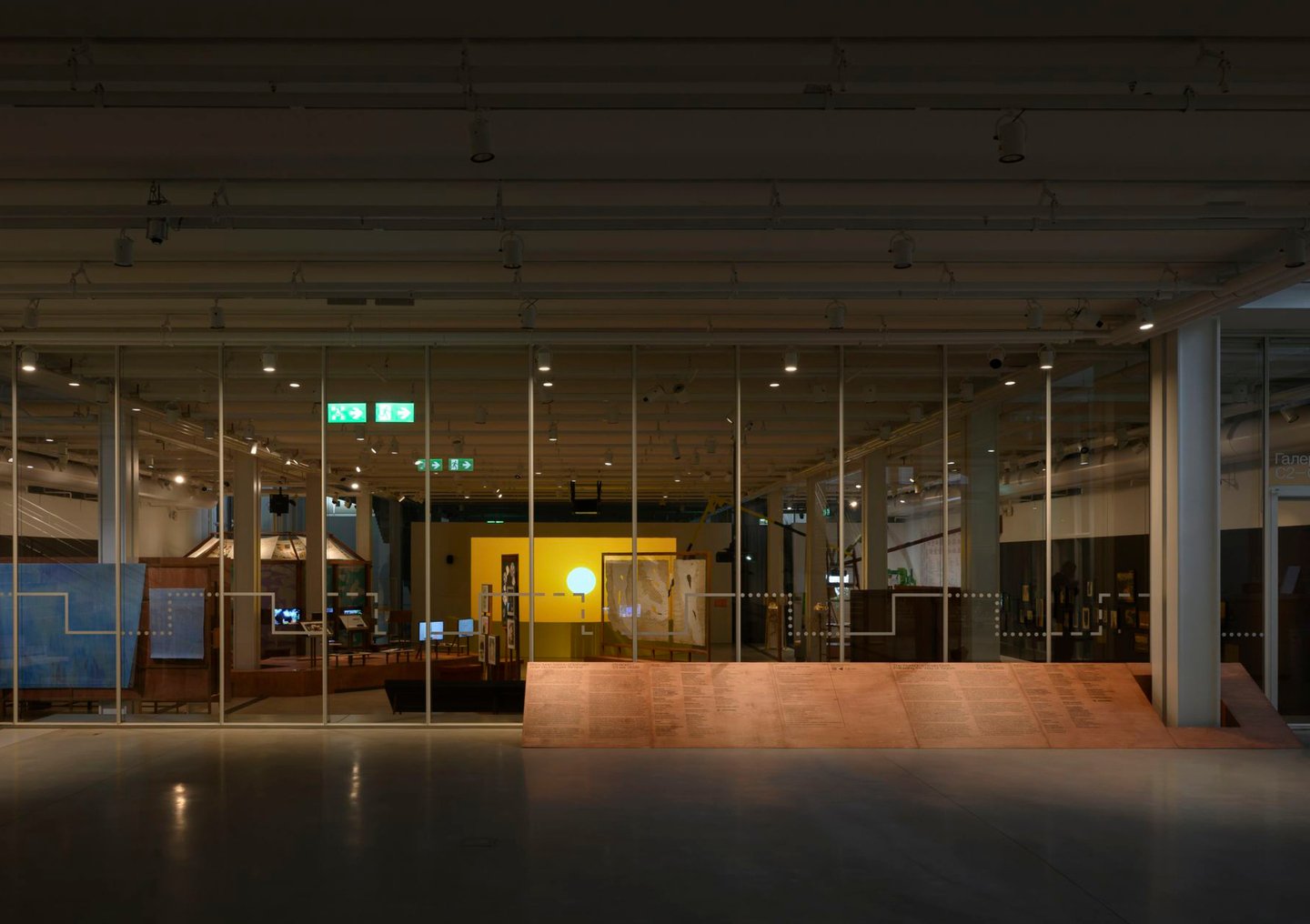
Exhibition Entrance
Image Source: GES-2 Press Service
It was announced even last winter that the GES-2 Culture House is preparing a large-scale international exhibition on the legacy of the Indian writer, thinker, and artist Rabindranath Tagore (1861–1941).
The institution’s website and social media channels were gradually filling up with materials about the upcoming project: a selection of artifacts, dances, tastes, and ideas, which, according to the authors of the post, was released on January 25th in Telegram to help the viewer «discover a new culture.» Although the phrasing is debatable—after all, you cannot «discover» a culture, just as you cannot open up an already existing world. You can become acquainted with it, engage in a dialogue, and try to understand its logic. It seems that this was the entire intention.
Photos from the exhibition team’s research trip to India
Image Source: GES-2 House of Culture Telegram Channel
Next—only more intrigue. A page with a loading GIF has appeared on the site, and the introductory text and a brief biography have been released. The exhibition has gradually become one of the most talked-about events of the season. It felt like a blockbuster was brewing. Meanwhile, curators and artists have been actively exploring Santiniketan—a cultural center in West Bengal where, at Tagore’s initiative in 1901, a school was established, and in 1921, the Visva-Bharati university was founded. It was there that his ideas about culture, shared education, and the free exchange of knowledge were formed.
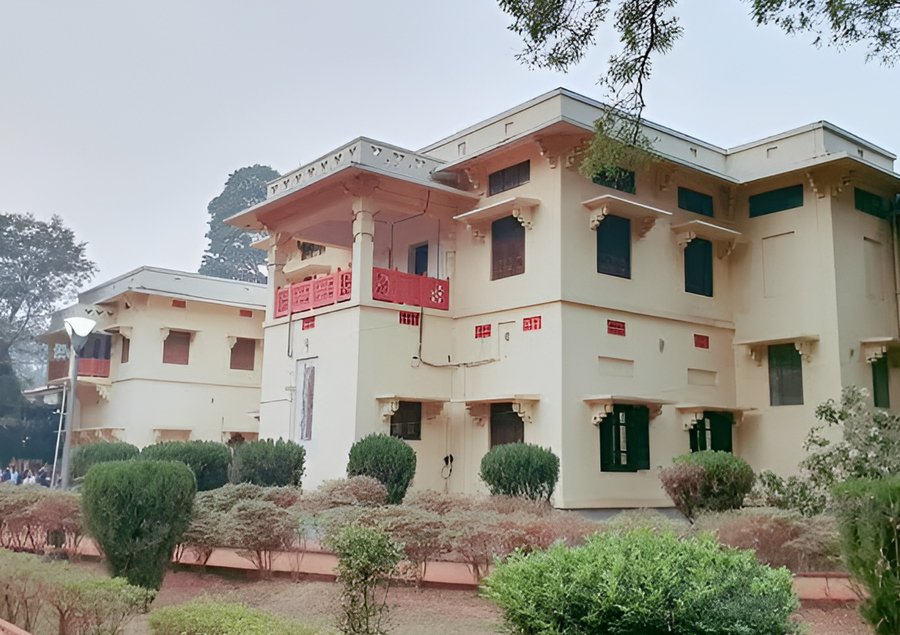
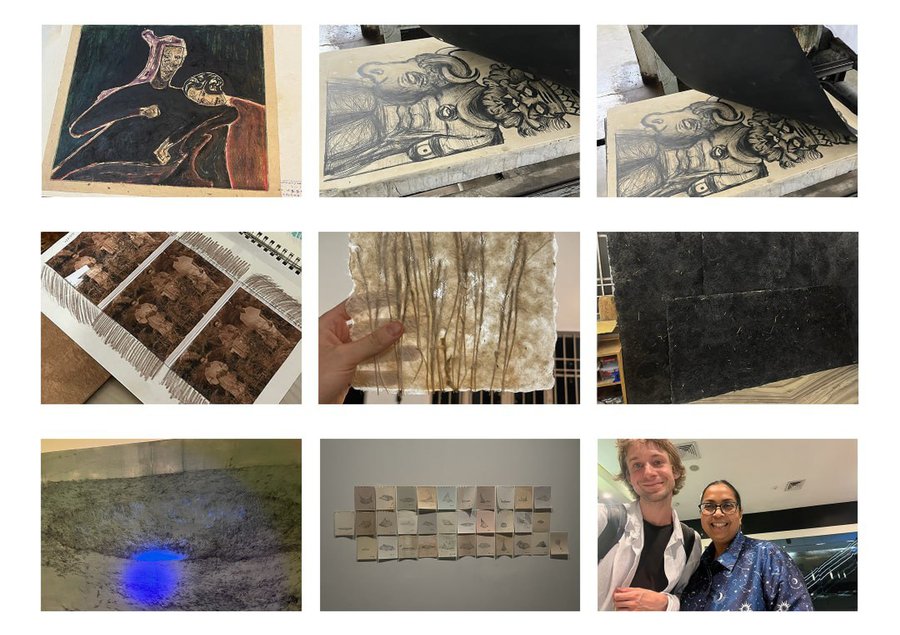
Left: Vishva-Bharati University in Shantiniketan / Right: The exhibition’s creative team explores the city
Image sources: Tripadvisor; GES-2 Culture House Telegram channel
The exhibition opening was postponed several times—it was initially planned for December 25, 2025, but the project continued to live on through publications and research until it finally opened physically on June 25.
The project concluded on August 23, leaving a rather intriguing aftertaste. Even though the exhibition closed its doors, we want to produce something akin to a critical «post-review,» breaking down the exhibit and everything surrounding it into its component parts.
«The Entire World Finds a Home Here: Following the Path of Tagore» — an example of ambitious cultural collaboration between Russia and India. The project was prepared with the support of the ministries of culture of both countries, the National Gallery of Modern Art in New Delhi, the Indian Embassy in Russia, and the Russian Embassy in India. Exhibits were provided by the Rabindranath Bhavan museum at the Vishwa Bharati University, the Birla Academy of Art and Culture, the Emami Art gallery, and Shrine Empire. The State Museum of Fine Arts named after A. S. Pushkin was also featured. In the exhibition, works by Indian and Russian artists coexist, creating a space for dialogue about pedagogy, being, and cultural friendship.
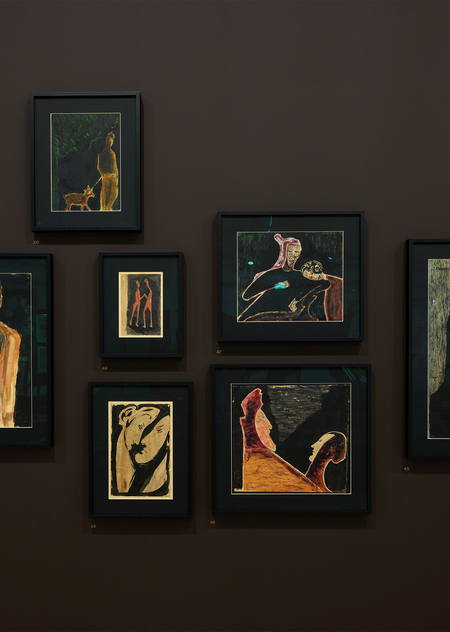
Rabindranath Tagore. «Untitled (A Couple Looking at Each Other)» (excerpt), c. 1929–1930
Image Source: GS-2 Press Service
But why does the exhibition feel so timely?
Rabindranath Tagore—a poet, composer, artist, and philosopher—became the first non-European recipient of the Nobel Prize in Literature; in 1913, he received the award for his collection, «Gitanjali» («Sacred Songs»). Later, his poetry formed the basis of the national anthems of India and Bangladesh.At first glance, the exhibition at GES-2 focuses less on the sheer magnitude of Rabindranath Tagore’s personality and more on his ideas. It is no wonder that the space contains hardly any photographs of the thinker or a timeline of his life: it seems the curators decided that his spirit should linger here, rather than reciting a dry biography.Yet, the viewer still wishes to see a «living» Tagore—to meet his family, view university photographs, and understand the context in which he was formed. The subject of the exhibition was born into a family of Bengali reformers, studied in India and Britain, and spent his life searching for points of convergence between cultures. For him, art, education, science, and everyday life were a unified system.
Left: Portrait of Rabindranath Tagore / Right: Title page of the English edition of «Gitanjali» from 1913
Image sources: Wikipedia
Tagore consistently opposed the notion of culture as a closed world—he traveled, gave lectures, and participated in international discussions. In 1930, he visited the USSR, exhibited his paintings at the Museum of New Western Art, and closely studied the Soviet education system.It was his travels and his work with the rural communities of Shantiniketan that led Tagore to the belief that openness to the world is not an abstract ideal, but a necessary condition for societal development. The university he founded criticized the colonial model of education and emphasized multifaceted development: students, regardless of their faculty, studied crafts, arts, sciences, agriculture, and traditions—and they showed genuine interest in other cultures. This pedagogical experiment vividly demonstrated that collective creativity and collaborative work genuinely yield results. Today, Tagore’s ideas are more relevant than ever, reaffirming their vitality.
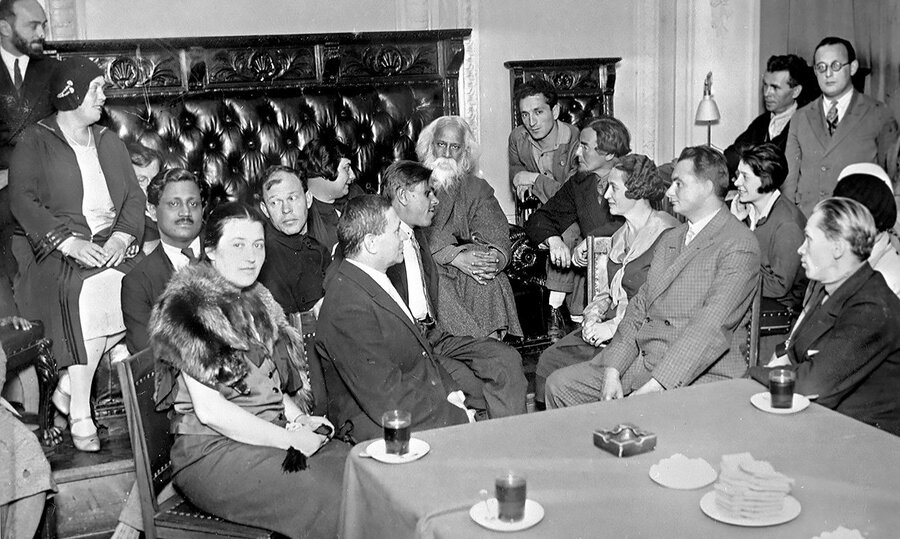
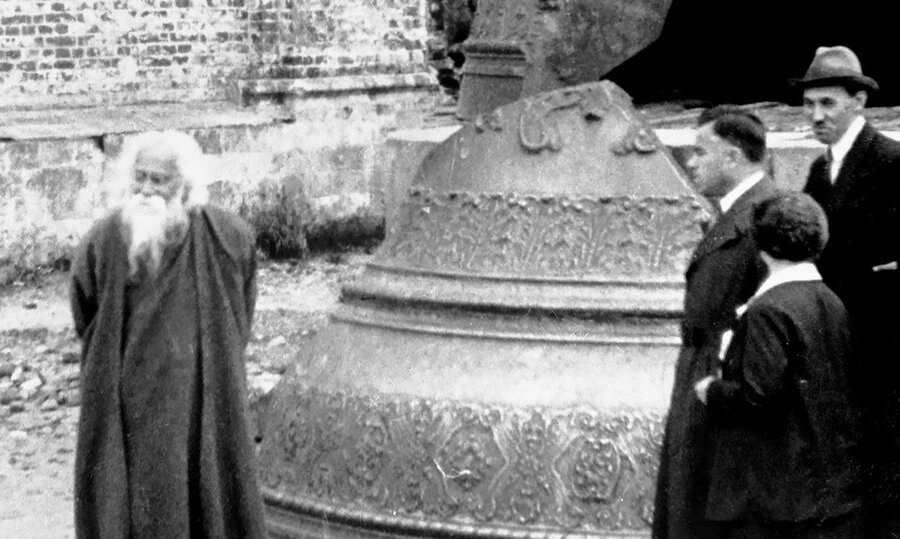
Rabindranath Tagore during his trip to the USSR in 1930
Image Source: The Art Newspaper Russia
Shall we take a walk through the exhibition?
Curatorial text, the participant list, and simplified readings—all of this waits by the coat check, behind the transparent wall of the main hall. It seems the organizers deliberately separated the conceptual framework from the multisensory space—or perhaps it’s just quieter in this area, and the hall behind the glass already draws you in with its atmosphere. My gaze keeps drifting to the reflections on the glass—and then onward, to the exhibition. I want to get in there quickly: the constructions, the projections, the objects—everything intrigued me. But I still want to read it through: because the entire narrative of the exhibition is built upon its historical and cultural context.The hall is cool, but pleasant. There are many warm tones—white, ochre, terracotta, dark brown; everything is natural, earthy. Indian chants can be heard, mantras, and poems by Tagore himself: these are the sounds from the film «Soil Horizon O» (2018) by The Otolith Group, which we will return to later. The audiovisual environment is so dense that the visitor involuntarily settles into a meditative state.
Exhibition view. Centerpiece installation: Liza Neklessa. «Branches of Poetry, Space of Image, ” 2025. Installation, fabric, paper, ink, watercolor, Oracle.
Image source: GES-2 Press Service (photo: Daniil Annenkov)
The only thing perhaps missing from this picture is scents and tastes. But incense and altars for the deities—that’s a direct route to exoticism and cranberry, so their absence is a deliberate choice. Still, the nose waits for something to delight it, and the eyes dart around: next to Tagore, there are works by contemporary artists, and all of this is quite a surprise. Where to go? What to see first? The easiest thing is to follow your instincts and then consult the brochure with the map and exhibition themes: it helps structure your route and lets you read more about the exposition’s motifs.
Rabindranath Tagore. Untitled («Forest Thicket») — fragment, 1935. Paper, gouache, colored ink.
Image Source: GES-2 Press Service
Speaking of the route. It turns out the exhibition occupies less than half of Gallery C2. A small space was allocated for the Tagore figure, and why this happened—we can only guess: perhaps they were unable to coordinate the transport of a larger number of exhibits, or perhaps the curators decided on it themselves. The grey curtain at the end of the exhibition area hints at promises of more rooms, but behind it is just an empty space stacked with art boxes. And yet, that is exactly where a separate section could have fit—detailing the biographies, history, and background of the school and the university—something the exhibition currently lacks. All this time, our imagination envisioned a comprehensive, four-hour blockbuster exhibition, but in reality, it turned out modest, though, we must admit, it is cozy—making it a perfect spot for a leisurely, meditative stroll.
The architectural space is organized around «islands”—terracotta wooden structures that highlight specific works and themes. The viewer experiences themselves as a boat floating along the Ganges among rocky shores—though in reality, the curators are referencing the tradition of outdoor university lessons held on stone benches beneath the sprawling canopies of the campus trees. In places, the space is punctuated by suspended installations; in others, it is moderated by shaped tables, display cases, and mobile walls; and elsewhere, massive installations rise up, inviting the viewer to immerse themselves in the values of the „Vishva-Bharati“ university.
If you view the exhibition as a whole, without delving into the details or the connections between the themes, it is perceived as a single, cohesive work (we are not referring here to gaps or the absence of biographical or chronological elements). There is no prescribed route, no signage indicating sections, and no strict viewing boundaries—the structure is holistic, which is characteristic of traditional Indian philosophies. The approach to the project reflects a view of the Universe as a single, living organism in which everything is interconnected, rather than a mechanical aggregation of disparate elements. Teachings such as Advaita Vedanta speak to the principle of «the all-in-all”—the soul and the Absolute are inseparable, and human existence is not separate from the world; rather, the person is a part of it. The exhibition follows this same logic.
Rabindranath Tagore with his works
Image source: Pinterest / Blogspot
Naturally, the viewer is free to choose their own perspective and viewing trajectory—to perceive everything at once or to examine it in segments that ultimately converge on a single point: that point being the university and Tagore’s social philosophy.
For convenience, you might proceed as follows: first, Tagore’s paintings, followed by a small archival exhibition about his 1930s exhibition in the USSR (curated by researcher Alexey Petukhov). The archival section is quite small, though, and it’s easy to walk past without noticing it, which is a shame—the subject matter there is genuinely interesting.
Next, we turn to the themes: «Nature,» «Agriculture,» «Multifacetedness,» «Pedagogy,» «Collective Creativity,» and «Internationalism.» Many of the exhibition participants fit into several themes—they are all conceptually interconnected.
Rabindranath Tagore. Untitled («Bird»), c. 1935–1936. Paper, watercolor, gouache / Rabindranath Tagore. Untitled («Mask: man with a goatee…»), c. 1930–1931. Paper, colored ink
Image Source: Press Service of GS-2
On two opposing walls, partially painted a dark color, is Tagore’s painting from the Rabindra Bhavan museum at Visva-Bharati University. The display is thematic: to the right of the entrance are «Landscapes | Flowers, ” „Animals | Chimeras | Ornaments, ” „Masks | Faces, ” and „Portraits | Figures“; to the left are „Figures | Movements“ and „Motifs | Moments.“ The presentation is almost „bibliographic, ” but it effectively demonstrates „contextual modernism”—the term the Indian art historian Raman Shiva Kumar used to describe Tagore’s style: the combination of global approaches with local traditions.The paintings envelop the exhibition space. Tagore arrived at this style at age 67 and left behind over 2,500 works. The exhibition features 59 of these works—which show notable references to Impressionism, Art Nouveau, traditional Chinese and Japanese painting, as well as ancient Indian artistic approaches. Spectators constantly gather near these walls, meticulously studying the works.
Exhibition of Paintings by Rabindranath Tagore
Image Source: GS-2 Press Service (photo: Daniil Annenkov)
Formally, the exhibition is educational: it explores Tagore’s ideas and showcases those currently developing his concepts. But as you move deeper into the gallery, you find yourself asking a deeper question—could the exhibition’s central figure, deprived of biography, archives, and historical context, risk becoming merely a specter discussed by others? This is a subtle question of value. It’s a question of emphasis, inflection, and the ethics of interpreting heritage.