1. Media Concept
«Off-Prompt» — a Telegram media outlet dedicated to helping students and novice designers utilize neural networks without losing their unique artistic voice. The concept remains the same as with Homework 1 and Homework 2.
Goal. To help integrate neural networks into the creative process mindfully. To understand at what stage they are useful, when they hinder the process, and how to remain the author of your own work. In six months—300 subscribers without an advertising budget and an ER above 15%.Topic. Using neural networks in studies and a designer’s first commissions without losing one’s unique style.Audience. Core (A) — 1st–2nd Year Design Students; character Anna. In order of priority: senior students and graduates (B, Dima), beginner freelancers (C, Katya), and professionals transitioning into design from other fields (D, Olga).
Unique Selling Proposition (USP). In «Off-Prompt, ” a student designer tests neural networks on real academic assignments, openly presenting the results: its cost, whether a VPN is necessary, and where the AI hindered the process.Channels and Rhythm. The primary channel is Telegram, with two posts per week. Additionally, we use VK Clips for short videos and Pinterest for mood boards showcasing results.Segments. Segments include „Prompt of the Week, ” „Before/After, ” „Project Analysis, ” „Works Without VPN, ” „Can This Be Submitted? , ” and a monthly livestream called „Conversation, ” along with clips.For this assignment, one feature of the concept is vital: the media itself narrates how to work with AI, so it honestly divides the labor between human and machine within its own workflow. The author is always responsible for the opinions, conclusions, and final text.
2. Data Sources for Media
In media, there are nine sources of data. The main ones are our own experiments and subscribers—more than half of our posts originate from these. The others are necessary to monitor pricing, university regulations, and how posts perform.
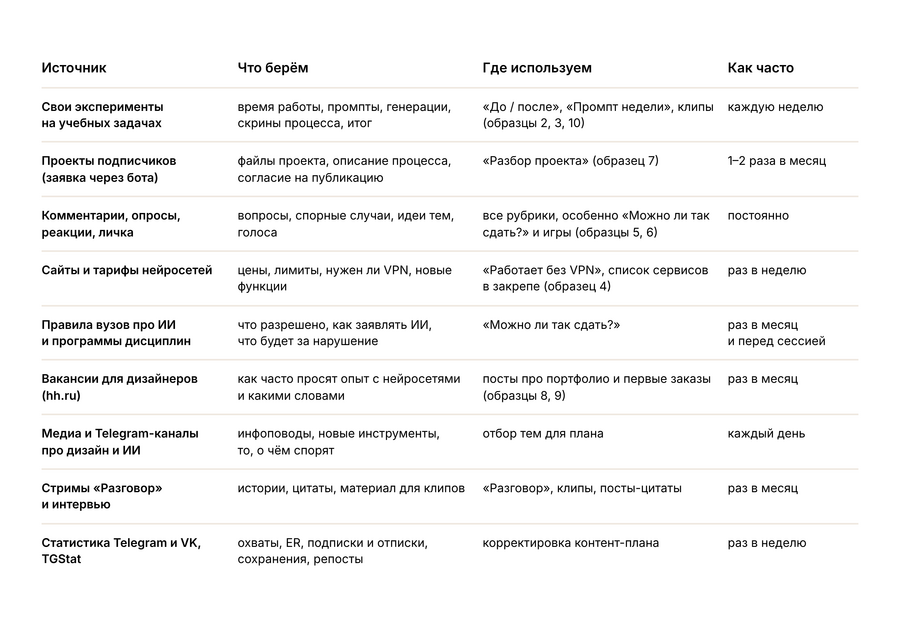
Our first three sources are our own data: experiments, subscriber projects, and their questions. Nobody else has this. We don’t take foreign statistics at face value. Before setting a price or a rule, we verify it on the service’s website, in the university’s document, or in the job posting itself.
3. Data Schema
Every post goes through seven stages. At each stage, the machine performs tasks that can be repeated without judgment: gathering, sorting, decoding, spell-checking, and publishing on schedule. The human makes all the decisions and writes everything the reader perceives as the media’s voice.
The boundary follows one principle: the machine works with data; the human works with meaning. If a step determines what a follower thinks of a neural network, a service, or the university, that step is done by the creator. Therefore, choosing a topic, fact-checking, drawing conclusions, and writing the post text never goes through automation, even if the neural network could handle it faster.There is one exception: in the «Before / After» generation section, the machine creates the post material itself, but the person writes the prompt and evaluates the outcome. Furthermore, the post always indicates where the generation occurred and where the manual work was performed.
Example: a «Before/After» post about a mood board for a coffee shop
This is how Sample 2 from Assignment 2 follows the scheme:
1. Collection. The author creates mood boards for a coffee shop’s brand twice: once manually in 2 hours and 40 minutes, and once with an AI generator in 1 hour and 10 minutes. The author saves the prompts, generations, and board screenshots.2. Selection. According to the content plan, one week is dedicated to the «Before / After» segment. The AI shows which questions regarding mood boards and references were most frequently seen in the comments.3. Preparation. The author compares the two mood boards and formulates the post’s central idea: the AI helps eliminate the superfluous, rather than selecting the final outcome.4. Creation. The AI generates the images for comparison. The text and the carousel of 6 images with red annotations are created by the author. The captions and the vertical version for the «Mood Board in 60 Seconds» clip (Sample 10) are prepared by the AI.5. Review. A proofreader corrects typos and inserts non-breaking spaces; the author proofreads the entire post.6. Publication. The post goes live according to the schedule; the author responds to comments and the «With AI or Without» poll.7. Analytics. The report shows reach, saves, and the voting results. The author decides whether to repeat the format and what to feature in the next «Before / After.»
4. Guidelines for Automated Services
Automation in «Not by Prompt» performs preliminary work but does not solve anything on its own. Below are six general rules and rules specific to each service in the diagram.
General Rules
1. Opinion and Text — Author Only. The machine does not write conclusions, grades, or the final text of the post. Its drafts are not included verbatim in the post.2. Every Number is from the Primary Source. For any price, limit, deadline, or rule the machine finds, the author opens the service or university website and verifies it personally.3. Personal Data Does Not Enter Neural Networks. Names, usernames, and contacts are removed from comments and applications before processing.4. All Machine-Generated Content is Labeled. Every result includes a date, a link to the source, and a «draft» tag. The generation in the posts is annotated with which service and what prompt was used.5. One Input—One Output. The service has one task and a consistent result format, making it easy to check and compare against the previous week.6. Media Functions Without Automation. Any service can be disabled, and the step can be completed manually. If a service makes two consecutive errors, the author reviews its settings or removes it from the workflow.
Rules for Each Service
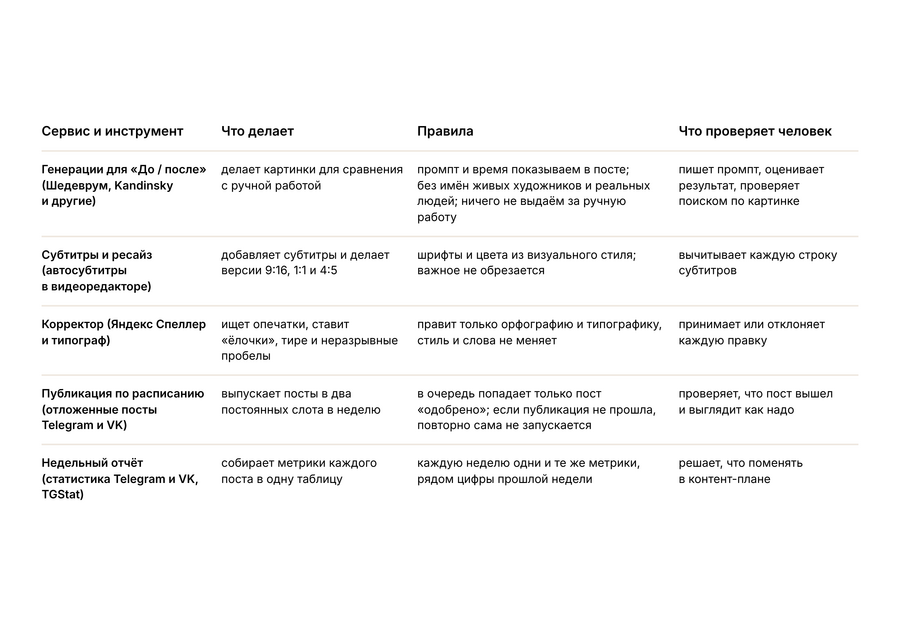
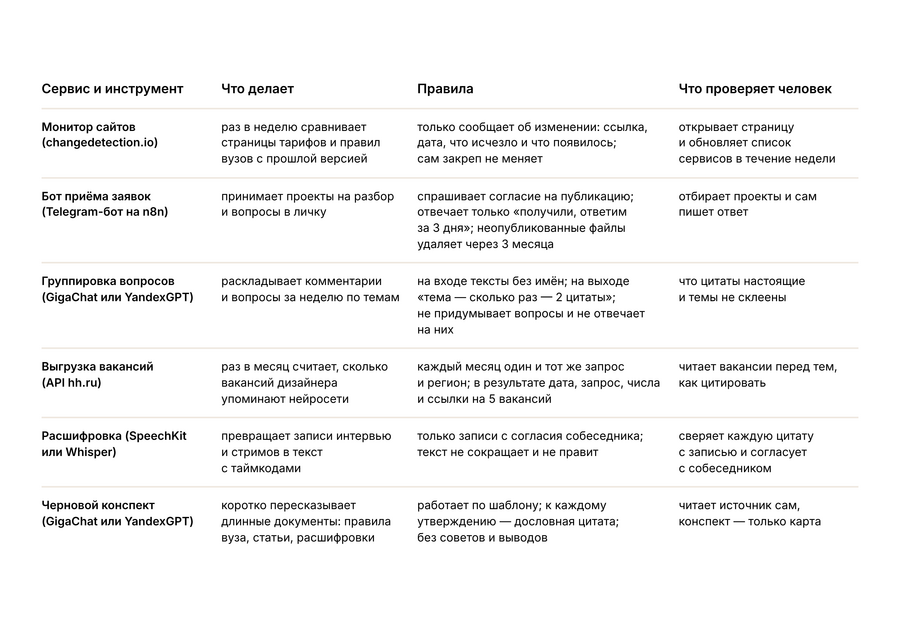
Draft Notes Request Template Here is how the rule «the machine works with data» looks in practice:
You are an editor’s assistant. Before you is a document: [title and link]. Extract up to 7 facts important for a design student. For each fact, add a verbatim quote from the document. Do not offer advice, evaluations, or conclusions. Do not add anything that is not in the text. If you do not understand something, write «unclear» and indicate the location. Format: fact — quote — document section.