Concept
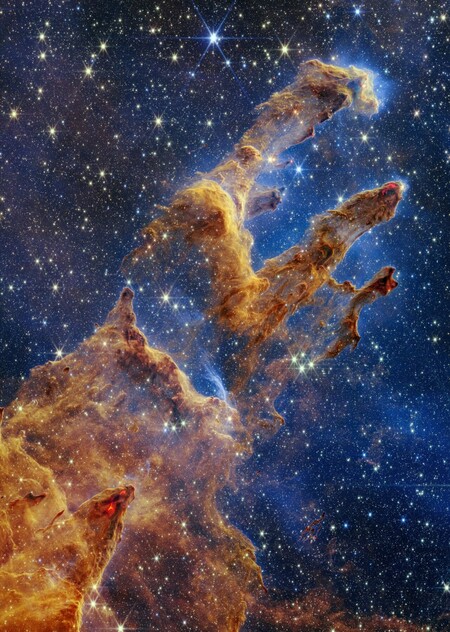
Since 2022, the James Webb Telescope has been regularly releasing new images, and with the admiration for these images comes the constant question: are these colors «real»? This debate is fundamentally aesthetic—it concerns what we experience when viewing a processed image. Immanuel Kant, when discussing the sublime, also referenced telescopes and distant galaxies, which were then called nebulous stars [1, pp. 120, 126]. E. Kessler already described the resemblance between Hubble’s images and Romantic landscape painting, but she understands the sublime broadly, as in the language of the Romantic era [2]. The novelty of this work is that the images—including those from Webb—are examined through rigorous Kantian distinctions, and documentary images are juxtaposed with computer graphics. The research tests whether the concept of the sublime can be applied to technologically created imagery and demonstrates which visualization techniques support it and which undermine it.
Key Question: Can a processed image of space evoke the sublime in the Kantian sense, and what role do the principles of the beautiful play in this?
At first glance, Kant answers negatively: the sublime, for him, is incompatible with attractiveness [1, p. 114]. However, he does admit that in art, the depiction of the sublime can be connected to beauty [1, p. 199].
Hypothesis: In the case of space, the sublime cannot be experienced without the principles of the beautiful. Since the naked eye cannot perceive most cosmic objects, processing provides a form through which the imagination grasps the subject and then confronts its boundlessness. The processing has a measure—its convincingness. When an image is perceived as computer graphics, the feeling of the sublime vanishes, much like how, for Kant, interest in the nightingale’s song disappears if it is revealed that a hidden human is singing [1, p. 175].
The visual material includes Romantic paintings and photography from the 19th century, unedited images of space, documentary photographs from the NASA, ESA, and STScI archives (Hubble and Webb), as well as artistic illustrations and computer visualizations serving as a control group. Widely recognized images and objects with multiple versions are selected.
The sections follow the progression of the hypothesis: from earthly sublime to space without mediation, then to the principles of the beautiful, to the breakthrough of the infinite, and finally to the measure of processing.
1. Proper Distance: The Sublime in Romantic Landscape 2. Cosmos Without Intermediaries 3. Devices of the Beautiful: Frame, Horizon, Landmark, Name 4. Devices of the Beautiful: Color and Light 5. From Form to the Infinite 6. Scale of Execution: Document and Computer Graphics 7. Conclusion
The principle for selecting textual sources is as follows. The theoretical foundation of the work is «Critique of Judgment» [1]. The monograph by E. Kesseler [2] serves as a basis for comparing images with 19th-century landscapes. The article by V. V. Bychkov [4] introduces the perspective of the Romantics themselves: C. D. Friedrich saw the painting as an intermediary between nature and humanity and rejected the illusion that supplanted nature [4, p. 205]. Evidence from STScI handlers [3] is necessary to accurately describe the technology. Kant’s propositions are not accepted as a ready-made answer but are tested against the visual sequence.
1. Proper Distance: The Sublime in the Romantic Landscape
Long before space telescopes, the visual language of the sublime was established in landscape. According to Kant, the sublime resides not in the object itself, but in the soul, yet the object must be presented in a way that allows the imagination to attempt to encompass it entirely [1, p. 115, 121–122]. Nineteenth-century artists and photographers solved this challenge through formal means: the choice of viewpoint, a small figure for scale, fog, or light. Thus, even earthly sublime in art passes through beauty, which Kant directly allows [1, p. 199]. This section sets the grammar of the sublime against which subsequent images of space will be compared.
Fig. 1. Giza Pyramids, southwest view, 1858 / Francis Frith
Kant explains the condition of the sublime through the story of General Savary: one cannot approach the pyramids too closely, nor one retreat too far [1, pp. 121–122]. Fritz’s photograph was taken from a vantage point where the pyramids fit entirely within the field of view. This is the correct distance in a literal sense—the condition under which the senses can fully encompass the object.
Fig. 2. Wanderer above the Sea of Fog, c. 1817–1818 / Caspar David Friedrich
A figure turned with its back to the viewer gives the viewer a space within the painting—we look into the expanse over the traveler’s shoulder. The fog conceals the distances and makes the far realm immeasurable. Friedrich himself wrote that the landscape in the fog seems wider and more sublime, drawing the imagination more strongly [4, p. 208].
Fig. 3. Monk by the Sea, 1808–1810 / Caspar David Friedrich
A tiny figure of a monk is almost lost between the strip of shore, the dark sea, and the vast sky. Kant suggests viewing the ocean as poets do—seeing only what meets the eye [1, p. 141]. Yet, even this nearly empty canvas is structured: a low horizon and a measuring figure transform the boundless into an image that the eye can encompass.
Ill. 4. Snowstorm: Hannibal and his army cross the Alps, 1812 / J.M.W. Turner
This is an example of the dynamically sublime: the power of nature, before which humanity is insignificant. Kant writes that thunderclouds and hurricanes attract us more intensely the more terrifying they appear, provided we are safe [1, p. 131]. Turner reduces the general to a barely visible figure on an elephant, while the vortex of clouds pulls the viewer’s gaze deep into the painting.
Fig. 5. Among the Sierra Nevadas, California, 1868 / Albert Bierstadt
The painting was not created on location, but in a European studio for studies, and depicts a composed view rather than one that was simply seen. Light breaks through the clouds, highlighting the peaks, the waterfall, and the lake, much like a scene on a theater stage. Bierstadt presented his canvases as a performance—in a darkened hall, behind a curtain.
Fig. 6. Yellowstone Grand Canyon, 1872 / Thomas Moran
Moran sketched the canyon from multiple vantage points during Frederick Hayden’s 1871 expedition and combined them into a single painting. The U.S. Congress purchased it in 1872, the same year Yellowstone National Park was established. It is with these Western American landscapes that E. Kessler compares the images from the Hubble [2].
Ill. 7. Mount St. Croix, 1873 / William Henry Jackson
Jackson’s photograph, taken during the same official territorial survey, speaks the same language of the sublime but carries a different status: it is a document. The snow cross on the slope struck viewers precisely because the camera captured it, not because an artist invented it. The question of how documentarity influences experience will be revisited in Section 6.
2. Unmediated Space
Unlike a mountain or the ocean, most celestial objects cannot be viewed simply by standing in the right spot. The eye perceives the starry expanse, but nebulae and galaxies are barely discernible as faint smudges, and infrared light is not visible at all. Kant describes two ways one might fail to see the pyramids: from a distance, parts merge together; up close, the imagination cannot connect them into a whole [1, pp. 121–122]. This section demonstrates that space, untreated, appears either as a blot or as noise to the imagination. The images are arranged in the order that more and more technology comes between the eye and the object.
Fig. 8. The Milky Way over the Paranal Observatory, 2015 / ESO, A. Gitti Piazza
This is closest to what Kant calls the starry heavens—an enormous, all-encompassing vault [1, p. 141]. The sky inherently evokes the sublime, but any individual object within it is indiscernible: this nebula is merely a bright smudge among thousands of stars. Even this photograph, captured with a long exposure, reveals more than the naked eye can see.
Fig. 9. Sketch of the M51 Nebula (Whirlpool), 1845 / William Parsons, Lord Rosse
In 1845, Lord Ross first discerned a spiral structure in the nebula using his massive telescope. Photography of such objects was not yet possible, and the observer’s hand was the sole intermediary between the telescope and the viewer. Here, the object’s form emerges in the image: the drawing depicts what the eye was able to capture.
Fig. 10. Andromeda Nebula, December 29, 1888 / Isaac Roberts