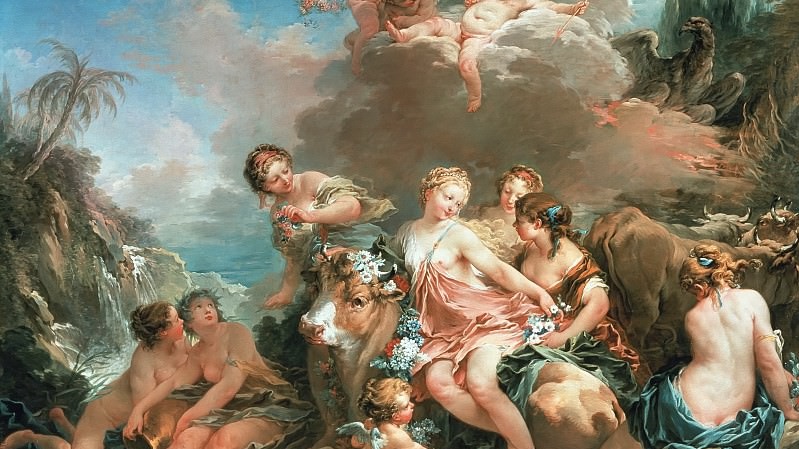
The myth of Europa’s abduction, narrated in Ovid’s Metamorphoses, remained one of the most sought-after subjects in Western European painting for many years. Each era offered its own visual interpretation of this event.
This study is dedicated to analyzing eight paintings from the 16th to 18th centuries to trace how the styles of the works, compositional decisions, and the psychological interpretation of the mythological imagery evolved. The research hypothesis posits that the evolution of the image of the «Abduction of Europa» reflects the trajectory of European painting.
Chapter 1
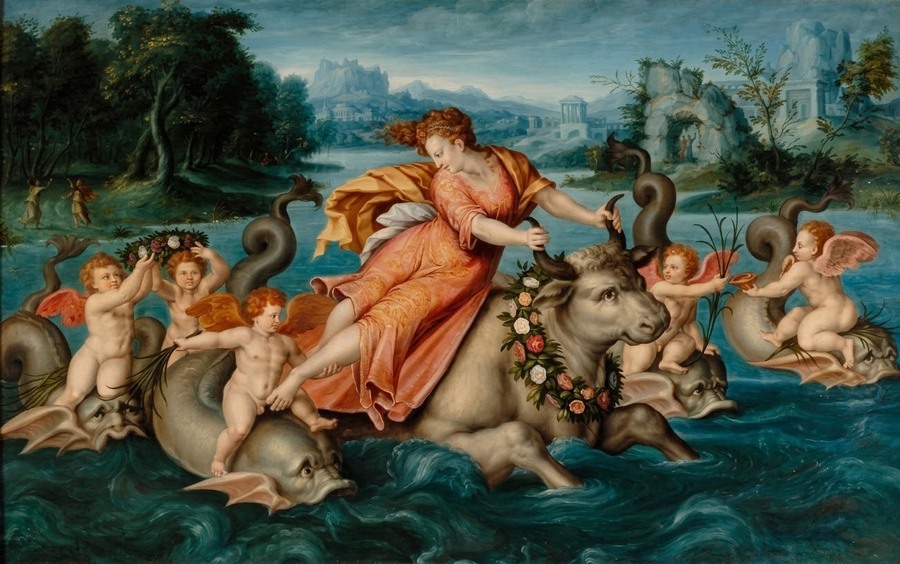
Jean Cousin Jr. «The Abduction of Europe»
Jean Cousin the Younger’s painting represents an early stage in the interpretation of the myth, a narrative to which researchers apply terms such as «romantic» or «idyllic.» The scene is devoid of aggression. Europe is clad in a garment that entirely covers her figure, and her posture and gestures suggest a willing escape rather than a violent abduction. She neither resists nor attempts to dismount the bull.
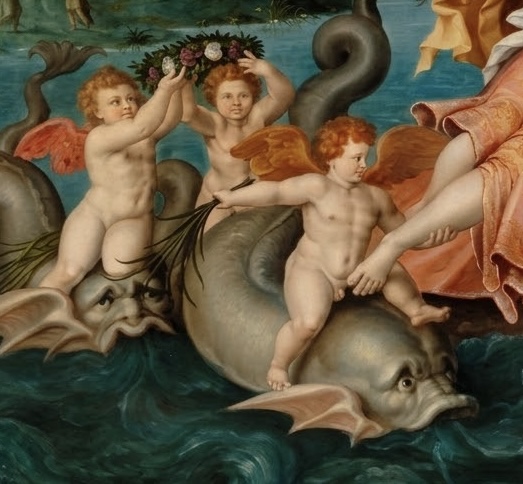
Jean Cousin Jr. «The Abduction of Europe» (excerpt)
The composition is structured in the frieze style. The figures are arranged on a single plane, and the space of the sea and the shore is distinctly delineated. The bull here appears calm and almost toy-like, adorned with garlands of flowers. Around Europe, putti frolic on dolphins, lending the scene a light character typical of the Renaissance. This work conveys not drama, but the allegory of love and journey, where the mythological undertones are softened by courtly aesthetics.
Jean Cousin Jr. «The Kidnapping of Europe» (Fragment)
Chapter 2
Titian, «The Rape of Europa»
Titian, in his «Rape of Europa, ” painted for Philip II of Spain, radically alters the rhythm. The painting, which is now housed in the Isabella Stewart Gardner Museum, marks a transition toward a dramatic and sensual interpretation.
Titian, «The Rape of Europa» (Fragment)
In Titian’s composition, he discards the static frieze. Instead, he utilizes a diagonal defined by the body of Europe, who is depicted semi-reclining on the back of a bull. Her white gown is lowered, exposing her chest and legs, while the billowing red cloak creates a sensation of rapid movement and anxiety. Europe is shown in a moment of despair. She turns back toward the shore, waving the red fabric as if calling for help.
Titian, «The Rape of Europa» (Fragment)
The Bull by Titian is no longer a toy animal, but a potent force. It stares directly at the viewer, and its muzzle is adorned with a wreath. The water beneath it churns and froths, emphasizing the speed of its movement. The landscape, with its mountains and figures on the shore, creates a contrast between the serenity of the past and the horror of the present. Titian, unlike Cousin, eroticizes the scene, presenting Europe as an object of desire, and the abduction itself—as an act of violence masked as myth.
Titian, «The Rape of Europa» (fragment)
Chapter 3
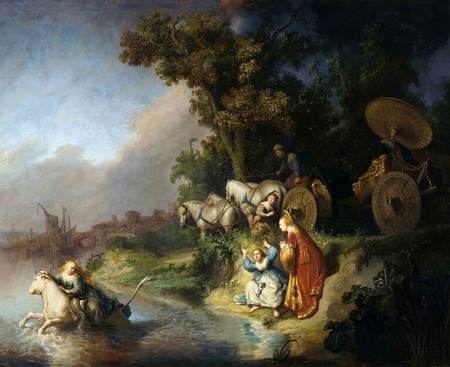
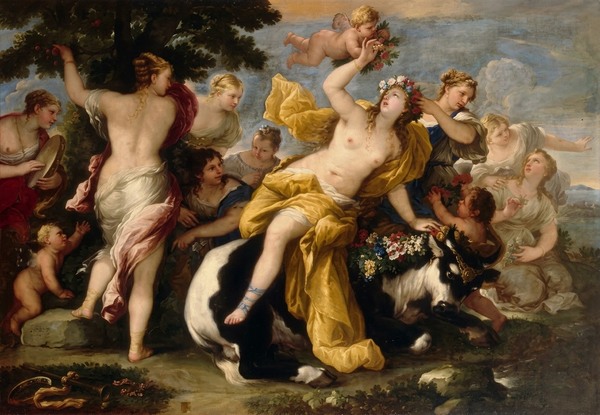
Right: Rembrandt Harmenszoon van Rijn, «The Rape of Europa»; left: Luca Giordano, «The Rape of Europa»
Rembrandt’s version offers a completely different approach. This is a rare mythological subject for the artist, which he interprets through dramatic gesture and visual effects. The action is set on the shore: Europe in a red dress has already climbed onto the white bull as it enters the water. Her posture expresses fear as she turns toward her companions, one of whom falls to the ground in horror.
Rembrandt Harmenszoon van Rijn, «The Rape of Europa» (Fragment)
Rembrandt «modernizes» the myth—in the background, we see a carriage, horses, and a port city that resembles not ancient Tyre, but modern Amsterdam to the artist. Light and darkness play a key role—a beam of light highlights the figures of Europe and the bull, while the background is steeped in an uneasy semi-darkness. This lends the scene psychological depth and a sense of impending catastrophe.
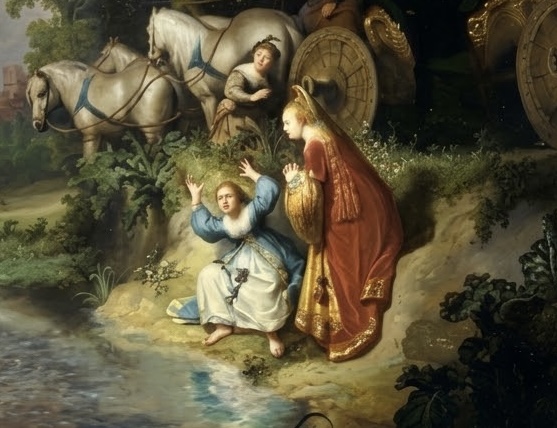
Рембрандт Харменсон ван Рейн «Похищение Европы» (фрагмент)
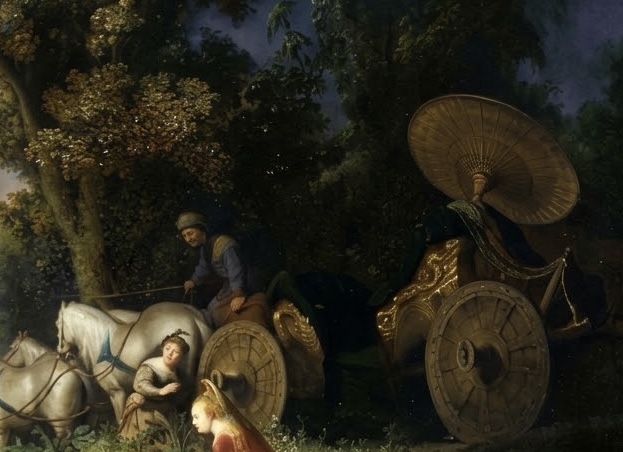
Рембрандт Харменсон ван Рейн «Похищение Европы» (фрагмент)
Luca Giordano pushes Baroque sensuality to its limits. His composition is a theatrical event, full of dynamism and vibrant colors. Europe, nude, sits on a bull surrounded by friends who help her decorate the animal with flowers.
Luca Giordano, «The Abduction of Europe» (Fragment)
Unlike Titian, there is no sense of violence here. The scene more closely resembles a celebration, where the abduction will begin in a second, but for now, it looks like a game. Giordano, nicknamed «Luca fa presto» (Luca the Quick), creates a sense of lightness and festivity, making his interpretation transitional toward Rococo aesthetics.
Luca Giordano, «The Abduction of Europa» (Fragment)
Chapter 4
Guido Reni, «The Rape of Europa»
Guido Reni, in his work, offers an antithesis to Baroque dynamism. The painting belongs to the late period of the artist’s work, which art historians call the «ultima maniera.»