This project is an academic assignment from a student at the HSE Art and Design School or a research project by a faculty member at the School. This project is non-commercial and serves educational purposes.
Visual Evolution and the Poetics of Space in Soviet Landscape Painting
Research Concept
This visual study is dedicated to analyzing the evolution of visual language and spatial strategies in Soviet landscape painting. Unlike traditional historical approaches, this work focuses on the internal mechanics of the painted image: how, through the interplay of light, color, and composition, artists created new forms of perceiving reality. The relevance of this research stems from the necessity to understand how the landscape genre transformed—under strict ideological constraints—from a tool for idealized reflection of nature into a space for profound philosophical self-expression.The research methodology is based on a comprehensive visual analysis of key works by Soviet masters. The study traces a fundamental shift in artistic perspectives: from the epic, impressionistic perception of vast space (exemplified by the early works of Konstantin Korovin) to the intimate, chamber-like experience of the light-air environment (Nikolai Krymov, Isaak Levitan). Special attention is paid to the late period, where there is a radical departure from external color expression in favor of «non-colors» and metaphysical silence (Vladimir Veysberg). The paper details how techniques for constructing perspective changed, how the color palette transformed, and how light became the primary dramatic element of the painting. The research demonstrates that the evolution of the Soviet landscape is not merely a shift in stylistic devices, but a deep psychological transition from the collective contemplation of the macrocosm to the individual immersion in the microcosm of human existence, where painting attained absolute inner freedom.
Navigation
- Space and Light: From Impressionism to Intimacy
1.1 Visual Language of Early Landscape Painting (K. Korovin)
1.2 Transformation of the Light and Air Environment
1.3 Transition to Intimate Space (N. Krymov)
- Artwork Analysis: «Winter Evening» by N. Krymov
2.1 Physics of Light and Geometry of Shadows
2.2 Color Contrast as Dramaturgy
- Autumnal Motifs: Painting as Nostalgia
3.1 The Canon of the «Mood Landscape» (I. Levitan)
3.2 Evolution of the Autumnal Palette in the Soviet Period
- Spring Waters: Dynamics and Reflections
4.1 Movement and Air Transparency
4.2 The Effect of Reflection and Space Multiplication
- Summer Stasis and Geometry
5.1 Midday Light and Compositional Rigor
5.2 Abandonment of Color in Late Work (V. Weissberg)
- Conclusion: Landscape as a Space of Freedom
Space and Light: From Impressionism to Intimacy
1.1 Visual Language of Early Landscape Painting (K. Korovin)
Konstantin Alexeyevich Korovin. «Paris. Café de la Paix.» 1906. State Tretyakov Gallery, Moscow.
In Konstantin Korovin’s early works, we observe the triumph of an Impressionist vision. The artist rejects academic detail in favor of conveying an instantaneous impression. The space in his canvases appears limitless, filled with vibrant air. The painterly surface is created through quick, impasto strokes that describe not so much form as they sculpt light. Color here is maximally saturated; it conveys not merely the local hue of objects, but the artist’s emotional state—his rapture before the energy and scale of the surrounding world.
1.2 Transformation of the Luminous Environment
Konstantin Alekseevich Korovin. «Still Life with Portrait of V.V. Pertsova.» 1916. State Tretyakov Gallery, Moscow.
Analyzing the light and air environment in the works from this period, it is important to note that light becomes an independent protagonist in the painting. It does not merely illuminate objects; rather, it shapes the space, blurring the boundaries between sky and earth. Shadows cease to be purely black—they become infused with color—blue, violet, green. This visual technique allows artists to convey the dynamics of time and the mutability of nature, creating a sensation of the viewer’s immediate presence within the landscape.
1.3 Transition to Intimate Space (N. Krymov)
Nikolai Krymov, «Landscape»
In the postwar period, there is a radical shift in artistic perspective. The epic grandeur and impressionistic vibrancy are replaced by restraint and intimacy. The artist’s gaze seems to draw closer to the earth, focusing on quiet corners of nature—village courtyards, birches by the river, wooden huts. Composition becomes stricter, and the color palette becomes reserved and precisely chosen. Painting acquires an intimacy, concentrating on the value of private space and the philosophical contemplation of everyday life.
2. Artwork Analysis: «Winter Evening» by N. Krymov
2.1 Optics of Light and Geometry of Shadows
Nikolai Krymov, «Winter Evening»
Nikolai Krymov’s painting, «Winter Evening,» is an outstanding example of visual precision and mastery in depicting the physics of light. On the canvas, we see the low winter sun casting long, intense blue shadows onto the snow. The composition itself is built around the geometry of these shadows, which establish a rigorous linear rhythm. The snow here is not merely white—it consists of complex hues of blue, lilac, and pearl. This is not simply a landscape depiction, but a visual investigation into the nature of light under wintry atmospheric conditions, where every object—tree, hut, fence—acquires an almost sculptural monumentality.
2.2 Color Contrast as Dramaturgy
Nikolai Krymov, «Winter Evening» (canvas, oil, 1933, State Russian Museum).
Visual analysis of the painting’s color scheme reveals a masterful use of contrast between warm and cool tones. The warm, golden glint on the wooden cottages sharply contrasts with the cold, deep blue of the snow. This contrast not only creates a powerful illusion of heat and cold but also shapes the painting’s dramatic narrative. Light acts here as an active force battling encroaching darkness, forging a sense of absolute, crystalline peace and harmony.
3. Autumnal Motifs: Painting as Nostalgia
3.1 The Canon of the «Mood Landscape» (I. Levitan)
Isaac Levitan, «Golden Autumn» (canvas, oil, 1895, Tretyakov Gallery)
Isaac Levitan’s creativity established the canon of the «mood landscape,» which became fundamental to the entire subsequent tradition. In the work «Golden Autumn, ” we see how nature becomes a mirror to the human soul. Yellow foliage, blue water, dark tree trunks—every element of the painting is imbued with deep lyricism. The painting of autumn here is not merely a documentation of seasonal changes, but a visual meditation on the fleeting nature of time, the beauty of decay, and the quiet melancholy of farewell.
3.2 The Evolution of Autumn Palettes During the Soviet Period
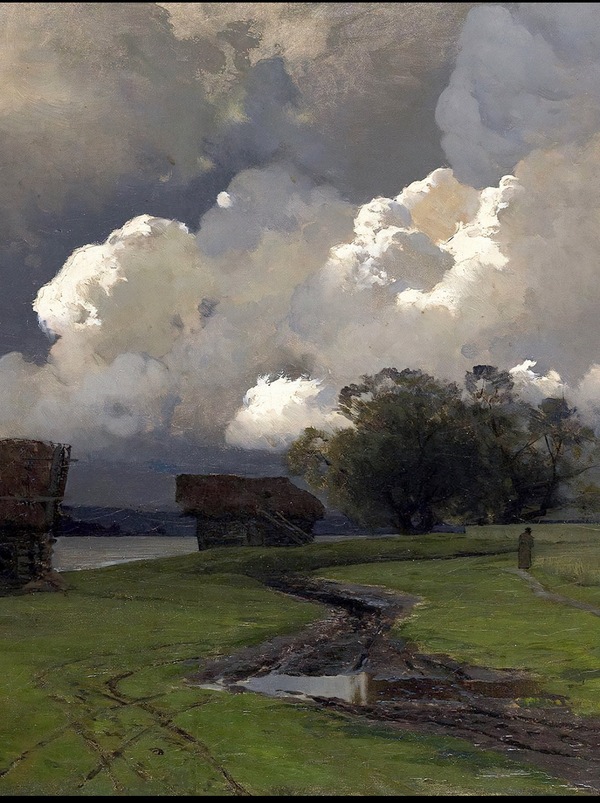
Isaac Levitan, «Before the Storm»
During the Soviet period, the autumn landscape undergoes a visual evolution. While early works featured rich orange and red hues that celebrated color, later pieces saw artists shift toward restrained, complex tones of brown, ochre, and gray. This change in palette reflects a profound psychological transition—from external appreciation of beauty to an internal, philosophical experience. The painting becomes more intimate and contained, focusing less on the external appearance and more on conveying the inner state of nature and humanity.