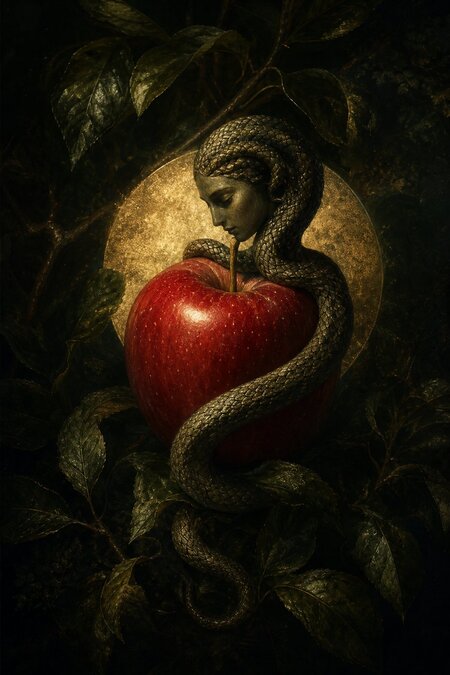
Concept
The apple is perhaps the most recognizable «biblical» fruit in Western visual culture. However, in the Book of Genesis, the fruit from the tree of the knowledge of good and evil is not named specifically; it is designated by the ancient Hebrew word peri—"fruit» generally, any hanging fruit. The fact that the apple became the representation in the public consciousness and in art is not a theological given, but rather the result of a chain of linguistic accidents, artistic choices, and cultural migrations. I am primarily interested in the visual aspect of this process: how the image transformed the nameless fruit into a red apple, and subsequently, through the figure of the tempting serpent, imbued the apple with a devilish aura. This topic connects art history (the Renaissance, Northern Renaissance, Baroque still life) with contemporary mass culture, allowing one to trace the «life» of a single symbol across five centuries.
Key Research Question and Hypothesis
Key Question: How and why did the unnamed biblical fruit in the Western visual tradition first transform into an apple, and subsequently into an attribute of the Devil, an instrument of temptation, and a symbol of death? Hypothesis: The apple became a symbol of the Devil not because of biblical text, but due to the convergence of three factors—(a) the Latin homonym malum («apple» / «evil») in Jerome’s Vulgate; (b) the narrowing of the French word pom/pomme from «fruit» to «apple» in the 12th century, after which Northern European artists began depicting specifically the apple; © the visual politics of the Northern Renaissance (Dürer, Cranach), which cemented the red apple and merged it with the figure of the tempting serpent. Once established as the «forbidden fruit, ” the apple metonymically transferred to the Devil himself and subsequently into the iconography of death (vanitas) and into popular culture, becoming the recognizable „brand“ of the Devil.
Research Goal and Methodology
Goal: To trace in visual materials how and why the unnamed biblical fruit (the fruit of the tree of the knowledge of good and evil) transformed in the Western artistic tradition first into an apple, and subsequently into an established attribute and recognizable visual marker of the devil (temptation, sin, death), and to identify the logic that connects specific images into a unified iconographic line. Method: The work relies on the iconographic method (following Erwin Panofsky: description $\rightarrow$ iconographic identification $\rightarrow$ iconological interpretation) applied to works of fine art. The primary tool is visual analysis of a selected series (composition, attributes, gestures, color, the relationship between the snake and the fruit) compared with historical and linguistic data. The comparative method (Italian vs. Northern European traditions; early and late versions of the narrative) and a historical-cultural approach to interpreting the symbol are used. The source base includes museum catalogs (Prado, Courtauld, Metropolitan Museum of Art, Rijksmuseum), authoritative art historical publications, and the contemporary research by A. Yadin-Israel, which refutes the popular myth about a Latin pun.