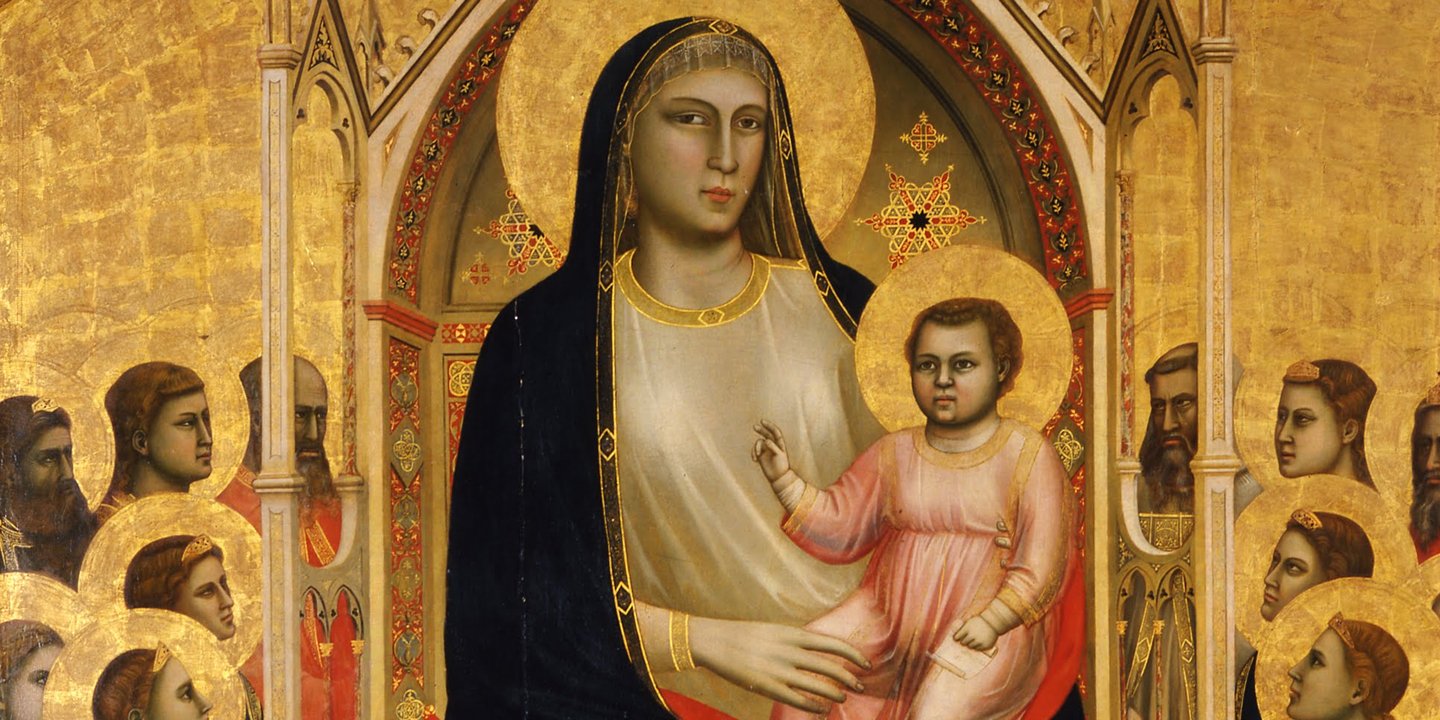
Трансформация изображения божественного пространства в итальянской живописи XIII–XV веков
«Perspective was one of the key tools used by Renaissance artists to depict the natural world, yet it also had another function: it could serve as a means of revealing the heavenly and the divine.» [1]
Between the quote and the concept, there will be a simply aesthetic photo.
1. Concept and Topic Selection
The golden background, mandorla, conventional architecture, and the special use of light ceased to be mere artistic techniques; they became symbols through which concepts of the divine and the eternal were conveyed. Lacking the ability to depict the sacred world directly, artists constructed its visual representation. Concurrently, as painting evolved, the methods of depicting space shifted: artists increasingly engaged with volume, perspective, geometry, and natural light. Thus, the sacred space gradually acquired features of the real, physically tangible world while retaining its symbolic meaning. It is crucial to trace the changes in artistic language and how it reflected the search for new ways to express the interaction between the earthly and the divine, the visible and the invisible.
Research Topics Index
I. Concept and Topic SelectionII. The Golden Ground: Symbolism of Divine Light and Eternity III. The Mandorla: The Visual Representation of the DivineLight and Volume: From Symbolic to Natural Representation An exploration of evolving methods for rendering light, modeling figures, volume, and the materiality of objects.. Architecture and Composition: Shaping Sacred Space 5. Perspective and Geometry: New Principles of Spatial Representation The development of spatial depth and the application of perspective constructions in 15th-century painting. The depiction of thrones, arches, columns, and architectural elements, alongside the evolution of spatial organization principles.Conclusion: The Transformation of Sacred Space in 13th–15th Century Italian Painting A comparative analysis of works from different periods and an examination of how the ways of depicting the divine world changed.
II. Golden Background
The gold ground gained wide popularity in Italian religious painting of the 13th–14th centuries. The Byzantine artistic tradition significantly influenced its development, where gold was used to depict celestial glory and a special, otherworldly space. Unlike landscapes or architectural interiors, the gold ground did not indicate a specific location. It lacked a horizon, depth, and the spatial references familiar to the viewer. Because of this, the depicted scene was perceived not as an event in a specific point of the earthly world, but as a phenomenon existing beyond ordinary time and space.
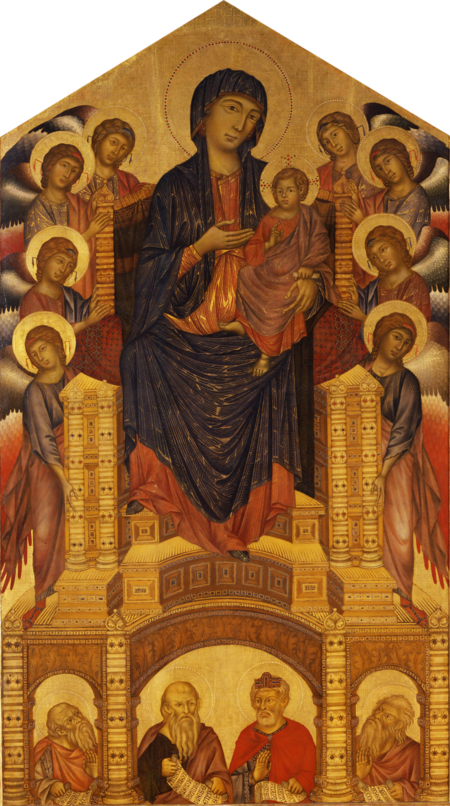
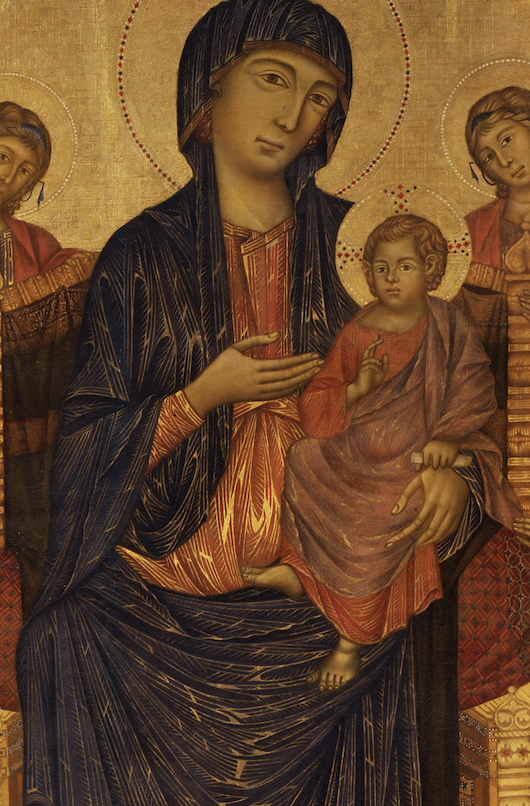
«Maestà di Santa Trinita» (Italian: Maestà di Santa Trinita) is an altarpiece by the Italian artist Cimabue, dating to around 1280–1290.
This is one of the most illustrative examples of the use of a gold background in 13th-century Italian painting. On the painting, the Virgin Mary with the infant Christ sits on a throne, surrounded by angels. The gold surface does not create an illusion of real space but rather emphasizes the solemnity and timeless nature of the scene.
The Symbolic Meaning of Gold The color gold held several important meanings: — Divine light. Gold was associated with the celestial radiance, the glory of God, and the divine presence. — Eternity. Unlike ordinary materials, gold resists corrosion and decay, thus associating it with immortality. — Sacred space. The gold surface separated the depicted characters from everyday reality, transporting them into a special spiritual sphere. — Divine majesty. The precious material underscored the significance and religious status of the depicted scene. Gold, in this context, did not merely imitate a specific sky color; it created the effect of light presence that had no visible source.
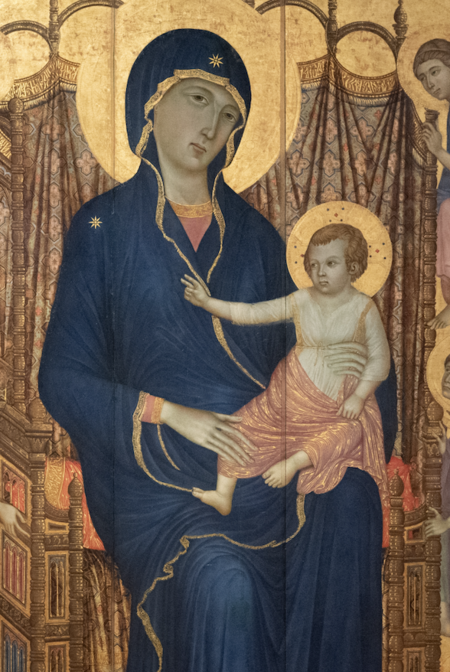
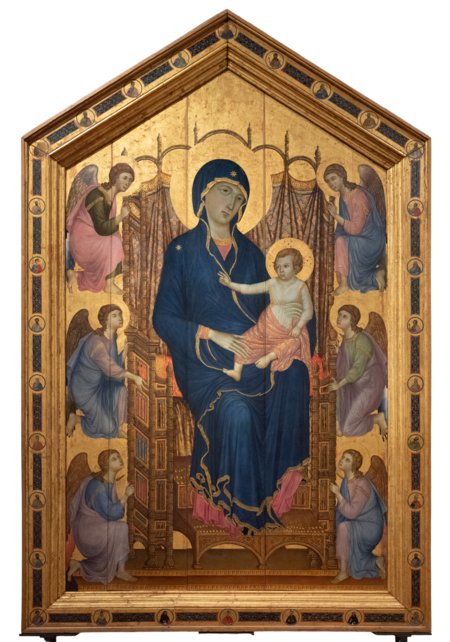
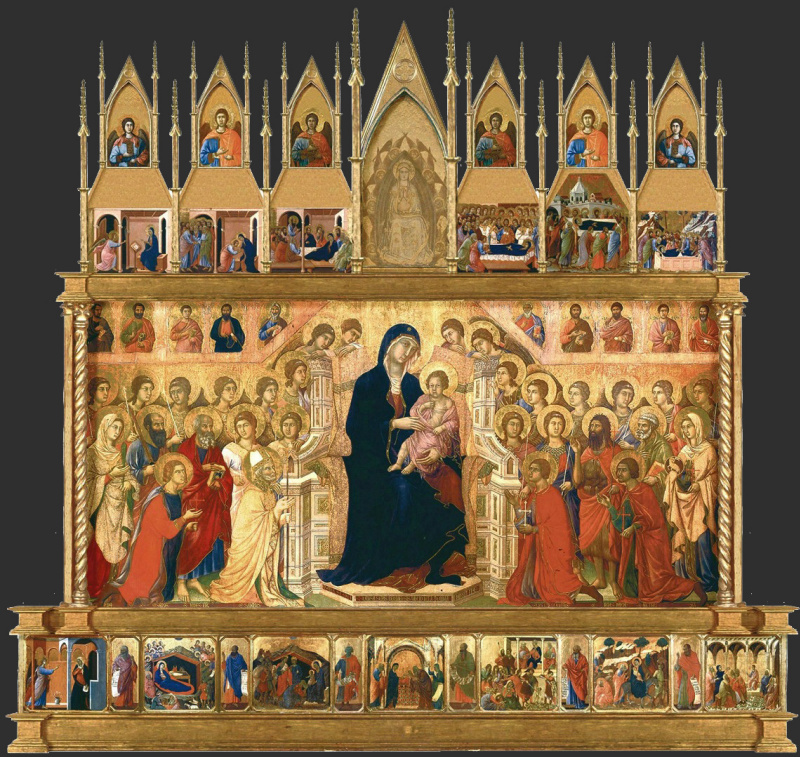
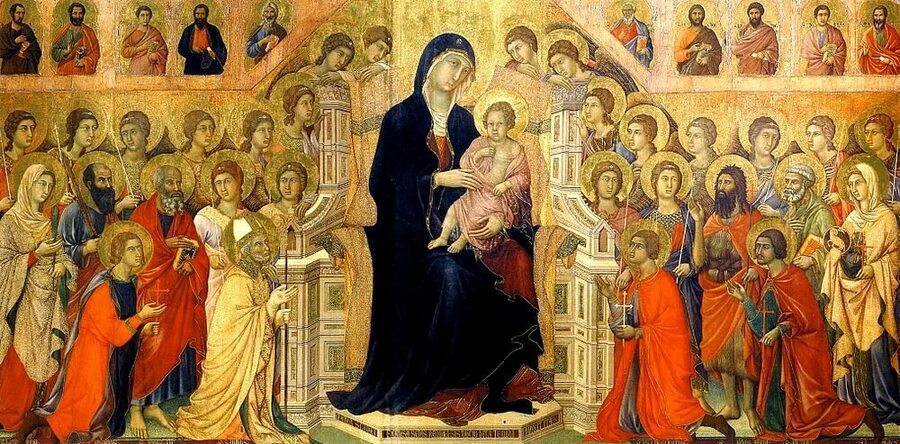
Duccio di Buoninsegna—"Maestà of the Rucellai,» 1285.
In this work, a golden background is combined with exquisite decorative elements, ornamentation, and the fluidity of lines. The angelic figures form an almost symmetrical composition surrounding the Mother of God.
It is particularly important to notice the contrast between the stillness and solemnity of the composition and the delicate plasticity of the figures. Space here does not yet strive for complete realism—its primary function is to convey the grandeur and sacredness of the depiction.
III. Mandorla: A Visual Image of the Divine
The Last Judgment. Giotto di Bondone, 1303–1305.
The word mandorla derives from the Italian word mandorla, meaning «almond.» It refers to the almond-shaped or oval glow that surrounds the entire figure of a sacred character.
It is important to distinguish the mandorla from the halo: the halo is placed around the head, whereas the mandorla encompasses the entire body.
The mandorla appeared in Christian art long before the period under discussion—its use is associated with early Christian and Byzantine traditions. In Italian painting from the 13th–15th centuries, it continued to be used as a way to signify divine glory.
Its primary function is to show that the character is in a special sacred state, surpassing ordinary human existence. It can signify the manifestation of God, a heavenly presence, divine transformation, or a transition between the earthly and celestial realms.
Madonna and Child on a Throne with Scenes from the Lives of Saints, Margherita d’Arcezzo, circa 1263–1264.
Core Functions of the Mandorla
- Denoting Divine Nature.
The mandorla emphasizes the unique status of the figure. Most often, it surrounds Christ in scenes of the Transfiguration, Ascension, Last Judgment, and other depictions of his divine glory.
- Creating a Boundary Between Worlds.
It visually separates the sacred figure from the surrounding space. The figure appears to exist within a special realm that does not adhere to the ordinary laws of the earthly world.
- Compositional Emphasis.
The mandorla directs the viewer’s attention to the central figure and enhances its significance. Its elongated shape can mirror the vertical axis of the composition, underscoring the majesty of the depicted character.
- Conveying Divine Light.
In certain works, the mandorla is depicted as concentric color zones or a radiance. It becomes a visual expression of the light emanating from the divine figure.
IV. Architecture and Composition: Forming Sacred Space