Navigation
- Concept
- Main Body: 2.1. The Emergence of the «Dance of Death» 2.2. Death and Various Classes 2.3. The «Dance of Death» in Graphic and Painting Arts 2.4. Development of the Motif in Art
- Conclusion
- Bibliography
- Image Sources
Concept
f
The Emergence of the «Dance of Death»
From the 14th to the 15th century, Europe was engulfed by a wave of terrifying events. The plague and the Hundred Years' War became profound tragedies for European civilization; in a hundred years, the population of Europe was cut in half. It was at this very moment that the theme of death gained popularity. People began to rethink their relationship with their own mortality—amidst constant epidemics and wars, death became commonplace. Anyone, regardless of social class, could die.
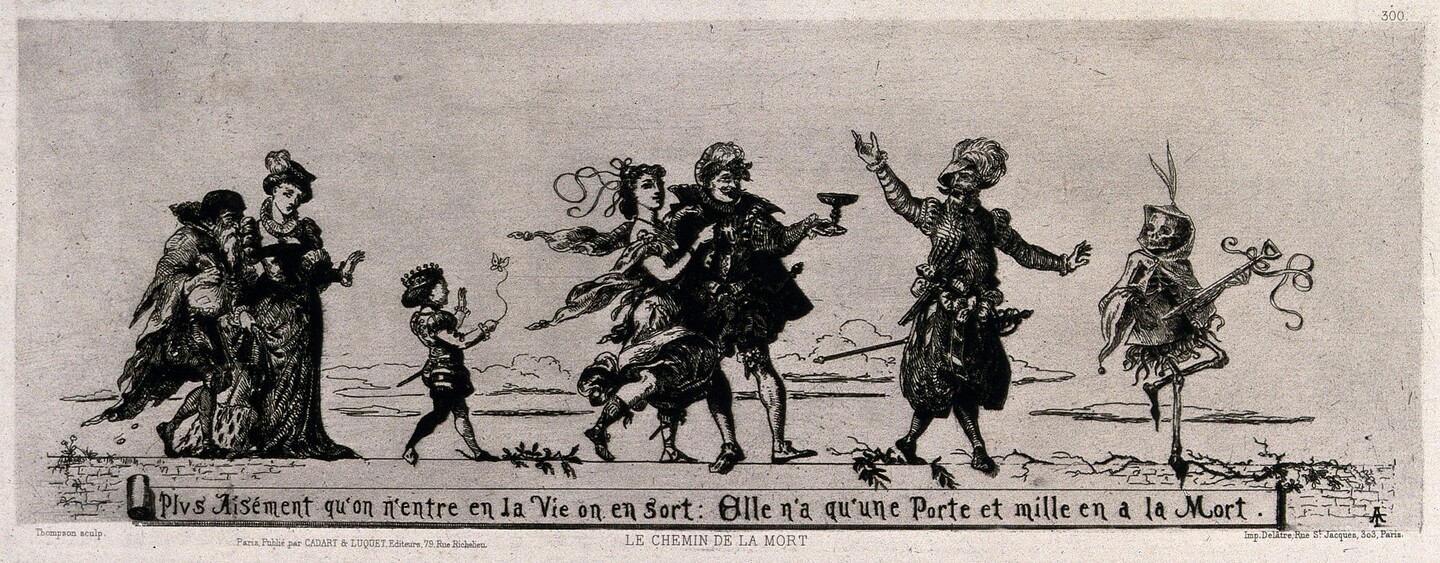
Amidst all these events emerges the «Dance of Death”—Danse Macabre. Its development began in France, later spreading across the entire European continent and appearing in churches, monasteries, and books. The main feature of this motif is the unusual interaction between the living and the dead. Death becomes a participant in a peculiar dance that involves representatives from various social classes. Kings, priests, knights, merchants, and peasants successively meet with the deceased. While their clothing and status retain social distinctions, before death, they all find themselves in an equal position.
One of the earliest known depictions of Danse Macabre is the Wall Painting at the Cemetery of the Innocents in Paris, created between 1424 and 1425. The cemetery was one of the most famous and frequently visited places in the city. Its walls were used not only for burials but also for placing religious images and inscriptions. The painting consisted of sequential scenes along the galleries and was supplemented with poetry. The original painting is no longer preserved, but its content is known through printed works.
View of the Cemetery of the Innocents, circa 1550. Engraving by Höffbauer.
In the late 15th century, the «Dance of Death» gains a new evolution in printmaking. As an example, I will cite the edition «La danse macabre nouvelle, ” published by the Parisian publisher Guye Marsan in 1485. Thanks to this book, the motif spreads to a wider audience. Images and accompanying texts played an important role in the book, constructed as a dialogue between the living and the dead. Over time, the motif ceased to be considered solely a religious or graveyard theme and became an independent artistic subject.
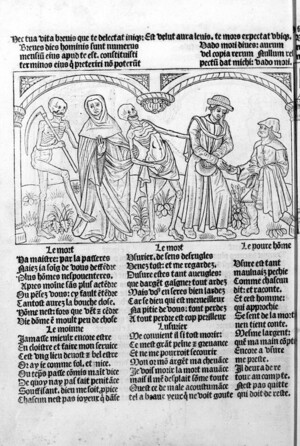
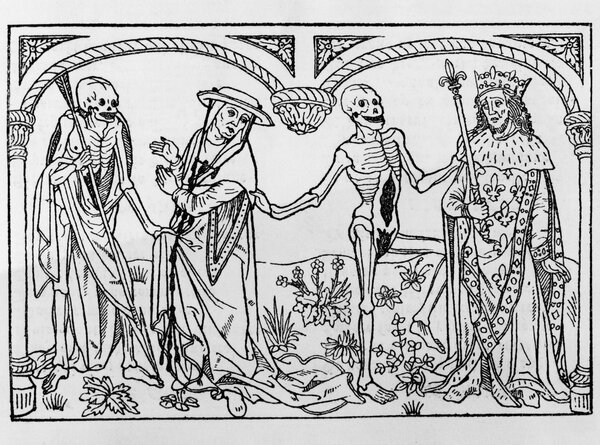
«Dance of Death,» Gilles Marchand, woodcut, 1485
«Dance of Death» emerged from the medieval contemplation of mortality and gradually evolved into an independent artistic motif. Initially, the motif appeared in wall paintings, and later it gained widespread popularity with the development and circulation of books. The advent of the «Dance of Death» transformed death from a singular symbolic image into a participant in a narrative that interacted with humanity.
Death and Social Classes
One of the surviving examples depicting a large number of people from various social strata is the fresco in the Abbey of La-Chaise-Dieu in France. The artwork is divided into three panels. The fresco portrays the deceased as rigid figures with bone adhered to the skin. The fresco should be viewed from left to right. Skeletal figures lead the living people toward death.
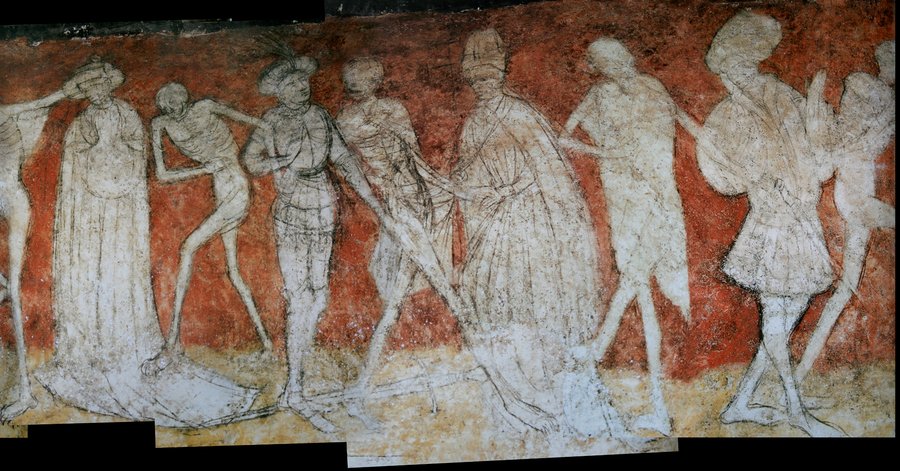
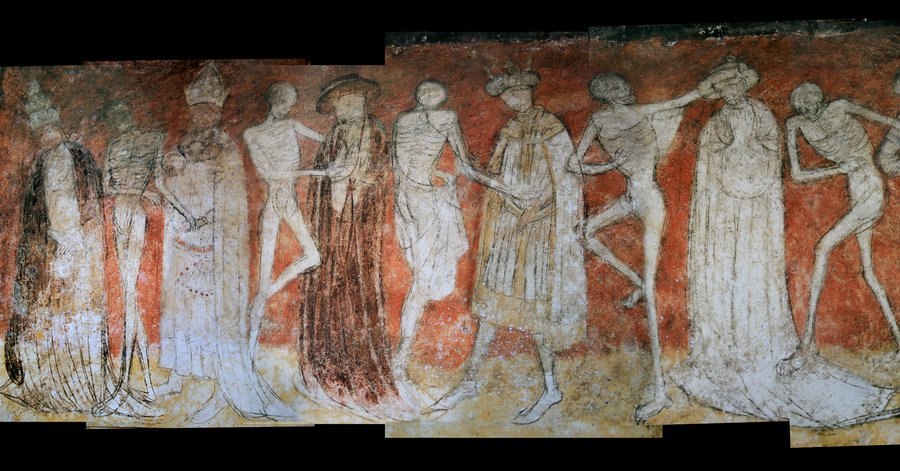
Unknown master. «Dance of Death.» 15th century (circa 1450). Fresco, Abbey of La-Chaise-Dieu, France. First panel.
The first segment of the triptych features influential figures: the Pope, Emperor, Cardinal, King, Papal Legate, Constable, Metropolitan Abbot, Knight. Their status is emphasized through their clothing, headwear, and symbolic objects representing their power. In everyday life, they are wealthy and powerful, but in the painting, near each person, a deceased figure appears, seemingly beckoning their companion to a dance. If the attire of the living underscores their status and grandeur, the bodies of the dead reveal that in the afterlife, all these attributes of power, luxurious clothing, and adornment hold no sway. Before death, everyone is equal.
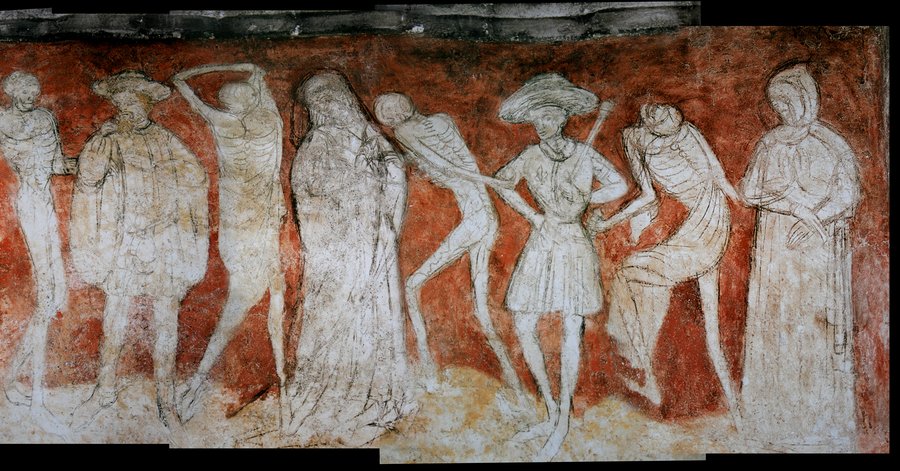
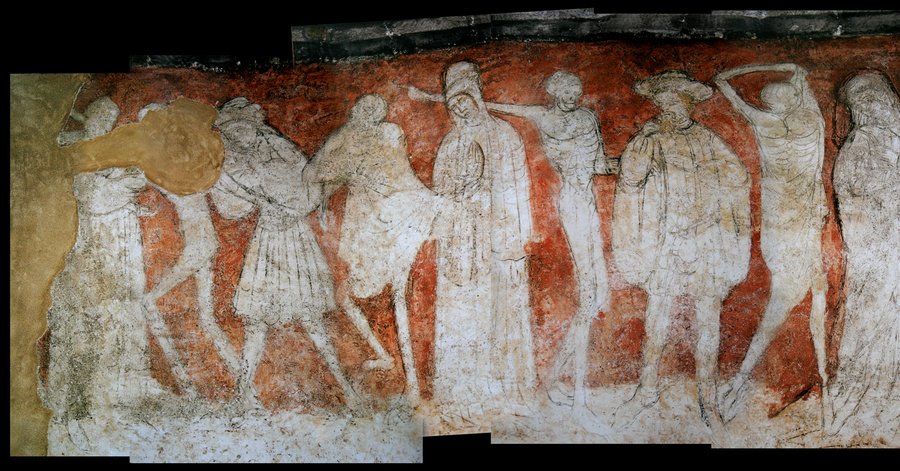
Unknown Master. «Dance of Death.» 15th century (c. 1450). Fresco, Abbaye de la Chaise-Dieu, France. Second panel.
In the second panel of the diptych, we can see a continuation of medieval society, but here there is a greater focus on the clergy and the nobility. Characters associated with religious authority appear. The presence of the clergy becomes particularly significant—in the Middle Ages, the Church held a substantial place in people’s lives and wielded immense influence over the state. Clergy were considered intermediaries between humanity and God, yet even here, their religious status does not grant them immunity from this fate.
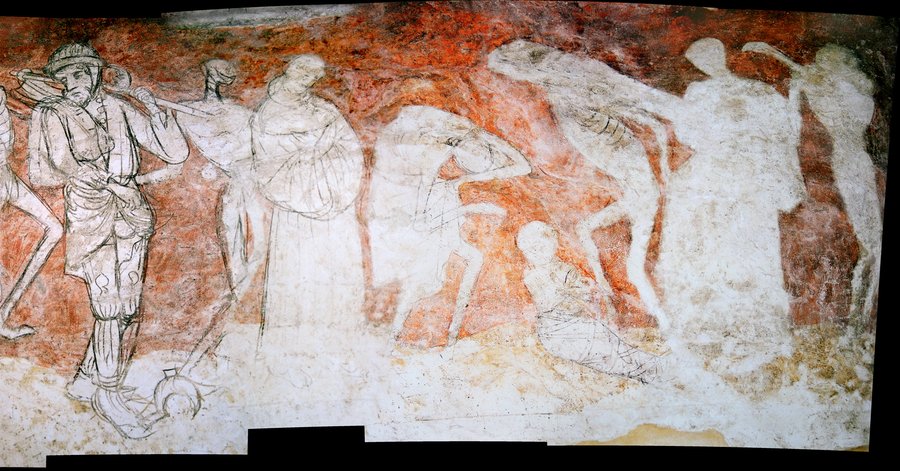
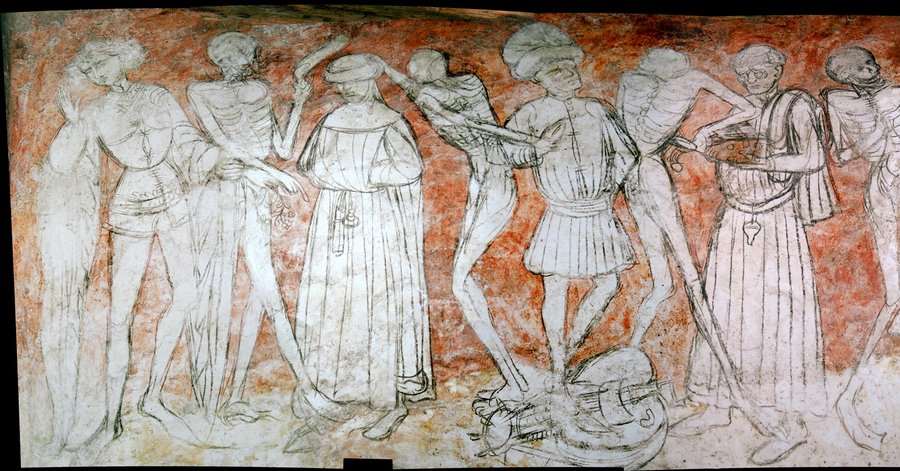
Unknown master. «Dance of Death.» 15th century (c. 1450). Fresco, Abbaye de La-Chev-d’Eaux, France. Third panel.
The third panel depicts the lower social strata. These individuals lack power and high social status. Their figures are contrasted with those of rulers, clergy, nobility, and kings. Death continues to accompany every person. The sequence of the panels is highly significant; it should be read from left to right. The viewer gradually moves through the different social levels of the public hierarchy and observes how death confronts each class. Differences between the characters are maintained in their appearance, attributes, and clothing, but all of this becomes meaningless before the presence of death. The third panel concludes the visual unfolding of the main idea of the «Dance of Death.» Death is revealed as a universal force that makes no exceptions and recognizes no human privilege.
Conclusion
[No content provided to translate.]
Abbaye de La Chaise-Dieu. The Dance of Death of the 15th Century [Electronic Resource]. URL: https://www.abbaye-chaise-dieu.com/visites/la-danse-macabre-du-xve-s/ (Accessed: November 12, 2026).
La Chaise-Dieu. Images of the fresco «Dance of Death» [Electronic resource]. URL: https://de-academic.com/dic.nsf/dewiki/817622 (Accessed: 11/13/2026).