Political Performance in Fashion: The Paradox of Legitimation and Neutralization in Museum Representation
How does the museum representation of political fashion performance simultaneously legitimize it as high art while neutralizing its protest potential, and what role does art criticism play in cementing this paradox?
The relevance of this topic stems from the convergence of fashion and contemporary art. Performative fashion shows featuring radical social gestures are increasingly migrating into museum spaces. The institutional system faces a paradox: by incorporating social fashion, the museum legitimizes it as high art, but simultaneously neutralizes its protest potential, transforming a living activist gesture into a safe aesthetic object. The research problem is to identify the specific curatorial and discursive mechanisms through which this «disarming» occurs, and to analyze how art criticism participates in constructing the myth of «fashion as art,» thereby obscuring the loss of political charge.
Rubric: 1. Theoretical Frameworks: Fashion as Institution and Performative Gesture 2. Political Performance in Fashion: From Commerce to Activist Statement 3. Museum Strategies of Appropriation: Mechanisms of Neutralizing Radicality 4. The Role of Art Criticism in Solidifying the Paradox of Legitimation 5. Conclusion
2. Political Performance in Fashion: From Commerce to Activist Statement
Examining fashion shows as a space for political performance requires analyzing the function of the human body and the clothing that covers it. Fashion often reflected—and even set—the norms, rules, and trends existing at different times. In the classic 19th-century fashion industry, these elements operated within a rigid commercial biopolitics. The models were primarily product demonstrators; they did not play roles, and casting was determined by conformity to universal measurements and sometimes typology, ensuring the look fit better and appeared more presentable—Roland Barthes referred to this as the «fashion body.» The clothing, moreover, lacked a distinct philosophical message; primarily, it was intended to be worn, and it also served as a marker of class status and gender normativity, completely stripping the individual of their genuine bodily subjectivity.
In the era of constructivism, an open resistance to the commercial sheen of the 1980s—with its cult of supermodels—begins to emerge. Artists and activists dismantle Bart’s artificial construct of the «fashion body, ” reintroducing vulnerable and defiant corporeality onto the runway. At this moment, clothing ceases to be merely a commodity or a beautiful sign of success, transforming instead into a carrier of social statement. Within this performative shift, the status of the model itself is radically transformed: she stops functioning as a passive displayer of clothing or an alienated normative ideal. Fashion performance returns corporeal subjectivity to the individual, and avant-garde shows begin to physically seize the runway, introducing into the space of the fashion show representations of diverse social groups historically excluded from capitalistic regimes of visibility.
John Galliano for Dior — «Haute Homeless»
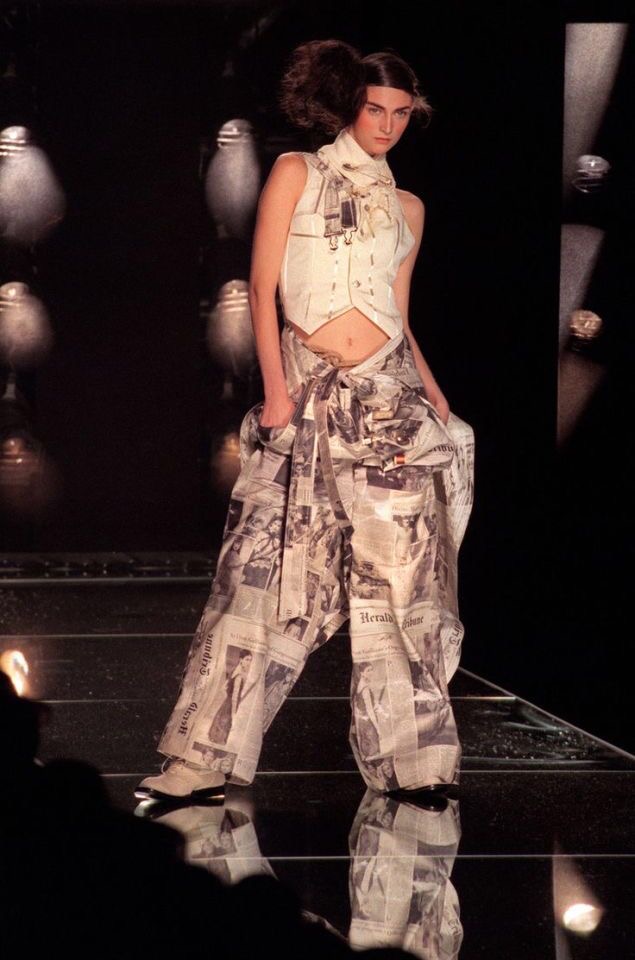
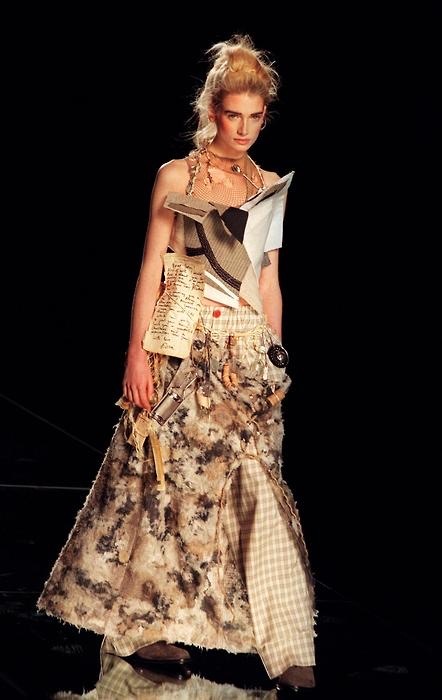
In Dior’s couture show «Clochards» (Spring-Summer 2000), the models depicted homeless individuals—such an unexpected turn clearly resonates with an elite house whose steady clientele does not include the middle class, and it is not aimed at driving more sales or broadcasting bourgeois prosperity. John Galliano staged one of the most controversial shows in haute couture history, inspired by the vagrants he saw during his morning runs along the Seine in Paris. The models wore torn, deconstructed garments wrapped in newspaper prints, complete with tin mugs and whiskey bottles tied to their waists, and faces smeared with dirt.
The designer was criticized for mockingly exploiting the image of the homeless, but the theme of social justice was not widely discussed in the industry at the time, and the same print reappeared in the brand’s next collection. This time in a much larger volume.

Conclusion
The museum cannot fully reveal social trends without altering their original message. Legitimation and neutralization are two sides of the same coin in the process of institutionalization. Art criticism functions either as a catalyst for this process—transforming activism into aesthetic discourse—or as its exposer.
https://static01.nyt.com/images/2026/10/11/multimedia/07ST-VUITTON-TELFAR-04-bvjl/07ST-VUITTON-TELFAR-04-bvjl-superJumbo.jpg?quality=75&auto=avif https://miro.medium.com/v2/resize:fit:4800/format:webp/1N0WSrqA_fKFwa2-WrY4zzg.jpeg https://miro.medium.com/v2/resize:fit:1152/format:webp/1kSg1ieXktMeVecZu6BRiCQ.jpeg https://encrypted-tbn0.gstatic.com/images?q=tbn:ANd9GcTlFEKpJUbQs61JZLU5Tlg-RbzqZJ9DreB9hmCEcIqGPqv3_Krcb_JtpA7R&s=10 https://encrypted-tbn0.gstatic.com/images?q=tbn:ANd9GcQG33ALZnp-ZPDy5ROC5MYTZR2QidpSvL7pMldBMaIsgoO7OlsNhifQ6YQ&s=10 https://encrypted-tbn0.gstatic.com/images?q=tbn:ANd9GcQG33ALZnp-ZPDy5ROC5MYTZR2QidpSvL7pMldBMaIsgoO7OlsNhifQ6YQ&s=10 https://blog.metmuseum.org/alexandermcqueen/images/McQ.1136a–g.EL.JPG https://blog.metmuseum.org/alexandermcqueen/images/7.McQueenVOSSSpring2001.EL.jpg https://blog.metmuseum.org/alexandermcqueen/images/5.McQueenRed,VOSS2001.EL.jpg https://media.ebony.com/sytwmfsyue/uploads/2026/10/07/TELFAR_SampleSale_0206_McKenna.jpg https://media.ebony.com/sytwmfsyue/uploads/2026/10/07/TELFAR_SampleSale_0991_McKenna.jpg
https://theblueprint.ru/fashion/document/newspaper-dress