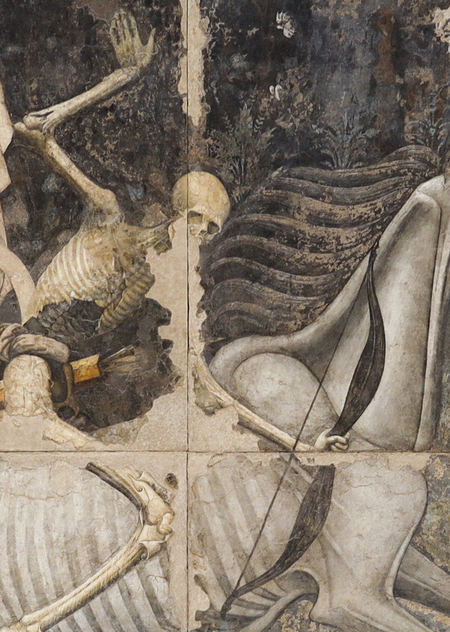
Concept
Death is an inseparable part of human existence—a phenomenon that has, throughout history, evoked fear, curiosity, and the drive to master it. Although everyone is aware of the inevitability of their own demise, the nature of death itself remains a mystery. This uncertainty has generated countless myths, religious concepts, and philosophical reflections through which humanity has sought to explain its own end.
Art has proven to be one of the most crucial avenues for contemplating this subject. Artists have addressed the theme of death to express the fear of the unknown, to remind us of life’s transience, or to articulate moral ideas. However, they faced a unique challenge: how to depict something that lacks an inherent form? To address this, they employed symbols and personifications, allowing the abstract concept to gradually acquire a recognizable shape.
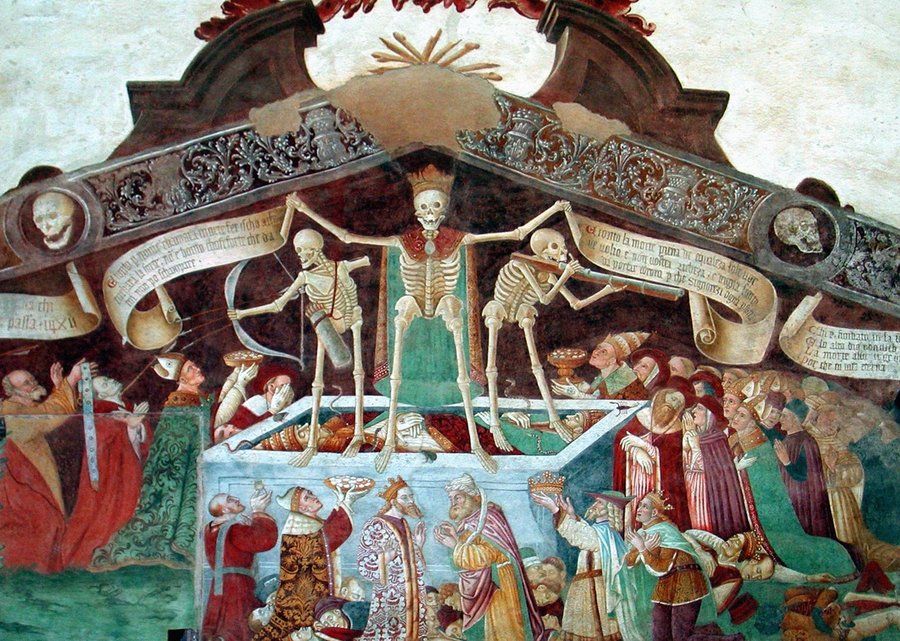
The human skeleton has become the most enduring visual representation of death. Its appearance directly reminds us of the physical finiteness of existence and allows the viewer to recognize the depicted phenomenon without further explanation. However, the recognition of this image does not imply a fixed character. In some works, death is presented as an impartial and uncontrollable force that obliterates everything in its path; in others, it is a terrifying adversary or an inevitable and constant companion. What is particularly interesting is that the same image can acquire vastly different meanings depending on the role the artist assigns to it. It is this very ability of artists to endow death with varied personalities while maintaining a recognizable form that led me to select this topic for my study. I am interested in examining death not merely as a symbol, but as an independent character possessing a specific personality and narrative role.
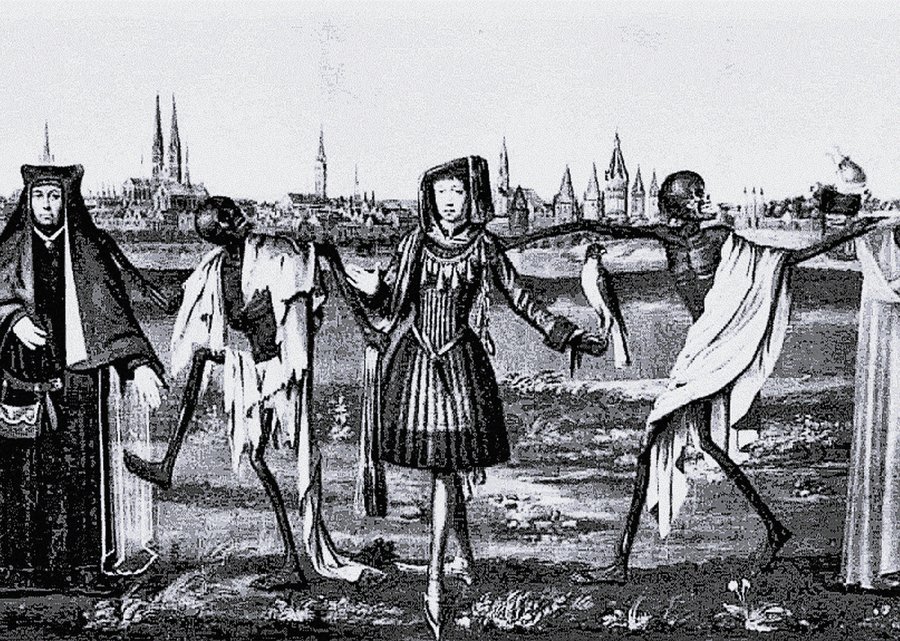
Бернт Нотке, «Любекская пляска смерти», ок. 1463 г.
For this study, I have selected Western European art from the 14th and 15th centuries. During this period, death occupied a central place in human worldview, a reflection of both religious beliefs and the epidemics, wars, and other upheavals of medieval society.
The primary criterion for selecting visual material was the presence of personified death, endowed with a specific role in the narrative. When selecting works, special attention will be paid to pieces that allow for a comparison of different ways of rendering one recognizable image.
The goal of my research is to determine what artistic means Western European masters employed to transform death from an abstract concept into an independent character. The main research question is this: How did artists create diverse representations of death’s character and role within a work while maintaining its recognizable appearance? I hypothesize that the perception of death depends less on its external appearance and more on how it interacts with its surroundings and what place it occupies in the depicted space. Through composition, scale, gesture, and movement, the same figure can be perceived as a destructive force, a ruler, an adversary, or a companion to humanity. By comparing the works, I aim to identify the visual techniques that allow artists to create these distinctions and how these techniques reveal humanity’s relationship with death.
Death as an uncontrollable force