Graffiti is the tattoos of the city.
Navigator
1. Concept 2. The Genesis of Wall Art 3. Walls as a Means of Communication 4. The Birth of Modern Graffiti Culture 5. Wall Art Today 6. Conclusion 7. Bibliography 8. List of Illustrations
Concept
Throughout history, humanity has strived to leave a mark of its existence. Even in prehistoric times, people created images on cave walls, inscribed symbols, and conveyed information to others through drawings. Over time, methods of self-expression evolved: cave art gave way to ancient inscriptions and murals, which later transitioned into modern graffiti and street art.
The relevance of this study lies in the enduring human desire to be seen, to express one’s thoughts, and to leave a lasting memory of oneself. Examining the evolution of mural art allows us to trace how methods of communication and self-expression have changed across different historical epochs.
Research Goal: To trace the development of mural art, from primitive cave paintings to contemporary graffiti.
The Genesis of Rock Art
Cave art is one of the earliest manifestations of human symbolic thought. The origin of cave art opens a window into understanding early forms of thought and culture. Primitive painting on cave walls allows us to glimpse the minds of our distant ancestors.
Cave art, or parietal art, is a collection of images and signs applied by humans onto natural stone surfaces. This includes drawings made with mineral pigments, engravings, handprints, and various geometric symbols.
Among the most ancient artifacts of art are the finds in the Blombos Cave in South Africa. They date back approximately 100,000 years.
Geometric ornaments on ochre fragments from the Blombos caves (a, b)
Among the artifacts found in the cave, researchers were drawn to fragments of ochre, one side of which was incised with straight lines both lengthwise and crosswise (Fig. 3, a, b). Of particular interest was a fragment about 6 cm long, one side of which was marked seemingly without any obvious system (Fig. 3, a, top). However, when the grooves inscribed first were later restored, it turned out that the incisions formed something resembling a primitive geometric pattern of intersecting straight lines (Fig. 3, a, bottom).
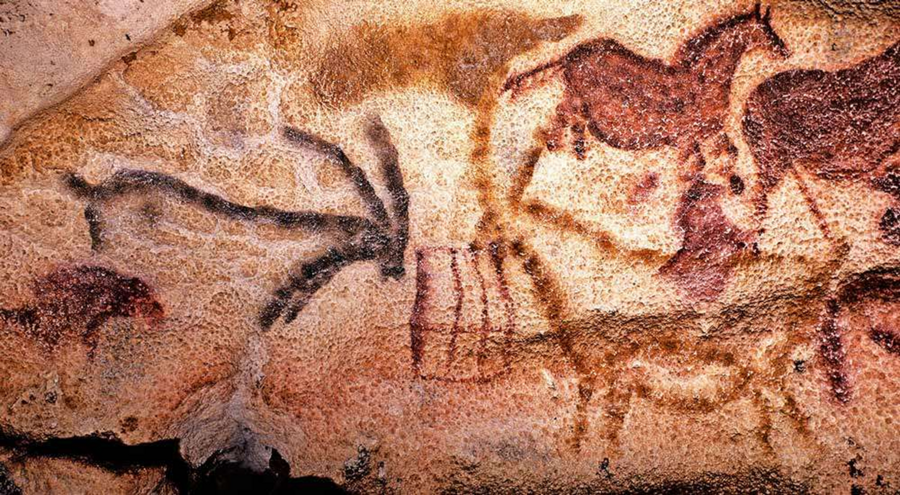
Early examples of Paleolithic art in Europe include the Chauvet caves in France (36,000 years ago) and Lascaux (17,000 years ago).
Chauvet Cave, France
Upper Paleolithic hunters did not live in these dim halls—they only left behind numerous paintings and likely conducted rituals. They created their art by the light of torches, primitive lamps carved from stone and filled with animal fat, and small fires from which they also gathered charcoal for drawing.In the halls and galleries of the Chauvet Cave, there are over 1,000 drawings, more than 420 of which depict animals. Among these, researchers have counted more than 14 species from the Pleistocene epoch (2.6 million — 11.7 thousand years ago): woolly rhinos, cave bears and lions, mammoths, bison, horses, deer, and possibly even hyenas.
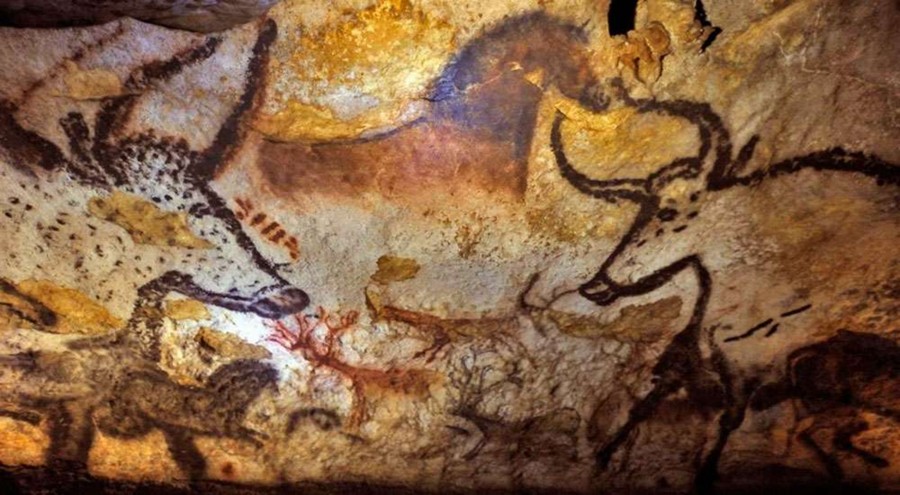
Another significant monument is the Lascaux Cave in France, discovered in 1940. Its paintings date back approximately 23–21 thousand years.
The most famous part of the cave is the Bull Hall, where large animals are depicted in black, red, yellow, and brown hues. Some figures reach several meters in length.