Concept
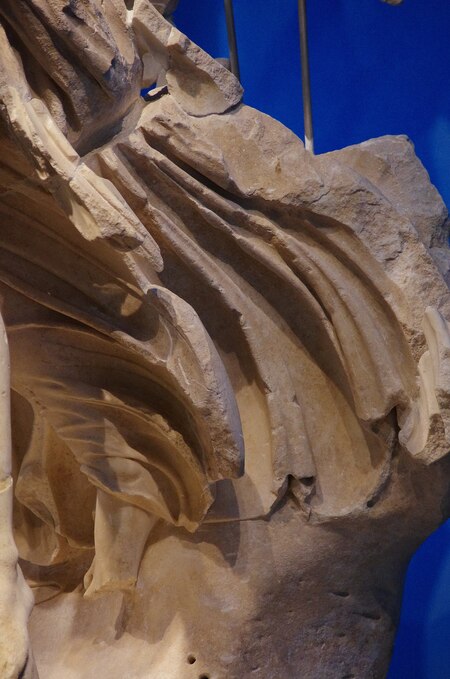
Clothing is present in almost every sculpture, from archaic Greece to the late Middle Ages. Yet, the viewer’s gaze usually skims over it: we focus on the face, the gesture, the narrative, while perceiving the folds as mere background. Meanwhile, the fold is one of the most painstaking and considered elements of a sculpture. The sculptor resolves it anew every time, and in that resolution, we can see how his era understands the body—whether it conceals it, reveals it, substitutes it with a symbol, or discards it entirely. The fold turns out to be a useful «metric» by which we can compare vastly different monuments based on a single feature.
What does a fold in fabric reveal about an era’s relationship to the body?
Drapery is a precise indicator of how an era perceives the body. In Greek Classicism, it serves and reveals the body. In Byzantine and Romanesque art, it displaces the body, becoming an independent linear pattern. Gothic art restores volume and weight to the drapery, and by the turn of the 14th–15th centuries, the fabric itself becomes the primary plastic mass—the body beneath it may become completely indiscernible. The trajectory of drapery moves from a body visible through the fabric to a fabric behind which no body remains.
Material Selection Principle
The study includes circular sculptures and reliefs made of stone and bronze—materials that must be carved or cast, not drawn. The sole exception is the 6th-century Ravenna mosaic, which is included as a transitional piece where the abandonment of volume is especially evident. Monuments were selected in which the drapery occupies a large portion of the surface and is deliberately rendered.The chronological scope ranges from Archaic Kore (c. 530 BCE) to the tombstone of Philip of Po (c. 1480). The geography encompasses Greece, Italy, France, Germany, and Central Europe, where the trajectory of plastic development is continuous and well-documented.
Rubrication Principle
The study is divided into four chapters based on how the fold relates to the body: the fold reveals the body; the fold replaces the body; the fold restores volume; the fabric supersedes the body. This is a typology, but the types succeed one another over time, so the structure can also be read as a chronology.In each chapter, the monuments are analyzed using three consistent parameters: the direction and rhythm of the fold lines; the depth of the carving and the handling of light and shadow; and the relationship between the fold and anatomy—whether it repeats the body’s form, ignores it, or substitutes it.
Principle of Source Selection and Analysis
The foundation was built upon comprehensive works in art history (E. Gombrich, H. V. and E. F. Jansen), which established the chronology and terminology, alongside B. R. Wipper’s work on the methodology of historical art study. To analyze the relationship between the body and clothing, research by K. Clark on nudity in art and A. Hollander on the depiction of dress was utilized. Questions regarding Romanesque and Gothic plasticity were refined using monographs by M. Shapiro and V. Sauerländer. The sources were used to verify dates, attributions, and terminology; the analysis of drapery and the conclusions are original to the author.
[Chapter 1]
The Fold Unveils the Body
Greek sculpture evolved from a schematic drapery to folds that possess an anatomical understanding. By the end of the 5th century BCE, the fabric in marble began to behave as if wet: it clung to the body, not concealing, but accentuating it.
Bark in Peplos. Circa 530 BCE. Marble. Acropolis Museum, Athens
Starting point. The peplos falls almost as a straight cylinder; the folds are indicated by shallow, parallel grooves. The fabric is not yet attached to the body—figure and garment form one monolithic volume.
[02] Delphic Charioteer. Circa 478–474 BCE. Bronze. Archaeological Museum, Delphi
The folds of the chiton fall in severe verticals, reminiscent of column fluting. The shadows between them are already deep, but the body beneath the fabric is barely discernible—the fold belongs to the architecture, not the anatomy.
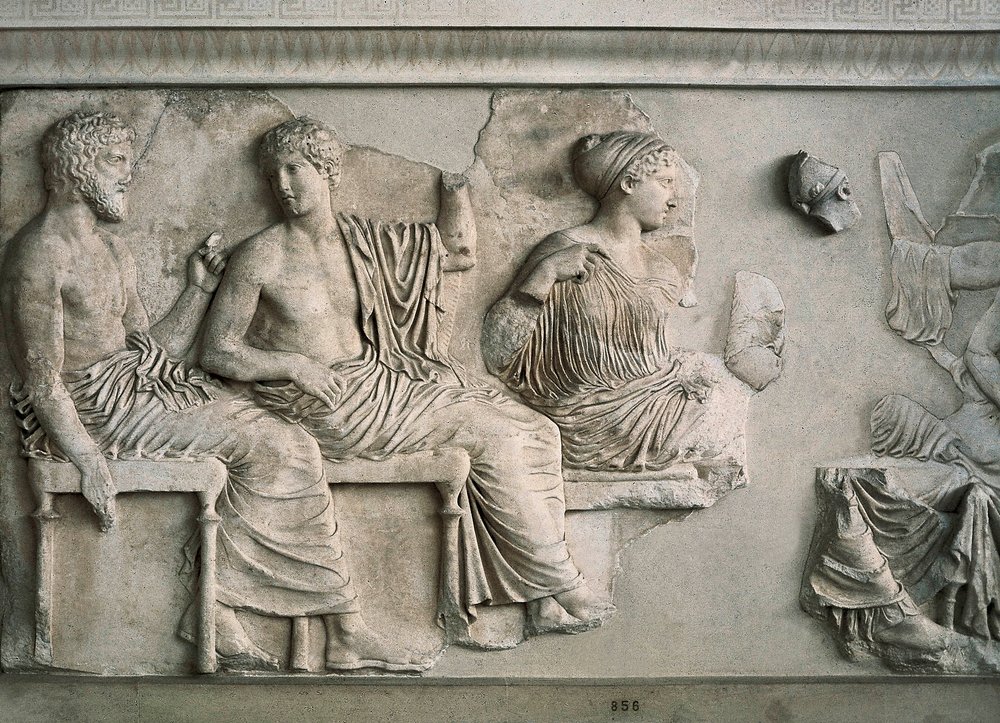
[03] Figures of goddesses from the eastern pediment of the Parthenon. c. 438–432 BCE. Marble. British Museum, London
Break. The sheer fabric drapes over the knees, hips, and chest, gathering between them in deep cascades. Folds sweep in an arc around the body’s form: light glides across the areas where the fabric «clings,» and sinks into shadow where it flows freely.
[04] Peony. Nika. Ok. 420 BCE. Marble. Archaeological Museum, Olympia
The fabric is pressed against the body by the opposing wind: it is nearly sheer at the front, but puffs out like a sail at the back. Thin, ribbed folds contour the leg, while deep folds create a background that makes the leg stand out even more vividly. The fold becomes an instrument of contrast.
[05] Peony. Nika. Fragment
[06] Nika untying her sandal. Plinth of the balustrade of the Temple of Athena Nike. Approx. 410 BCE. Marble. Acropolis Museum, Athens
The apex of «wet drapery.» The thinnest folds run along the body, mirroring every curve. The relief is subtle, yet the light catching the crests of the folds creates a sense of complete volume.
[07] Aphrodite («Venus the Progenitor»). Roman copy from the 1st–2nd centuries CE of an original dating to c. 410 BCE. Marble. Louvre, Paris
The same technique, pushed to its extreme: the fabric almost dissolves into a net of fine lines on the body’s surface. The fold exists now as a pattern atop the anatomy.
[08] Nika Samofrakis. c. 190 BCE. Marble. Louvre, Paris
Hellenism introduces movement. Folds simultaneously convey body form, the rush of wind, and a stride. The carving is deep, and the contrasts of light and shadow are sharp.
[09] Athena battles the giant Alcyoneus. Frieze from the Pergamon Altar. c. 180–160 BCE. Marble. Pergamon Museum, Berlin
The folds curl into vortices, almost detaching from the body. The fabric still outlines the figure, but it is beginning to live its own expressive life—the first hint of what is to come.