Categories
1. Epigraph
2. Hypothesis
3. Rubrication Principle
4. Rationale for Topic Selection
5. Areas of Study
6. Main Body
a. Introduction to the Temporal Context
b. «Marble Portrait Bust of a Woman with a Scroll»
c. «Plaque with Dionysus, Ariadne, and Eros»
d. «Bone Panel with Venus»
e. «Bone Plaque with a Woman and a Flag»
f. Comparison
7. Confirmation or Refutation of the Hypothesis
8. Bibliography
9. Image Sources
Epigraph
Through gestures, I want to explore human behavior in society and in solitude.
Hypothesis
In the art of the Greek-speaking world of the 5th century CE, gestures conveyed diverse meanings. Some indicated an individual’s social standing and authority, while others expressed care, respect, a request, or protection. I hypothesize that the bust with a scroll and the bone plaque featuring a woman and a flag belong to the first group, while the plaque with Dionysus and Ariadne and the bone panel with Venus belong to the second. Furthermore, there may not be a clear boundary between the public and the personal. To understand the meaning of a gesture, one must consider the image’s context, the characters' postures, and the artistic characteristics of the era.
The Principle of Rubrication
I interpret gesture as encompassing more than just hand movement. This includes posture, arm positioning, head orientation, gaze, and how a person holds an object or piece of clothing. I analyze each gesture based on three questions:
1. To whom is it addressed: to society, to a loved one, or only to the subject depicted?
2. What is it communicating: status, power, education, or care, respect, a request, or protection?
3. Where might the object have been: in a public place or at home?
I term a gesture as «public» if it is intended for the gaze of strangers and communicates status. A «private» gesture is directed toward a loved one or is for no one, and it expresses feeling or disposition. The third question is necessary because the intended use of both objects can only be hypothesized, and the line between public and private cannot be drawn based on a single gesture.
Rationale for Topic Selection
In middle school, I was interested in the Greco-speaking world. I observed the art and noticed various gestures, and I wanted to understand what they signified. Through them, I aim to examine human behavior both in society and in solitude. The 5th century is suitable for exploring my question because it is a time when Greek tradition and Christian culture coexisted. The Greek language and ancient education persisted, Christianity had already developed, and Greek myths still remained present in decoration and daily objects. Therefore, the same gesture can be compared across different contexts.
Areas of Study
Semantics of gestures in the art and culture of the Greek-speaking world at the turn of the 4th–5th centuries CE; body language and the human image in public and private artistic contexts.
Main Body
a. Introduction to Temporal Context
Visualizing Ancient Constantinople: The Heart of the Byzantine Megalopolis.
In 330 CE, Constantine declared the ancient city on the shores of the Bosphorus the capital of the empire, and it was named Constantinople. The new capital was long referred to as the «New Rome» [2]. In 395 CE, the Roman Empire split into the Eastern and Western Empires [2]. The eastern portion included the Balkans, Asia Minor, Syria, Palestine, and Egypt [2]. The population there was diverse: Greeks, Copts, Syrians, Armenians, and Jews. Greek became the most widespread language [2]. This world, I call Hellenistic.
Greek education remained a marker of high social standing. According to Udaltsova, the tastes of the capital’s elite were rooted in classical education and ancient traditions, and the court was marked by elaborate ceremonialism [2]. Only educated and wealthy individuals could study philosophy according to established scholastic methods [2]. Lazarev notes that the ancient tradition did not cease in Constantinople: antique statues lined the streets, classics were studied in schools, and residents spoke a sophisticated Greek [1]. Since scholarship was a privilege, it was naturally displayed, and education could become a subject for portraiture.
Greek culture did not displace Christianity. A segment of the senatorial aristocracy adhered to the old religion, first openly, then secretly [2]. Noble pagan families persistently maintained classical forms [1], while Christians readily adopted the most neutral motifs from the ancient repertoire [1]. Lazarev refers to the 4th and first half of the 5th century as a time of particularly active infiltration of ancient forms into Christian painting [1]. Udaltsova adds that the prestige of ancient culture was considered part of the prestige of the Roman state [2]. Against this background, a Greek myth on a domestic object from Egypt does not seem strange.
Strength and Faith: Konstantin presents the urban model of the Hagia Sophia.
The very image of humanity is changing. Lazarev illustrates this in his portraits. In the 4th–5th centuries, he states, the dualism of spirit and body in art achieves a definitive victory: the spirit seems to separate from the body—enlarged pupils gaze into the distance, and the faces appear weary. Overall, these portraits convey the tragedy of people who witnessed the death of their own culture [1]. For my topic, this implies one thing: the meaning of the image is carried by the face and the gaze, not just the hand, and the gesture must be read in conjunction with them.There is also a limitation. Lazarev acknowledges that we know almost nothing about Constantinople’s painting from the 4th–5th centuries, and a cohesive Constantinopolitan style only emerges in the 6th century [1]. Therefore, I focus on sculpture and smaller forms and speak of the Greek-speaking world, rather than Byzantium: the Byzantine style had not yet fully formed by the 5th century.
b. «Marble portrait bust of a woman with a scroll»
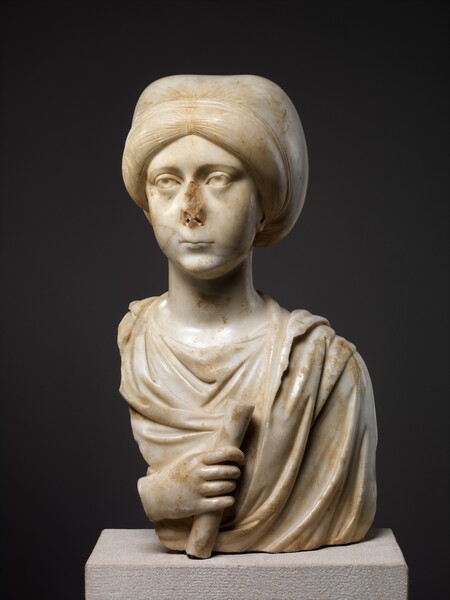
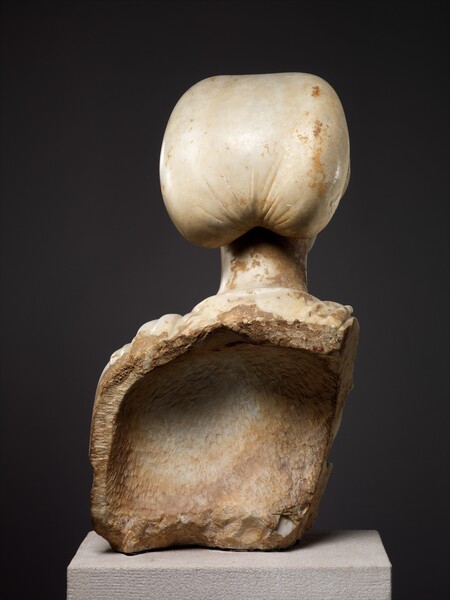
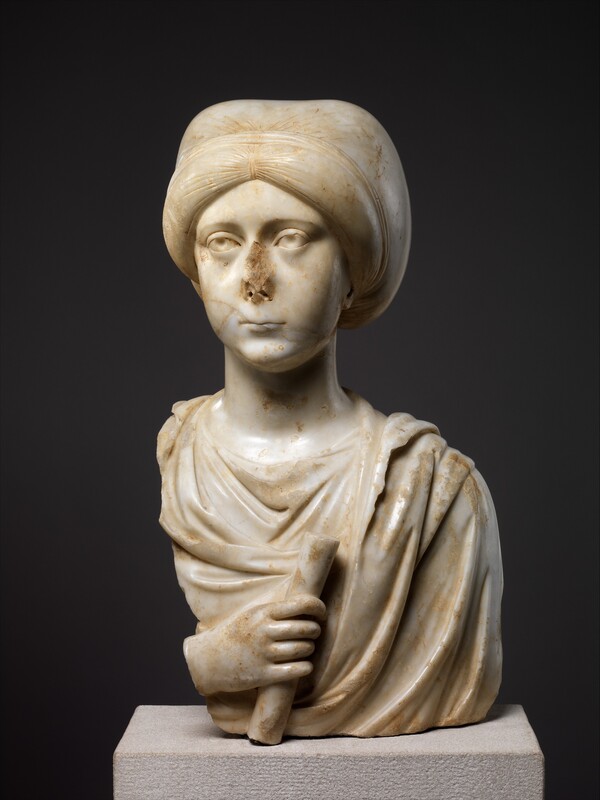
Marble portrait bust of a woman with a scroll. Late 4th — early 5th century. Constantinople.
Description
The photograph depicts a bust of a mature woman, whose name is unknown. Her head is covered with a headdress. She wears a tunic and a mantle over her shoulders. The museum considers this attire typical of an aristocrat and notes that similar head coverings only became fashionable in the 4th century [3]. Her right arm emerges from beneath the edge of the mantle, grasping a scroll that stands vertically before her. Her nose is missing, and there are cracks on her face, but her features are clearly discernible.
Gestures
The main gesture of the bust is the scroll held in the right hand. The hand is positioned outside the folds of the mantle so that the object is visible. The scroll is not unrolled or legible—it is simply held. The museum interprets it as a sign of interest in classical scholarship and affiliation with the elite [3]. By that time, scrolls were already giving way to the codex in bookmaking: according to Lazarev, the codex supplanted them toward the end of the 1st century [1]. Therefore, it seems to me that in this portrait from the late 4th century, the scroll serves more as a sign of tradition than as a practical object. The gesture is directed toward an external viewer, conveying status—meaning it is public.The posture is closed. The left hand is concealed beneath the mantle, and the right hand is pressed against the body. The hands do not reach out, plead, or offer. I believe this is how restraint appears: dignity, not a request or a concern. The head is raised, the lips are closed, and the gaze is directed forward. The museum describes the expression as pensive and the gaze as penetrating [3]. The face is calmer than in the portraits described by Lazarev; it lacks strained facial muscles and sharp wrinkles. Yet, there is a sense of concentration and detachment, which correlates with what he describes [1]. Here, a personal nuance emerges: the woman is on display, but she appears to be looking inward.
Purpose
The museum allows for two interpretations. The bust could have been part of a memorial ensemble, perhaps marking a public donation, or it could have been situated in a private residence [3]. In the first scenario, the gestures are directed toward the city; in the second, they are directed toward the family and guests. The set of gestures remains unchanged, and the scroll speaks to this placement in both cases. The distinction between public and private is determined by the location, not by the gesture itself.Summary
The core meaning of the bust’s gestures is public: education, status, and dignity. The personal aspect is conveyed through the gaze—the only element where the image transcends a mere social sign.
c. «Plate with Dionysus, Ariadne, and Eros»
Plastique with Dionysus, Ariadne, and Eros. 4th–5th Century. Egypt.
Description
On the left side of the image, Dionysus is visible. He is young, wearing a wreath of leaves on his head, and is reclining on folded drapery. With one hand, he raises a tall staff or stem; the other is extended toward the edge of the panel. A spotted pelt is faintly visible at his feet. In the center is a small, winged Eros. He is leaning toward Ariadne, and above her, a hand holding something resembling a torch is raised. To the right, Ariadne is semi-reclining with a bare torso; one of her arms is bent near her shoulder, and her head is turned toward the center. Behind her, there is a netted oval shape, resembling a blanket or canopy. The folds of the fabric at the bottom link the three figures into a single line.
Gestures
Ariadne’s pose is open and relaxed: her torso is uncovered, her arm is bent at the shoulder, and her head is turned. This manner depicts rest or sleep—that is, vulnerability. The museum describes her as asleep, but in the photograph, her eyes appear open. Perhaps the artist captured a moment of awakening, which the museum suggests when retelling the Egyptian understanding of the subject [4]. This gesture is intimate; it conveys nothing about the heroine’s state and is not intended for an outsider.Dionysus lies calmly, without sudden movements, while holding his staff. Based on the photograph, he is not touching Ariadne. His gesture is more patronizing: the god is present, and the heroine’s fate hinges on his appearance. This is the closest depiction to what the hypothesis terms protection, even though there is no direct defensive movement with his hand.
Eros leans toward Ariadne, holding up a torch. The museum interprets his presence as an allusion to a future union [4]. Through this gesture, the relationships between the characters are conveyed, rather than their physical positions.
There is also a religious subtext. According to Walter’s description, in Egypt, Dionysus was also considered a god of immortality, and Ariadne’s awakening can be read as a return to life [4]. In that context, the gesture of awakening is not merely romantic; it promises life. For the era when Greek myths existed as decor alongside Christian culture [1; 2], this interpretation seems plausible. The calm composition, free of tumultuous movements, is also consistent with what Lazarev writes about the Alexandrian circle [1]. The museum does not state the plate’s origin in Alexandria, so this is only a comparison. Udaltsova mentions local carvers of bone and wood whose work carries a regional flavor [2]. The plate may have come from such a craft world.