concept
Gardens are associated with beauty, tranquility, and harmony. But why might plant illustrations in medieval manuscripts appear almost like depictions of an idyllic world? In the miniatures of Tacuinum Sanitatis, trees are laden with fruit, plants occupy a significant portion of the space, and people are harvesting crops and cultivating herbs. I became interested in exactly which visual devices achieve this impression.
The basis of the research was the illuminated manuscript Tacuinum Sanitatis, created in Northern Italy in the late 14th century and currently held in the National Library of Austria in Vienna (Cod. Ser. n. 2644). Its content relates to health and daily practices. Therefore, it is important to me not to attribute the initial concept of the paradise image—the «ideal garden» in the title—as a descriptive metaphor for the research, but rather as the genre of these miniatures.
My research question is: how do composition, color, the repetition of botanical forms, and the interaction between characters and nature create a sense of harmony and abundance in the Tacuinum Sanitatis miniatures? I hypothesize that the artists made nature visually appealing not just through subject selection, but also by ordering the plants in space, their rhythmic repetition, vibrant contrasts, the profusion of ripe fruit, and the integration of the human figure into the natural environment.
To test the hypothesis, I am selecting miniatures from a single, specific codex to avoid mixing different artistic schools and centuries. The main body of work includes images of fruit trees, garden plots, flowers, medicinal plants, and seasonal activities. Selection criteria include clear attribution by leaf, availability of the digital image, expressive composition, and the potential for comparison with other scenes.
The research progresses by systematically testing a hypothesis. Initially, I examine the organization of natural space—the boundaries, depth, scale, and placement of plants. Next, I consider the aesthetic qualities of abundance—the repetition of fruits and the richness of plant mass. The following section is dedicated to the language of form: color, rhythm, silhouettes, and ornamentation. After that, I analyze the placement of the human figure among the plants, their gestures, and daily activities. Finally, I compare my observations and pose a critical question: does every scene truly evoke the feeling of an ideal garden?
The miniatures themselves become the primary material: I display them in their entirety, compare them, examine the details, and create simple graphic diagrams. Textual sources help clarify the dating and origin of the codex, the content of the treatise, and the characteristics of the botanical illustrations. I use the manuscript catalog, records from the Austrian National Library, and scholarly publications on the Tacuinum Sanitatis as references. The author’s commentary remains brief—its purpose is to explain which visual feature can be observed and how it relates to the hypothesis.
Research Question
How did the artists of the Tacuinum Sanitatis manuscript from the late 14th century use visual elements to depict a life in harmony with nature?Hypothesis
The repetition of botanical forms, color accents, compositional order, and the positioning of the human figure among plants help evoke a sense of abundance and well-being.
garden space
How do plants define the boundaries, depth, and scale of the depicted world?
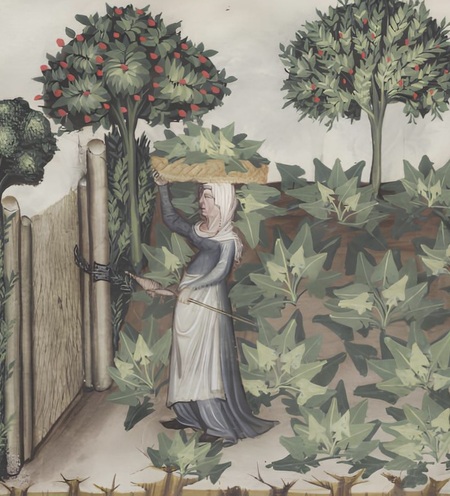
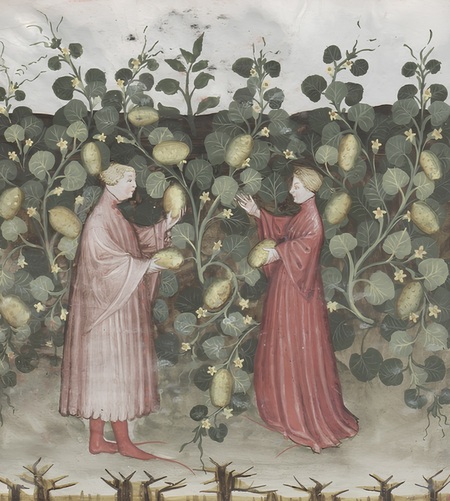
1. Unknown Artist. «Spinach Harvest.» 1380–1399. 2. Unknown Artist. «Cucumber Harvest.» 1380–1399.
In «Spinach Harvest,» the space is emphasized by a fence, while the scene with the cucumbers features a repetition of shoots. Both solutions integrate the plants and people into a cohesive composition.
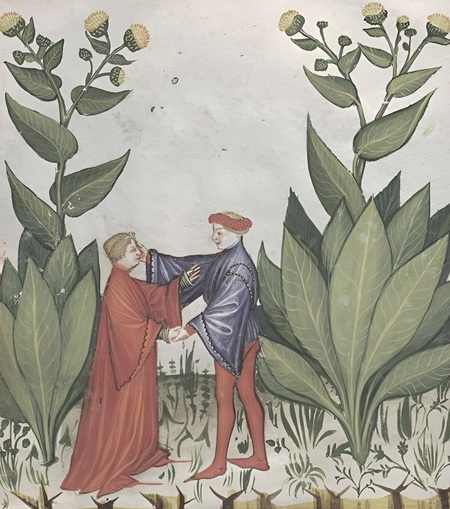
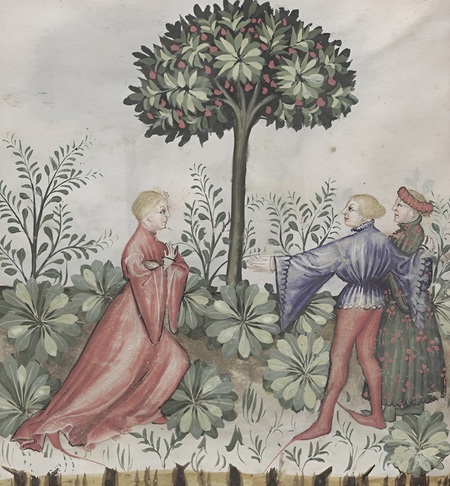
1. Unknown artist. «Ninefoils.» 1380–1399. 2. Unknown artist. «Mustard.» 1380–1399.
The mustard and horseradish are shown in large relation to the characters. The plants frame the human actions and become the foundation of the composition, rather than merely the background.
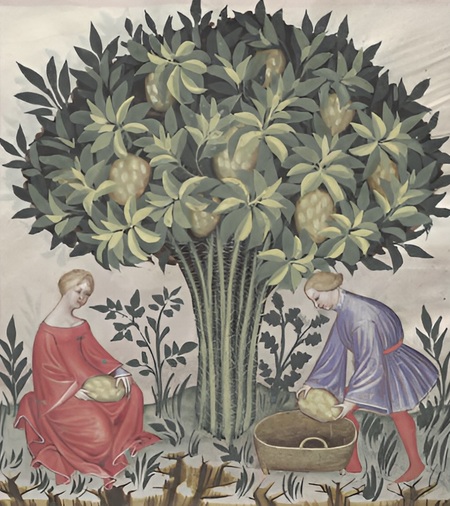
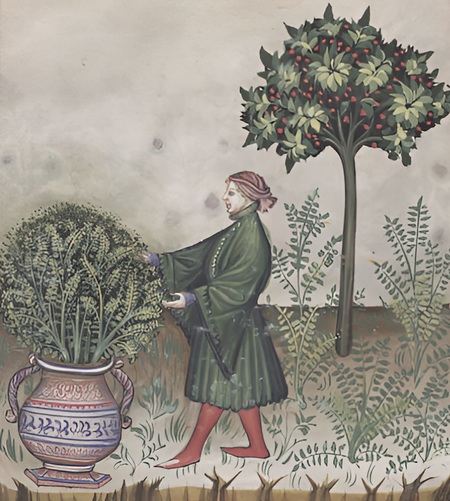
1. Unknown Artist. «Citron Tree.» 1380–1399. 2. Unknown Artist. «Basil.» 1380–1399.
Near the lemon tree, the characters exist within a natural environment. In the scene with the basil, the focus narrows to two plants—the garden space becomes more intimate.
The garden is portrayed as harmonious not only through geometric order. Artists use boundaries, foliage density, and variations in scale to unify nature and humanity.
Aesthetics of Abundance
Does the feeling of natural abundance arise from the quantity of produce? Let’s compare different plants and the arrangement of the harvest within the composition.
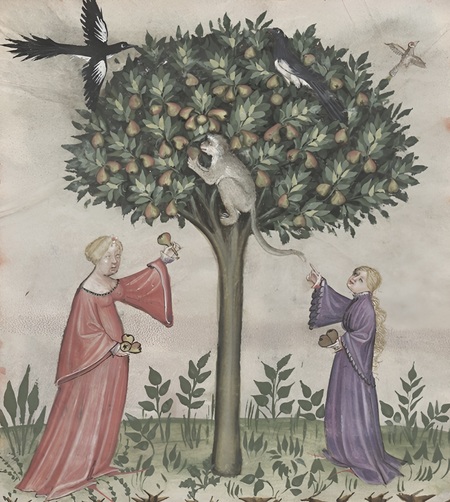
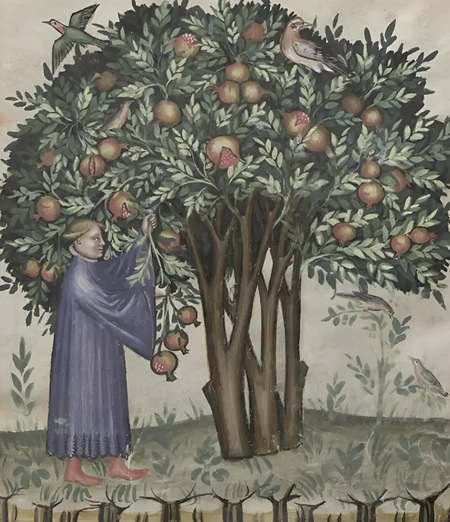
1. Unknown artist. «Pear Harvest.» 1380–1399. 2. Unknown artist. «Grenades.» 1380–1399.
In both miniatures, the fruits repeat across the treetop. Their quantity and placement create a rhythm, transforming the harvest into the central visual motif.
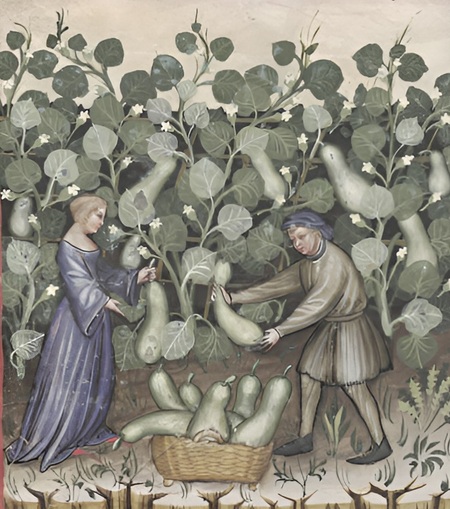
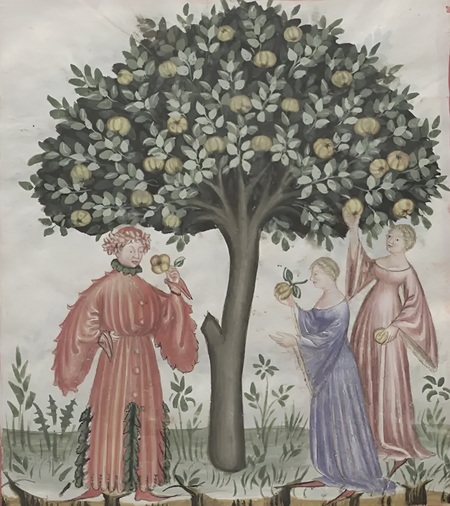
1. Unknown Artist. «Harvest of Pumpkins.» 1380–1399. 2. Unknown Artist. «Harvest of Quince.» 1380–1399.
Large pumpkins are distinguished near the ground, while quince fills the tree’s canopy. Artists utilize diverse placements for the harvest, yet in both instances, they make the fruits visually significant.
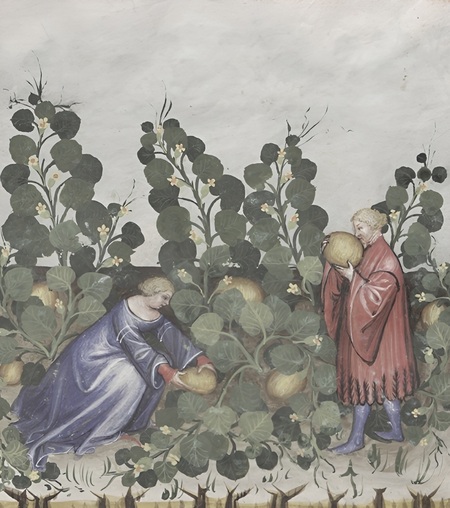
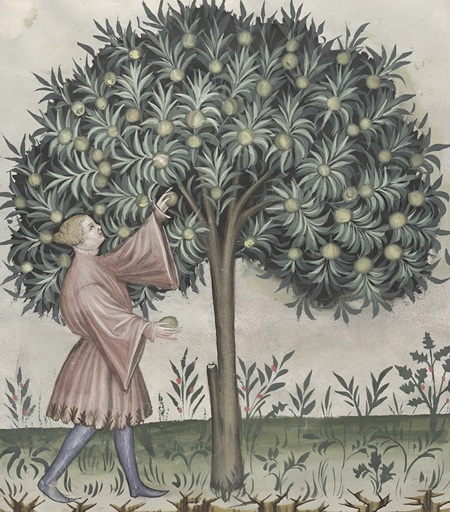
1. Unknown artist. «Watermelons.» 1380–1399. 2. Unknown artist. «Apricot Harvest.» 1380–1399.
The gathering and consumption of fruits connect natural abundance with humanity. Abundance is evident not only in the plants but also in the characters' actions.
The repetition of the fruits, their color contrast, and the large scale create an impression of rich nature.
The Language of Nature
Why can even a small plant be expressive?