Table of Contents
1. Concept 2. Ancient Egypt 3. The Middle Ages 4. Image Comparison 5. Conclusion
Concept
Cats are contradictory creatures that have pursued humanity for many centuries. Often, artists of different eras dedicate their work to cats. These fluffy animals have inspired artists since ancient times and can carry entirely different meanings. In some creations, the cat is depicted as a typical family member; in others, it symbolizes elegance, wisdom, and protection, while in some places, it is considered an ill omen bringing misfortune. This visual study is dedicated to a comparative analysis of cat imagery in two historical periods—Ancient Egypt and the Middle Ages. The selection of these periods from our history is not arbitrary, as they demonstrate to the viewer two diametrically opposed portrayals of the same animal.
The ancient Egyptians' special affection for cats is well-known. The animal attained divine status there, becoming an integral part of ancient Egyptian society, all thanks to its fierce yet protective temperament and hunting abilities. Luxurious paintings on tombs, magnificent statues, and intricate adornments—all testify to the Egyptians' deep love for cats. They respected, protected, and elevated them to the status of divine beings; killing them was strictly punished, with the perpetrator sentenced to death. Throughout the centuries, cats in Ancient Egypt maintained their high status, which is documented in ancient sources. Only with the arrival of Christianity did these animals lose their divine status.
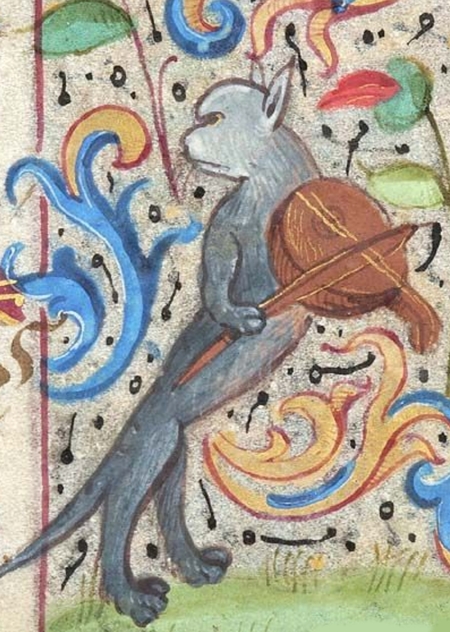
The next stage of research reflects the visualization of cats during the Middle Ages, a period when their image took on dark hues, becoming a sort of black mark in the history of creations. Throughout the Middle Ages, artists primarily depicted religious and mythological themes, imbuing every detail of their work with symbolism. Cats frequently appeared in the art of that era, but their depiction differed sharply from that of Ancient Egypt in its unreality; they evoked repulsion and aversion. Cats in various works and in the minds of different artists appeared strange and grotesque—for example, they had distorted proportions that created dissonance in the viewer’s mind; something familiar was warped to the point of absurdity, lending an unpleasant impression. At times, the animals were depicted with humanoid faces and realistic eyes that seemed to gaze directly into the soul, which only intensified the uneasy and contradictory effect.
As creatures depicted in both mundane everyday life and symbolic imagery, cats are an ideal subject for study. Through this visual investigation, I intend to trace why the image of a sacred animal evolves into something more dangerous, even demonic. My hypothesis is that the perception of the cat has been influenced by human worldviews and religions, as well as the general zeitgeist of those eras.
Ancient Egypt
Image fragment of a cat from the tomb of «Nebamun goes hunting,» circa 1350 BCE.
A drawn wild cat in the tomb of Khnumhotep II, Ancient Egypt period
The Sarcophagus of Ta-miu, Prince Tutmoses' Cat, Ancient Egypt Period
Cat killing the snake Apophis from Spell 17, The Book of the Dead of Ani, circa 1250 BCE.
Cat killing a snake, Senneches' tomb in Deir el-Medina, 1295–1213 BCE.
It is important to remember that in Ancient Egypt, cats were revered as divine beings. This is why they were depicted with exquisite refinement and sophistication, imbued with particular affection. Their hunting prowess was often praised, which led to them becoming a symbol of protection.
Mural painting, Ipuu’s tomb in Deir el-Medina, circa 1250 BCE.
Often in the frescoes, cats were depicted under women’s chairs, which could be interpreted as equating the animal with a symbol of fertility.
Bronze votive statue of a cat with kittens, circa 664–30 BCE.
The symbolism of fertility could also be traced in the statuettes of that era, where cats were depicted alongside their offspring.
Bronze statue of the goddess Bastet, 1300–400 BCE.
Statues of Sekhmet and Bastet, after 656 BCE, 664–332 BCE.
Bas-relief of the Goddess Sekhmet, 180–47 BCE
Feline traits could also be observed in some gods of Ancient Egypt.
Sarcophagus for a cat mummy, circa 305 BCE.
Sarcophagus for an animal mummy crowned with a cat, Ancient Egyptian period.
Cat Mummy, exhibited in the Louvre’s Egyptian Antiquities Department.
The cats were also escorted with special honors.
The Middle Ages
14th-century Dutch engraving.
Unknown artist, Medieval period.
Unknown artist, Medieval period.