Concept
In the 20th century, the image of the circus in art begins a gradual transformation. Where the circus was previously primarily associated with entertainment, celebration, and spectacle, Modernist and Avant-garde artists increasingly began depicting it as a space of anxiety, loneliness, and the individual’s inner isolation. This is particularly noticeable in the figures of clowns, acrobats, harlequins, and itinerant performers. Despite the vibrant costumes and theatricality, the characters in many paintings appear weary, alienated, or even tragic. I am specifically interested in this contradiction between the external spectacle and the inner state of the individual.
My interest in this topic is connected not only to the circus image itself but also to how it visually transforms in 20th and 21st-century art. I am drawn to the fact that, for many artists, the circus becomes more than just a setting—it evolves into a distinct psychological space where the boundary between performance and reality dissolves. The visual language of circus imagery allows artists to speak about human vulnerability, the social mask, loneliness, and the feeling of alienation. It is also fascinating how the theme of the circus unites vastly different artistic movements—from Modernism and Expressionism to Surrealism and Contemporary Art—while retaining recurring visual motifs: makeup, mask, stage lighting, bright color, distorted space, and theatrical poses.
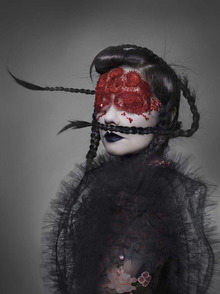
The study will feature the works of Pablo Picasso, Marc Chagall, Georges Rouault, Bernard Buffet, and Fernand Léger. While all these artists address the circus, the stage, the carnival, or the clown in different ways, they utilize similar visual mechanisms: artificial theatricality, the contrast between vibrant and somber tones, the deformation of the human figure, and the motif of the mask. The focus will primarily be on paintings. Special attention will be paid to the analysis of color, composition, space, and the depiction of the body. For instance, in Picasso’s work, circus performers are often placed in empty space and appear emotionally isolated, despite the group composition. In Chagall’s paintings, the circus transforms into an almost dreamlike space where the laws of perspective and reality are suspended. In the works of Rouault and Buffet, the clown becomes a tragic figure, hiding emotions behind makeup and a mask. For Cindy Sherman, the circus archetype already takes on an almost unsettling quality, linked to the themes of artificial personality and visual grotesque.
The study will be structured into several visual and conceptual sections. The first section will be dedicated to the circus as a space of alienation and solitude in early 20th-century modernist painting. The second section will examine the circus as a space of dreams, fantasy, and irrational perception. The third section will focus on the figure of the clown and the mask as symbols of hidden anxiety, internal fracturing, and the theatricality of human personality. This structure will allow us to trace how the same visual motif evolves across different art movements and historical contexts.
The central question of this study is why, in 20th-century art, the circus gradually ceases to be solely a space of entertainment and transforms into an image of psychological tension, solitude, and artificiality.
The Circus as a Space of Solitude
In the art of the early 20th century, the image of the circus gradually begins to lose its traditional connection to entertainment and festivity. Modernist artists become increasingly interested not in the performance itself, but in the internal state of the performers—the people who exist outside the stage. Acrobats, harlequins, and circus families in the early 20th-century art appear not as heroes of a bright spectacle, but as individuals experiencing emotional isolation.
Composition, empty space, a subdued color palette, and the static nature of figures play a particularly crucial role here. Artists deliberately diminish the sense of movement and spectacle typically associated with the circus, transforming it into a space of melancholy and inner solitude.
Pablo Picasso
Picasso’s circus themes appear rather frequently. This can be attributed to the fact that during that period—his «pink period”—the artist lived in Paris and often visited the Medrano Circus, where he observed the lives of acrobats, harlequins, and itinerant performers.
In many of Picasso’s works, circus characters become a peculiar reflection of the artist himself and the human condition in the modern world.
Pablo Picasso, «Girl on a Sphere,» 1905
The painting is built upon the contrast between a fragile acrobatic girl and the massive figure of a seated athlete. Despite the characters' shared presence, there is almost no emotional connection between them. The space surrounding the figures appears empty and lifeless, which amplifies the sense of isolation.
Pablo Picasso, «The Family of the Comedian,» 1905
The figures are rendered quite smoothly and calmly, without abrupt movements. The empty space surrounding the characters lends the composition a more static quality.
Pablo Picasso, «Family of Acrobats with a Monkey, ” 1904–1906.
Instead of vibrant circus hues, the artist employs muted pinks, ochres, gray-blues, and browns. Because of this, the circus setting feels less like an entertainment venue and more like a calm, even melancholic space.
Pablo Picasso, «The Acrobat and Young Harlequin, ” 1905.
Harlequin in Picasso’s art becomes the figure of a person existing between the stage and real life. He is always framed within a mundane, semi-empty space.
Pablo Picasso, «Acrobat and Young Harlequin,» 1905.
The Circus as a Space of Dreams
Marc Chagall
In many of Marc Chagall’s works, circus performers, clowns, and acrobats appear almost like characters from a fairy tale. They float in the air, defy the laws of space, and become part of a vibrant, emotional, and slightly irrational world. Through circus imagery, Chagall often conveyed themes of memory, inner experience, and human fragility.
Marc Chagall, «The Great Circus, ” 1956.
In comparison to Picasso, Chagall’s circus is rendered with the most vibrant energy. It captures movement, music, brilliant color, the sensation of a dream, a disruption of spatial logic, and emotional theatricality. He uses the circus—a space already brimming with color—in a slightly different way, pushing it to complete absurdity, and this satiety generates a feeling of anxiety.
Marc Chagall, «Three Acrobats,» 1926.
The figure of the juggler appears distorted, as if floating within the composition. The space of the painting violates the laws of perspective.
Marc Chagall, «Juggler,» 1943
Fernand Lege
Leje was interested in the circus as a space of movement, rhythm, and visual mechanism. Unlike Picasso or Rho, he was not drawn to the psychological aspects of the circus, but rather to its dynamics and its almost mechanical organization.
Fernand Léger, «Acrobats in the Circus,» 1918.
Fernand Léger, «Acrobats and Clowns, ” 1950.
Fernand Léger, «Circus Medrano, ” 1918