Media Concept.
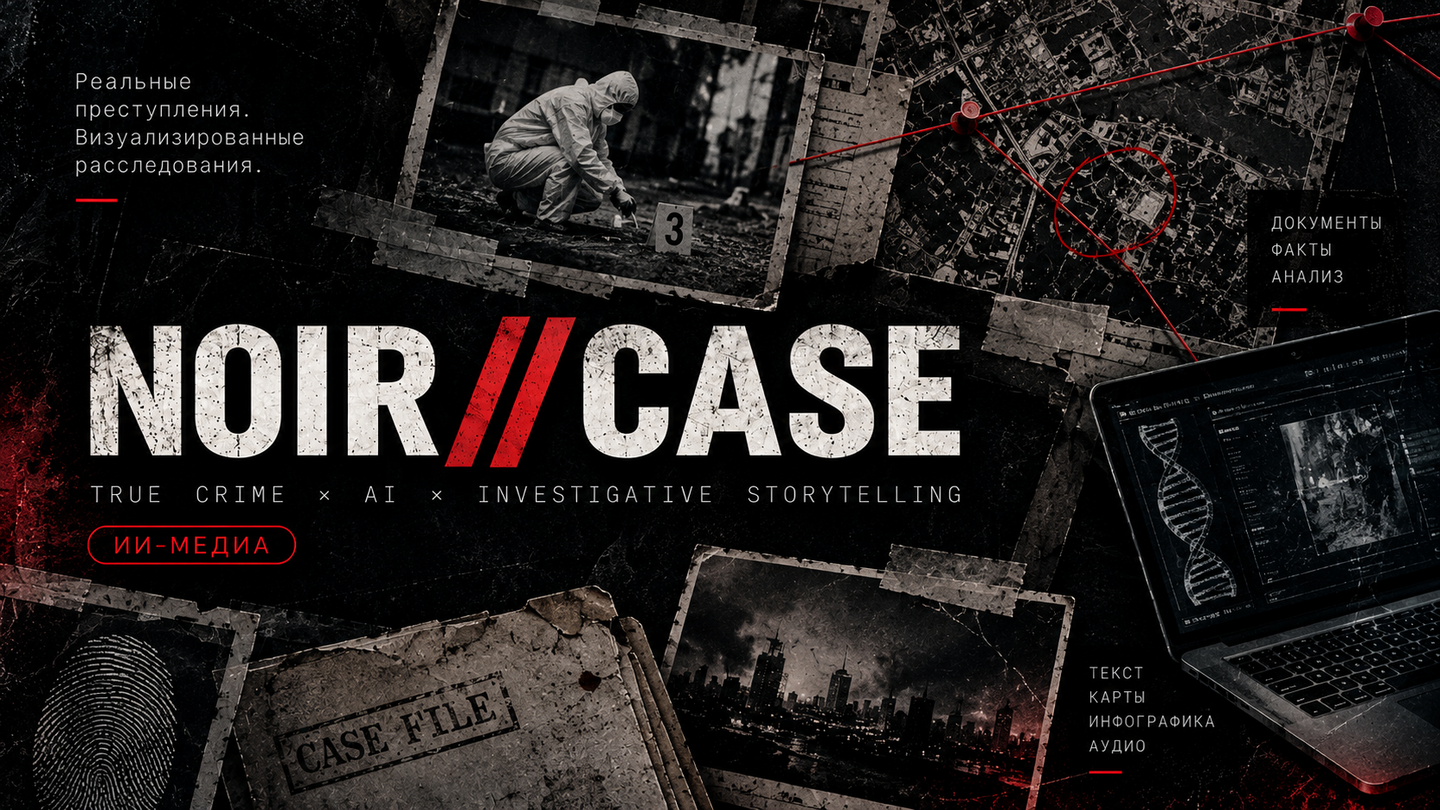
NOIR//CASE — AI Media on Crime Reconstruction. The project presents investigations in the format of digital dossiers: from the circumstances of the incident and discovered evidence to the analysis of digital footprints, investigative theories, and judicial rulings.
The main goal of the project is not just to retell crime stories, but to visually demonstrate how the evidential picture is formed and how modern technologies help reconstruct the sequence of events.
Main Format: A Telegram channel featuring textual investigations, infographics, maps, timelines, relationship diagrams, visual reconstructions, and audio materials.
Target Audience: Readers interested in real crimes and documentary investigations; students of legal disciplines and individuals interested in criminology; enthusiasts of intellectual puzzles and fact analysis; and audiences interested in AI and digital technologies.
Main Sections: CASE FILE, COLD CASE, EVIDENCE, TIMELINE, AI RECONSTRUCTION, FACT / THEORY, and BEHIND THE CASE.
Role of AI: Assistance in searching and structuring information, preparing drafts, creating diagrams, infographics, visual reconstructions, and audio versions. However, AI does not replace editorial review: facts, dates, quotes, and conclusions are verified by a human using reliable sources. Generated images are labeled as reconstructions, not as real photographs.
Data Sources for Media.
- Official Sources:
Police and law enforcement websites. Publications from the prosecutor’s office and state investigative bodies. Court decisions, trial materials, and official press releases. Public archives of government institutions.
These are used to verify core facts: dates, names, the progress of the investigation, charges filed, and judicial rulings.
- Forensic and Scientific Sources:
National Institute of Standards and Technology (NIST). National Institute of Justice (NIJ). FBI and its public information materials. Scientific publications and research on digital forensics, DNA analysis, and other expert methods.
These materials are necessary to explain how evidence examination methods work and what their limitations are. For instance, the NIJ publishes materials on digital evidence, while NIST publishes on digital forensics methodologies.
- Archival and Journalistic Sources:
Archival media publications. Investigative reports from established publications. Interviews with event participants and specialists. Historical newspaper and magazine materials.
These sources help to reconstruct context, uncover additional details, and compare different versions of events. However, journalistic publications should not be automatically considered proof of a fact; crucial information must be cross-referenced with official documents.
- Visual Resources:
Archival photographs and video recordings. Maps and site plans. Published diagrams and illustrations. Photographs of artifacts and materials, if publicly available.
These are used to prepare visual materials. If the original image is unavailable, a conditional reconstruction using AI may be created, but it must be explicitly identified.
- Sources for Research and Organization:Google Search — for locating publications and documents. Google Scholar — for finding academic articles. Google Alerts — for tracking new publications on selected topics. Official archives and search databases of government agencies.The main rule: for every investigation, you must gather several independent sources, prioritizing primary documents. If information is supported by only one publication or remains debatable, this must be noted separately in the text.
Data schema with separation for human and machine processing
- Raw Data CollectionCourt documents and official statements. Archival media publications and journalistic investigations. Scientific articles and forensic studies. Photographs, video recordings, maps, and other open materials. References to primary sources and dates of information acquisition.↓2. Primary Machine ProcessingText recognition and information extraction from documents. Data parsing and structuring. Deduplication and material sorting. Extraction of dates, names, locations, and mentions of evidence. Preliminary grouping of information by topic.↓3. Data Processing Breakdown3A. Human Processing (Human-in-the-Loop) Verification of source reliability. Fact and date checking. Separating facts, versions, and hypotheses. Analysis of contradictions between sources. Assessment of ethicality and publishability. Expert interpretation of complex evidence.3B. Machine Processing (AI/ML) Entity extraction: names, dates, and locations. Construction of a draft timeline of events. Searching for recurring mentions and connections. Classification and material grouping. Preparation of the future dossier structure.↓4. Data Integration and StructuringIntegration of results from human and machine processing. Attaching each fact to its source. Formation of the investigation file/card. Creation of timelines, evidence lists, and relationship diagrams. Tagging of facts, versions, and unconfirmed information.↓
↓5. Quality ControlMachine Check: Verification of file formats and data completeness. Search for duplicates and inconsistencies. Check for source citations.Human Review: Re-verification of key facts. Assessment of conclusion accuracy and chronology. Evaluation of material veracity and ethics. Approval of the final investigative version.↓6. AI-Assisted Content CreationDrafting textual publications. Generation of visual reconstructions. Creation of maps, timelines, and infographics. Preparation of audio versions of the materials.↓7. Final Editorial ReviewReview of text and visual assets. Cross-referencing signatures, dates, and sources. Labeling AI-generated reconstructions. Verification of the absence of fabricated details. Final publication clearance.↓8. Publication and AnalyticsPosting the dossier on Telegram. Adapting materials for other platforms. Collection of viewing statistics, reactions, and shares. Audience interest analysis. Adjustment of the future content plan.
Guidelines for Automated Services in the Scheme
- ChatGPT — text analysis and preparation.
Task: Material structuring, fact extraction, timeline compilation, and drafting publication content.
Guidelines: Provide the AI only with compiled materials and cite the sources. Ask the model to separate confirmed facts, investigative hypotheses, and unknown circumstances. Do not permit the model to independently fill gaps in the investigation. Require citation for every significant assertion. Use the result as a draft, not as a ready-to-publish, verified piece.
Example prompt: «Analyze the provided investigation materials. Compile a timeline of events, separate confirmed facts, investigative theories, and information that cannot yet be established. For every fact, cite the source. Do not add any information not present in the documents.»
- NotebookLM — Document Work.Objective: Studying a large volume of sources, legal documents, articles, and archival materials.Guidelines: Create a separate notebook for each investigation. Upload only materials relevant to the specific case. Use prompts to locate necessary information within the documents. Verify all quotes and conclusions against the original source text. Do not assume that the absence of information in the uploaded documents proves that an event did not occur.Example Prompt: «Compare the uploaded documents and find every mention of date, time, location, and digital evidence. Show in which sources each piece of information is contained, and highlight any contradictions.»
- Midjourney or Adobe Firefly — Visual Generation
Task: To create atmospheric illustrations, conditional reconstructions of locations, objects, and event circumstances.
Guidelines: Use only details confirmed by the case materials, or explicitly denote artistic assumptions. Do not create images that could be mistaken for authentic crime scene photographs. Do not depict real people in fictional circumstances as if they were documentary footage. Maintain a consistent noir style for the project: a dark color palette, red accents, and archival texture. Properly label all reconstructions.
Prompt Example: «Create a conditional visual reconstruction of an urban alleyway in a documentary noir style. Use only the following confirmed details: [list]. Do not add people, objects, or events not specified in the description. The image must be perceived as an illustration for an investigation, not as a real photograph.»
- Make or n8n—process automation.
Task: Connecting services and automating repetitive actions.
Guidelines: — Establish a unified workflow for transferring materials between the storage, database, and editor tasks. — Configure notifications for new materials and incomplete reviews. — Automatically generate publication drafts, but do not send them to the channel without human confirmation. — Save links to original sources along with the processed materials. — Do not automatically transfer personal or private data to third-party services.
Example automated process: A new topic is added to the database → an investigation folder is created → the editor gathers sources → AI assists in drafting → the editor receives a notification requiring review → after approval, the material is passed to the publishing queue.