The ammonite is a perfect natural form. It is not only an important guide fossil that holds great scientific significance but also something entirely special outside the strict confines of the scientific world.
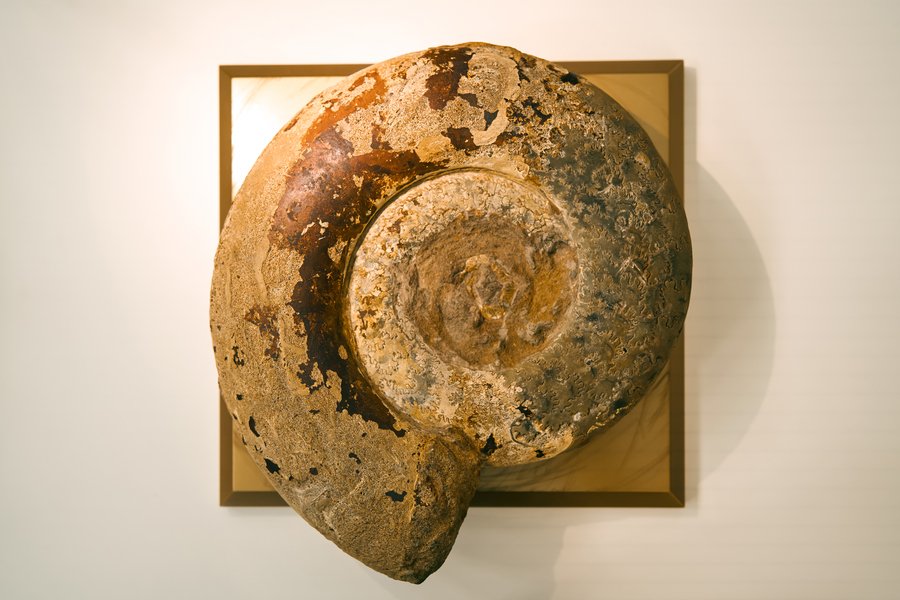
Paleontological object. Ammonite. Featured in the exhibition «12 Signs of Life» in Pavilion No. 31, «Geology, ” at the Biocluster. The specimen is from the collection of the K. A. Timiryazev Biological Museum.
The captivating spirals of ammonites inspired artists and architects, were incorporated into heraldry, and became symbols of bygone eras. In the cultures of many peoples, the fossilized shells received mythological names—“serpent stones» or «horns of Ammon» (named after the ancient Egyptian deity with ram’s horns, from which the name «ammonite» itself derived). These spirals are perceived as the material embodiment of deep geological time, a connecting thread between the world that is gone and our present.
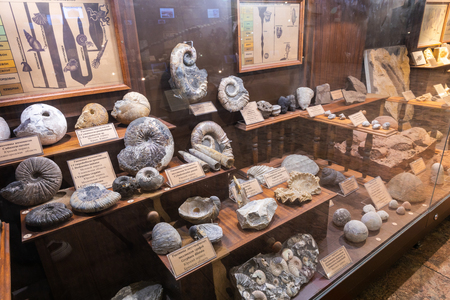
Ammonites were an extinct group of marine cephalopod mollusks, relatives of modern octopuses, squid, and nautiluses. They first appeared in the Devonian period about 400 million years ago and dominated the seas and oceans during the Mesozoic Era until they disappeared, surviving only slightly longer than non-avian dinosaurs, about 66 million years ago. Throughout their existence, ammonites developed an immense variety of forms—from flat, coin-sized discs to gigantic «wheels» exceeding two meters in diameter. In science, ammonites play an invaluable role. Due to their rapid evolution and wide geographical distribution, they became ideal guide fossils: geologists and paleontologists used them to date rock strata and correlate layers across different parts of the planet. Without ammonites, the biostratigraphy of the Jurassic and Cretaceous periods would be incomparably poorer.
Among the ammonite shells discovered by researchers and fossil enthusiasts, there is a special category—the so-called aberrant shells. This term denotes a deviation from the typical, «normal» form. Aberrancy usually refers to various growth irregularities of the shell: asymmetry, sharp fractures, thickenings, bends, changes in the coiling pattern, the appearance of abnormal ribs or spines, underdevelopment, or, conversely, excessive growth of individual parts. Several causes are possible: mechanical damage (for instance, the shell was harmed by a predator), infections or parasitism, environmental stress, and finally, genetic abnormalities—inherited or random mutations during the organism’s growth and development.
Ammonite shell of Quenstedtoceras lamberti with life damage. Quenstedtoceras lamberti Ammonite. Quenstedtoceras lamberti (Sowerby, 1819). Period: Jurassic, Middle Epoch, Callovian. From the collection of the K. A. Timiryazev Museum of Biology.
We are accustomed to viewing damage and its traces as flaws, but aberrant shells are not museum curiosities or simply «nature’s defect.» They are documented traces of life. A symmetrical, flawlessly preserved ammonite is undoubtedly an ideal paleontological specimen—an incredible find. It is beautiful, but quietly so. Another matter entirely is a shell with a covered crack, a bump that appeared in the place of an old wound, or a spire whose direction suddenly shifted after some catastrophic event in the animal’s life. In such an object, we see not just morphology, but destiny. Behind every anomaly hides a specific event: an attack by a predator, a critical change in seawater parameters, temporary famine, or disease.
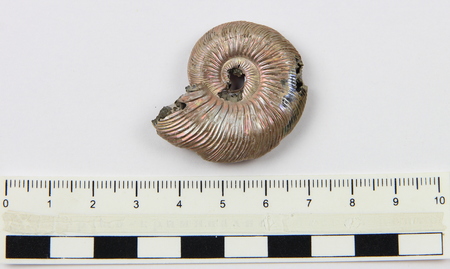
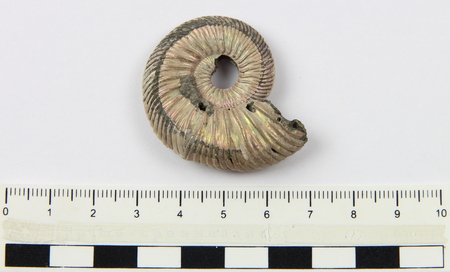
This is precisely why aberrant shells serve as valuable material for paleobiology. They allow researchers to reconstruct not only the morphology but also the ontogeny—the individual development of a specific specimen. Through them, one can determine the age at which an animal sustained an injury, how long it took to heal the damage, and how significantly the deviation affected subsequent growth. Sometimes, traces of regeneration can be observed on aberrant shells—unique evidence for paleontology that ancient organisms were capable of repairing damage, much like their modern counterparts.
It’s easy to forget, when looking at fossilized shells, that they are more than just an interesting «twisty rock.» These were once living organisms that grew, suffered, adapted, fought for survival, and eventually died. Aberrant shells are the actual trace of their history—a preserved moment that bears the living testimony of what happened and endures in time.
The ideal spiral is mathematics. But the fracture overgrown with a new layer of aragonite—that is life.