Multiple Identity
In the era of developed platform capitalism and total digitalization, the human «self» has completely lost its monolithicity. Modern individuals are forced to engage in constant cognitive and social switching, consciously and unconsciously toggling between radically polar modes of representing their identity. This process is no longer a marginal or crisis state, as classical psychoanalytic tradition described it as the defense mechanism of splitting. Multiplicity and fragmentation have become the new ontological norm and a fundamental characteristic of existence. The discursive field of this issue has begun to actively form at the intersection of the 20th and 21st centuries, when sociologists and philosophers such as Zygmunt Bauman with his concept of «liquid modernity,» Kenneth Gergen with his theory of the «saturated self,» and later digital culture theorists like Lev Manovich, documented that the technological environment demands that individuals produce multiple avatars, profiles, and digital footprints.
The issue is that interfaces—from government services and medical portals to Tinder, LinkedIn, and anonymous Telegram channels—institutionally fragment the human being into functional components. Alienation occurs. Loved ones see us as emotional and vulnerable, employers see us as efficient, and dating app algorithms view us as a collection of consumer tags. When looking inward, a person discovers the impossibility of assembling these fragments into a unified narrative. A therapeutic yearning for wholeness arises in a world where social survival directly depends on the quality and speed of simulating different identities. Accepting this fragmentation or resisting it through attempts at «digital asceticism» becomes a key strategy for modern people.
Cao Fei — RMB City, 2007–2011
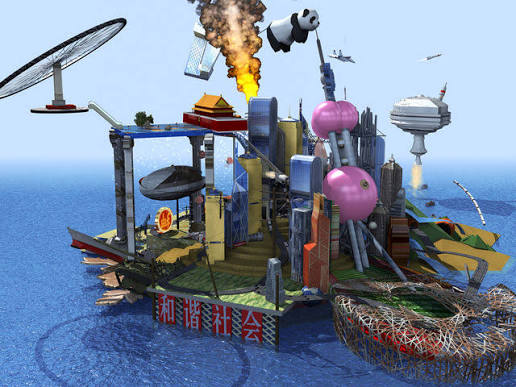
In 2007, the project developed as a large-scale total installation and a virtual platform based on the Second Life platform until 2011. The first presentation of the physical documentation took place at the 52nd Venice Biennale in 2007 and at the Serpentine Gallery in 2008. Media art, virtual architecture, digital performance, video art.
In RMB City, my avatar, China Tracey, lives a completely different, experimental life—one separate from my physical reality. This virtual city has become a laboratory where Chinese society, utopias, and dystopias are reassembled through new identities. <…> The boundaries between my real self and my digital avatar blur here: the avatar is not just a mask; it is a subject that generates new meanings and possesses an economic and creative freedom unavailable within the rigid confines of physical Beijing.
Cao Fei’s project conceptually links to the stated theme through the investigation of the avatar as a radical tool for the decentralization of the «self.» The artist utilizes the virtual world medium of Second Life not merely as a space for representation, but as an ontological alternative. The specific artistic solution involves creating an alter ego—Chinese Tracy—who does not duplicate Cao Fei but enters into a dialogue with her identity. The project’s elements—the chaotic, eclectic landscape of RMB City, which mixes Communist symbols, consumerism, and unfinished skyscrapers—mirror the internal architecture of the fragmented consciousness of modern humanity. Cao Fei argues that in digital space, individuals are forced to construct themselves from scratch using pixels and scripts, creating an identity that conflicts with their embodied, physical experience. This directly relates to the thesis that we live autonomous, and sometimes mutually exclusive, lives across different websites and platforms. In RMB City, multiplicity is celebrated as a liberation from state and social dogma, yet within this lies anxiety: the avatar becomes more visible, influential, and aesthetically complete than the living artist herself, thus deepening the crisis of assembling a cohesive self-image.
Amalia Ulmman — «Excellences & Perfections, ” 2004
April–September 2014. The first institutional exhibition in a physical space took place at the Tate Modern, and in 2016, as part of the Whitechapel Gallery. Network performance, Instagram art, digital photography, mystification.
The idea was to prove that femininity is not an inherent state, but a construct—a performance, an outfit you can put on or take off. I studied the language of Instagram, the aesthetics of popular bloggers, to create a scenario that people would accept at face value. <…> It was a performance designed to dismantle the myth of authenticity on social media. People believed this lie because it aligned with the platform’s algorithmic expectations of what a «country girl conquering the metropolis» should look like. My true self at that moment was completely hidden and erased by the rules of the game.
Amalia Ullman’s work is an investigation into interface alienation and simulated identity, directly addressing the core issue under examination. Ullman’s artistic approach is built upon total misrepresentation within the Instagram platform. By dividing the performance into three acts—"cute girl,» «sugar baby / post-plasticity escort aesthetic,» and «mindfulness and yoga"—Ullman vividly demonstrates how the digital environment compels an individual to format their «self» to fit rigid clichés and audience expectations. Every element in the frame—from bleached sheets and branded bags to fake tears and poses—is analyzed by us as a visual code of fragmentation. Ullman presents an identity mode analogous to a profile on a «dating site» or «social media platform» mentioned in the assignment’s theme. Her performance proves that in digital space, it is impossible to present an authentic, unified «self» because the interface itself only promotes the commodity-like appearance of an identity surrogate. The Instagram profile in this instance functions as an alienated prosthesis of the self. The tension between the artist’s real state (who was recovering from a serious accident during the performance period) and the glossy image exposes the tragic impossibility of being whole—the subject becomes trapped in the snare of their own constructed and monetized digital double.
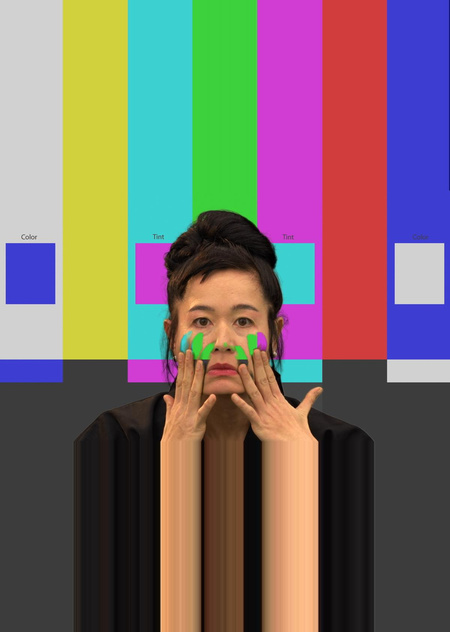
Hito Steyerl— «How Not to Be Seen: A Fucking Didactic Educational .MOV File, ” 2013
- First shown at the 55th Venice Biennale (2013) as part of the «Illuminations» pavilion. Essayistic video art, 3D animation, digital installation.
«Today we are caught between two opposing demands: we are obligated to be constantly visible—recorded by cameras, registered in databases, digitized—and yet, we want to disappear, to become invisible to protect ourselves. <…> Being invisible in a world of total digital surveillance and facial recognition regimes is a military strategy. Our image no longer belongs to us; it is fragmented, compressed into pixels, and distributed across servers. To become a pixel, to become screen resolution, to hide in the noise of the data—perhaps this is the only way to preserve the remnants of subjectivity.»
The video essay by Hito Steyerl examines the issue of multiple identities from political and technological perspectives—through the lens of the subject’s total fixation by state and corporate interfaces (analogous to «State Services» or «clinics»). Steyerl’s artistic solution is an ironic «tutorial video,» where real people attempt to merge with satellite calibration targets in the desert or wrap themselves in green chroma key fabric. Analyzing this project within the context of our theme, we see that the inability to «assemble oneself into a coherent image» is caused by the fact that the algorithms of the military-digital complex (surveillance cameras, facial recognition systems, digital scoring) inherently perceive the human as a fragmented set of biometric data. Steyerl visualizes this disintegration, transforming human figures into digital noise and low-resolution pixels. The connection to our theme reaches its apex here: the subject is forced to fragment and conceal elements of their identity precisely because the «coherent image» has become a target for control and exploitation. The attempt to hide, to become invisible, to blur one’s contours within interfaces—this is a radical response to the compulsory cataloging of the human in the modern world.