In the Picture of the Day section, on September 16, we are discussing Andrea Mantegna’s painting, «Dead Christ,» circa 1483.
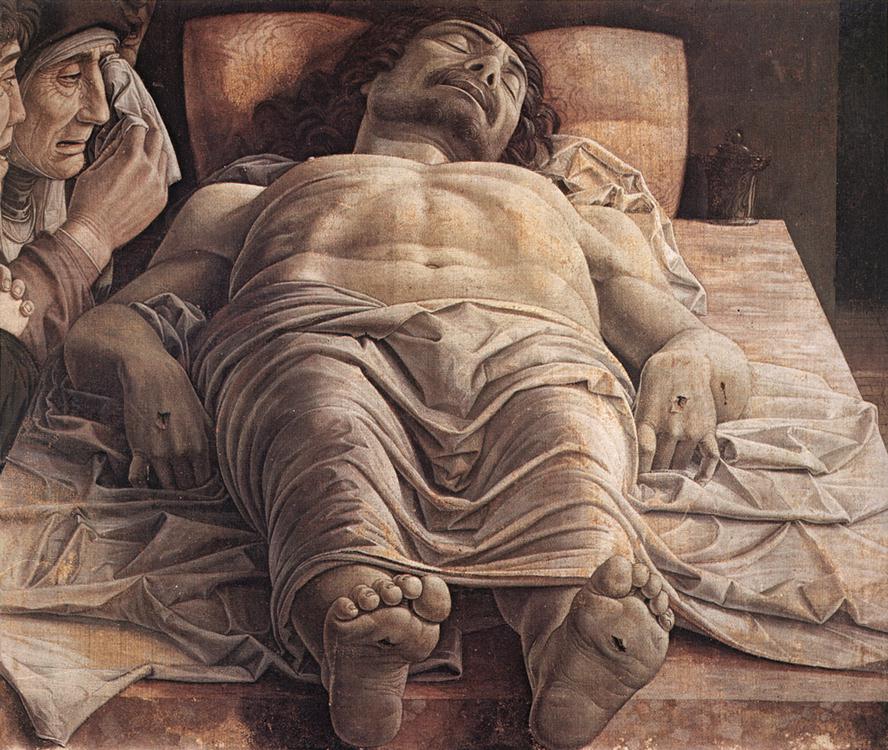
The body of Christ, lying on the marble slab and surrounded by Saint John, the Theotokos, and Saint Mary Magdalene, is the main element of the work and the center of the composition. The subject of the Lamentation of Christ was particularly popular during the Renaissance and Baroque periods, but no one depicted it like Mantegna did.
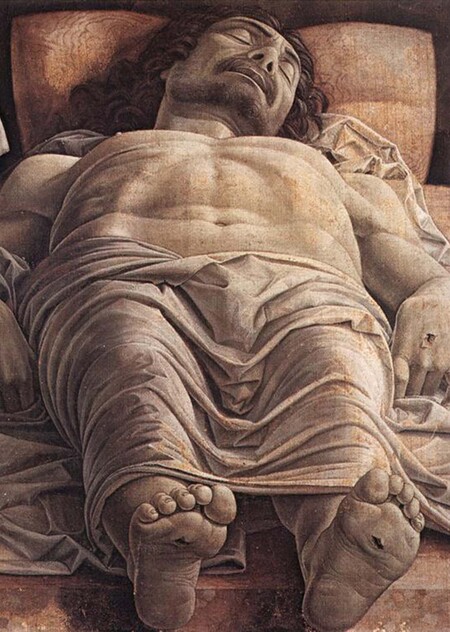
This work stands out due to its unusual compositional solution: the body of Christ is depicted perpendicular to the picture plane. The mantle defies the mathematical laws of linear perspective to create a cohesive image—it has reduced the size of the feet, which would obscure a large portion of Christ’s body if proportional, and unnaturally exaggerated the size of the head. These distortions are neutralized using reverse perspective (a technique characteristic of an earlier period in art history, used for medieval imagery).
The emotional tension in the work is conveyed not only through compositional structure but also through a spare, colorful palette: the color scheme not only suggests the pallor of the body but also seems to mimic it with stone washes. Tension is further emphasized in the depiction of other characters—only faces drawn with sorrow and strained hands are visible. Against the almost monochromatic background, a barely perceptible halo stands out, offering a hope for Christ’s resurrection.
«Dead Christ» was considered Mantegna’s property—he kept it with him until the end of his life. The canvas was only discovered in his studio after the artist’s death. Although the dating of the painting remains a subject of debate, it is currently believed that it was completed in 1483.
The painting is currently housed in the Pinacoteca di Brera in Milan.