Contents
1. Concept
Concept
Cleopatra VII is one of the most famous rulers of the ancient world. However, much of her modern renown is not based on surviving evidence of her political activities but on the image that developed after her death. In European culture, Cleopatra often appears as a beautiful and dangerous woman capable of influencing powerful men, surrounded by luxury, and who takes her own life. This image has become so ingrained that the historical personality is often obscured by artistic myth.
This study examines how this myth was formed and what visual devices artists of different eras employed. The main focus is on the transition from the image of a ruler to that of a heroine in a tragic narrative. Key materials include works created during Cleopatra’s lifetime or shortly thereafter, as well as medieval manuscripts, drawings, engravings, and paintings from the 16th and 17th centuries. Comparing these sources reveals that the perception of the queen was not static—it evolved alongside political circumstances, literary sources, and artistic objectives.
Cleopatra VII ruled Egypt from 51 to 30 BCE and belonged to the Ptolemaic dynasty—a Greek royal family that established power in Egypt after the death of Alexander the Great. Her reign coincided with a period of active Roman influence expansion in the Eastern Mediterranean. Her relationships with Julius Caesar and Mark Antony were tied not only to personal matters but also to an effort to preserve Egypt’s standing amid Roman political struggles. Therefore, reducing her biography to a story of romantic relationships oversimplifies the historical situation and repeats an interpretation that became prevalent in later literature.
The first stage of the research is devoted to the contemporary image of Cleopatra. Coins featuring her profile and temple reliefs allow us to examine how the queen presented herself to different audiences. On the coins, she is depicted in the tradition of Hellenistic royal portraiture, while in the Egyptian Temple of Dendera, she is shown in accordance with the canon of Pharaonic power. These works are important not only as potential evidence of Cleopatra’s appearance but also as documents of her political self-presentation. They demonstrate that the ruler’s image was constructed taking into account the cultural environment and served a specific social function.
The second stage relates to how Roman authors portrayed Cleopatra after her defeat and death. In accounts of Mark Antony, her influence is often attributed to her beauty, wealth, and ability to affect emotions. However, ancient texts were created within a specific political and literary context. Rome’s victory over Egypt was accompanied by the formation of an image of Cleopatra as a dangerous foreign ruler who allegedly subjugated a Roman general. Therefore, written testimonies must be compared with material artifacts and their period of creation must be considered.
The third stage examines the medieval and early Renaissance perception of the queen. In Giovanni Boccaccio’s De mulieribus claris («Of Famous Women»), the biographies of historical and mythological heroines are unified into a moralizing narrative. Cleopatra is included in the European tradition of tales about famous women. During the Renaissance, the renewed interest in antiquity brings her back into the sphere of painting and printmaking. In this context, artists reference not historical reconstruction but specific legendary episodes, primarily the queen’s death.
The final stage focuses on the 16th and 17th centuries, when Cleopatra’s death transforms into an independent artistic subject. In drawing, engraving, painting, and sculpture, artists interpret her final moments in diverse ways. The snake, the royal diadem, the bed, the nude body, gesture, and facial expression become the elements through which the viewer recognizes the heroine. The comparison between 16th-century graphic works and 17th-century Baroque painting is particularly illustrative: some works feature a restrained composition, while others convey emotional tension and sensual expressiveness.Therefore, this study does not aim to reconstruct Cleopatra’s appearance or provide an exhaustive biography. Its goal is to demonstrate how a historical figure metamorphosed into an artistic image and why themes of female power, beauty, and death became central to subsequent cultural memory. It is also crucial to consider the boundaries of accuracy: later paintings are not portraits of Cleopatra, and the traditional narrative of her death by snakebite remains one of several ancient versions, rather than an indisputably established fact.
Historical Cleopatra: ruler of the ancient era
The Woman Remembered in Legend
Cleopatra VII is known as the last ruler of independent Hellenistic Egypt. However, in European culture, her name has become primarily associated with beauty, seduction, and tragic death. There is a significant distance between historical evidence and this enduring image.
Two Images of Cleopatra
Historical Cleopatra was a participant in the political struggle to preserve the Egyptian state. Artistic Cleopatra is a heroine whose characteristics were defined by the perceptions of artists and audiences from different eras. These two images intersect, but they are not the same.
Ptolemaic Dynasty of Egypt
Cleopatra belonged to the Ptolemaic dynasty, which was established after the collapse of Alexander the Great’s empire. The rulers of this dynasty originated from the Macedonian Greek milieu but governed Egypt, a land possessing its own religious and artistic traditions. Consequently, the culture of Cleopatra’s era blended Hellenistic and Egyptian elements.
Alexandria — center of power
Alexandria was the capital of Egypt and a vital hub of the Eastern Mediterranean. Trade routes, political interests, and the cultural traditions of various peoples converged there. It was in this environment that Cleopatra forged her power and presented herself as a sovereign ruler.
Cleopatra VII: Beginning of Reign
Cleopatra became queen in 51 BCE after the death of her father, Ptolemy XII. Initially, she ruled jointly with her younger brother, Ptolemy XIII. Dynastic conflicts soon escalated into a fight for the throne.
The Struggle for Power
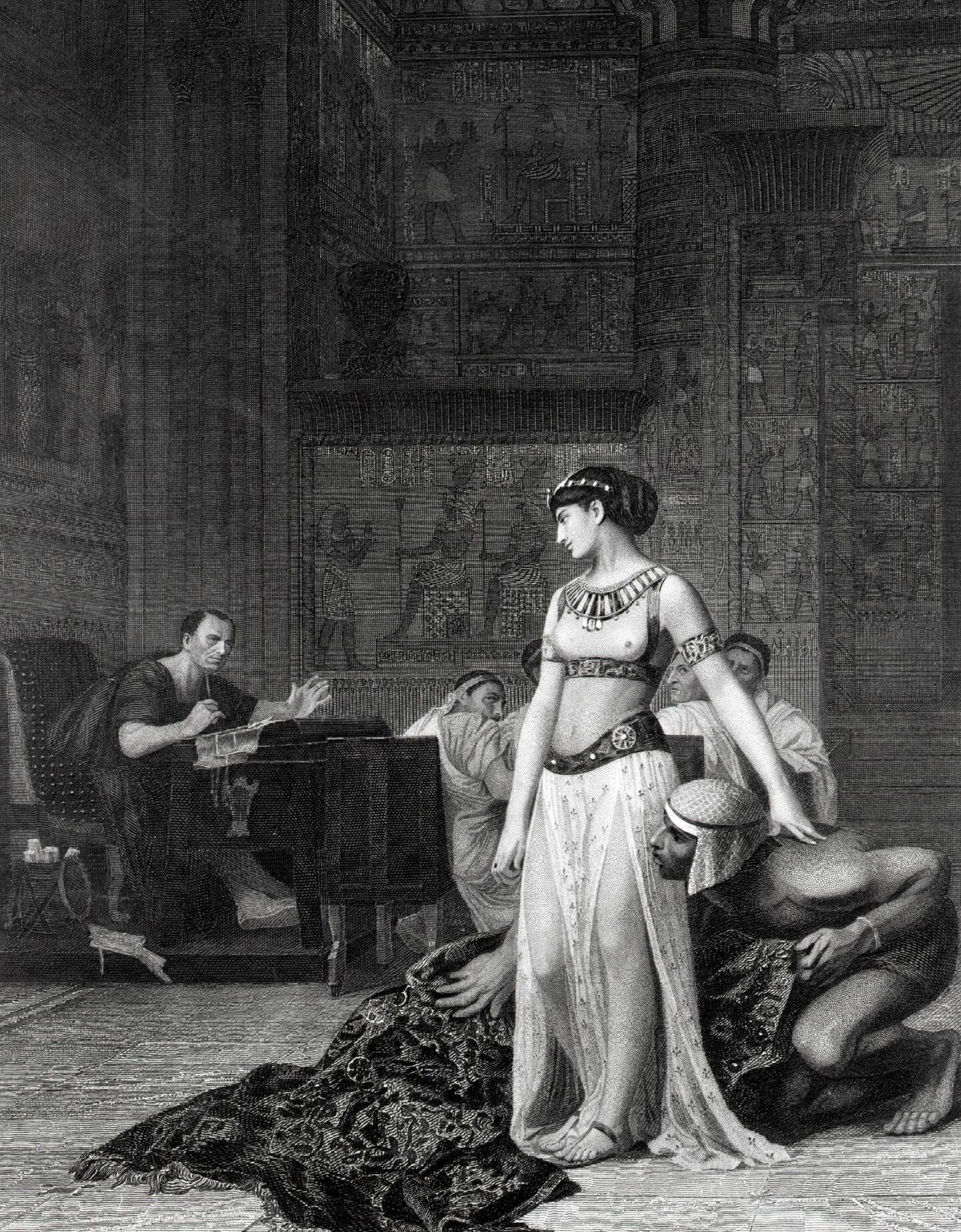
Cleopatra’s position was precarious. Her conflict with Ptolemy XIII led to the intervention of Julius Caesar, who was in Alexandria during the Roman Civil War. Subsequently, Caesar’s support helped Cleopatra restore her standing as ruler.
Cleopatra and Julius Caesar
Cleopatra’s alliance with Julius Caesar had both personal and political dimensions. For the queen, he represented an opportunity to strengthen her position and secure the backing of an influential Roman politician. In later culture, this relationship was frequently depicted as a romantic story, although its political significance was no less vital.
Caesarean — heir
Ptolemy XV Caesarion, son of Cleopatra, was presented as the heir to royal power. His connection to Julius Caesar held significant political weight, as it could bolster the dynasty’s position. The image of the mother and son in Egyptian temple art emphasized the continuity of power.
Mark Antony
After the assassination of Caesar, Mark Antony became one of the principal players in the struggle for power in Rome. His alliance with Cleopatra was tied to the distribution of political influence in the Eastern Mediterranean. Egypt’s resources and the queen’s standing were important to Antony, while his military strength was vital to Cleopatra.
Political Alliances and Personal Relationships
Later authors often attributed Antony’s defeat to his reliance on Cleopatra. However, such an explanation oversimplifies the causes of the conflict. Their relationship should be viewed within the context of the power struggle between Antony and Octavian.
The Battle of Action