Contents
Introduction.
Chapter 1. The Search for Form.
Chapter 2. The Ideal in Motion.
Chapter 3. Change in Canon.
Chapter 4. Change in Proportions.
Conclusion.
Concept
The 5th–4th centuries BCE mark the flourishing of ancient Greek sculpture. During this period, classic ideals of the human form were established. Sculptors studied anatomy, proportions, weight distribution, and movement, striving to create the perfect human image.
In the 5th century BCE, the ideal figure was built upon the proportionality of the body’s parts, developed musculature, and balance. Sculptors depicted not a specific individual, but a generalized image of physical perfection. By the 4th century, this approach began to change: masters started treating proportions more freely, paying greater attention to the naturalness of the pose, the softness of the body, and the variety of movement.
Changes in art occurred simultaneously with shifts in Greek society. This study examines the works of Polykleitos, Myron, the masters of the Parthenon, Praxiteles, Scopas, and Lysippos. The main focus is on proportions, body structure, figure pose, surface treatment, and the conveyance of movement.
Project Goal: To analyze and illustrate the evolution of the approach to depicting the ideal human form. Thesis: The representation of the ideal body in ancient Greek sculpture involved not only mathematical precision of proportions but also visual appeal rooted in cultural and societal values.
Chapter 1. The Genesis of the Canon.
Historical Context:
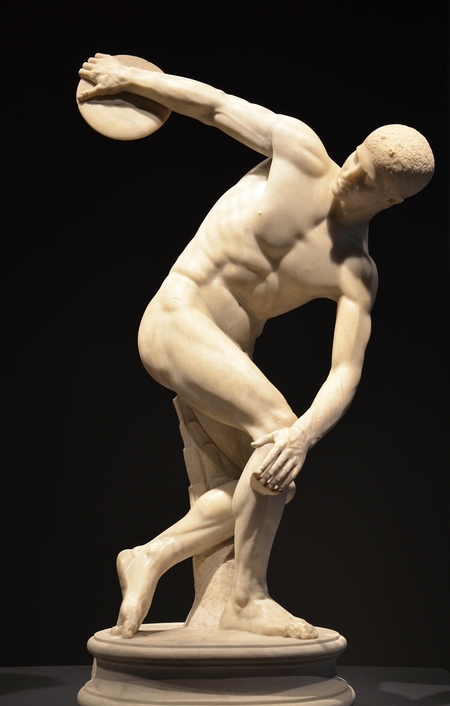
In the 5th century BCE, the Greek polis remained the central hub of social, political, and religious life. The citizen was primarily viewed as a member of the urban community, from whom participation in its defense and governance was expected. Physical fitness was linked not only to athletic competitions but also to the preparation of future warriors. A developed, trained body was considered one of the merits of a free man.
Greek culture held a concept of kalokagathia—the union of physical beauty and moral virtue. Physical perfection was associated with upbringing, self-control, and dignified behavior. These ideas did not constitute a single, mandatory system for all Greeks, but they were important to classical culture.
The flourishing of Athens coincided with the large-scale construction of temples and public buildings. Sculpture played a role in creating the image of a thriving polis. Depictions of gods, heroes, and athletes embodied the concept of the ideal human, and bodily beauty was linked to harmony and proportion.
At the same time, Greek culture was not isolated from neighboring peoples. Maritime trade connected the cities with Asia Minor, Egypt, and the Eastern Mediterranean. Through these contacts, new materials, craft techniques, and artistic motifs were disseminated. However, the classical ideal of the body primarily developed within the Greek tradition, where athletic competitions, the depiction of nudity, and the search for proper proportions held a special place.
1.1 — Doriform Polyclade
«Doryphoros, ” created around 440 BCE, depicts a nude figure of a young spear-bearer. The original bronze has not survived; the work is known through Roman marble copies.
Polykleitos sought to define the proportions of the perfect human body. He set forth his ideas in the treatise „Canon, ” which has not reached us.
The basis of the composition is the chiasmus—a cross-correspondence between tense and relaxed parts of the body. The supporting right leg is contrasted by the more active left arm, and the free left leg is balanced by the relaxed right.
Thanks to this arrangement, the figure appears natural, although its pose has been meticulously calibrated. Polykleitos achieves equilibrium without full symmetry.
The proportions of individual parts are coordinated with each other. For a clear explanation of Polykleitos’s canon, a conventional ratio of head to height of 1:7 is often used. However, the precise numerical relationships proposed by the sculptor are unknown.
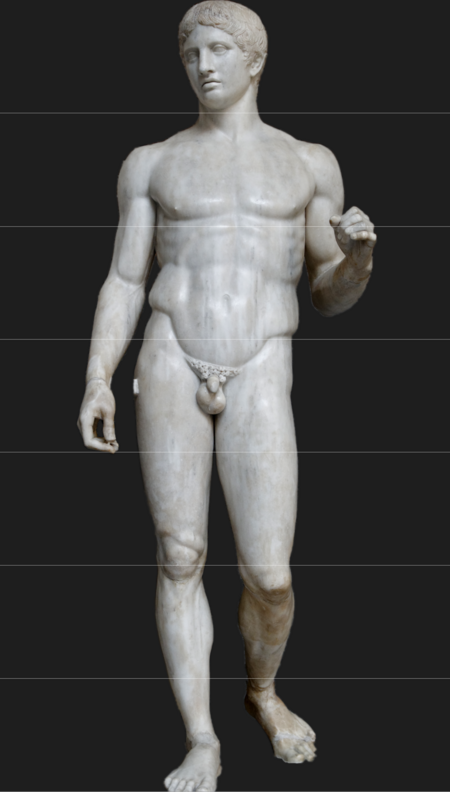
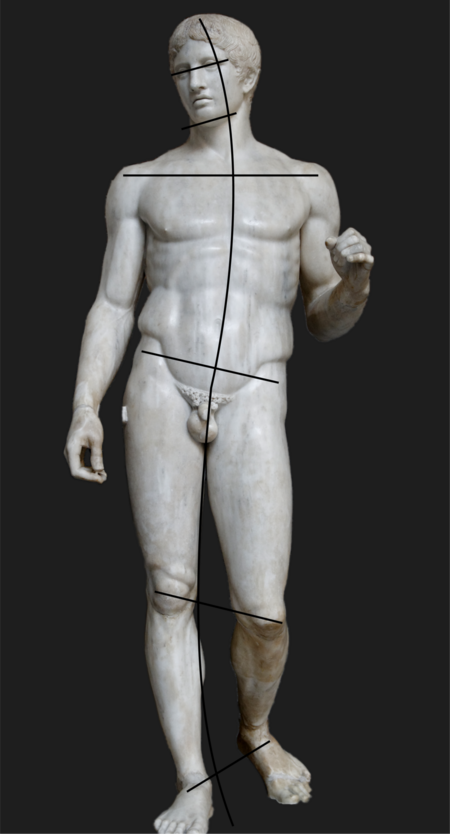
In the «Dorophore,» broad shoulders are paired with a relatively narrow pelvis, and a developed ribcage features distinctly defined abdominal muscles. The musculature of the arms and legs is rendered with sufficient detail, yet without excessive volume.
The figure’s posture is no less important. The weight is shifted onto the right leg, while the left is relaxed and slightly drawn back. The hip tilts to one side, and the shoulders tilt in the opposite direction. This stance is called contrapposto.
The proportions of individual parts are coordinated with one another. For a clear explanation of Polykleitos’s canon, the conventional ratio of head height to total height of 1:7 is often used. However, the precise numerical relationships proposed by the sculptor remain unknown. In the «Doryphoros,» broad shoulders are combined with a relatively narrow pelvis, and a developed ribcage is matched with clearly defined abdominal muscles. The musculature of the arms and legs is rendered in considerable detail, yet without excessive amplification of volume.