INDEX
- Concept 1.1. Core Research Question 1.2. Material Selection Principle 1.3. Structuring Tactics
- Returning to the Roots: How Sarcophagi Became Alive
- Italian Traditions: Rigidity Against Art
- Volumetric History
- Conclusion
CONCEPT
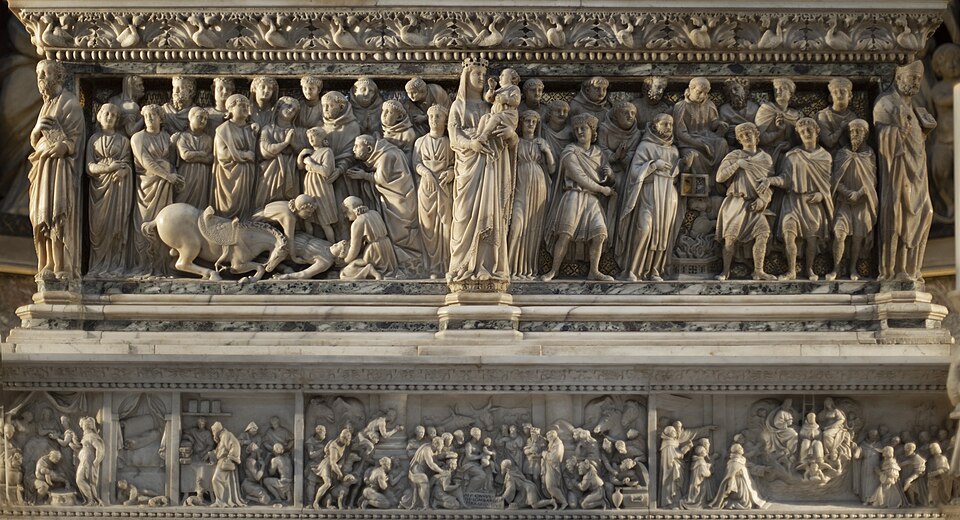
The goal of this study is to trace the similarities and unique characteristics of ancient sarcophagi and how they influenced the development of Italian Gothic in the 13th century and the early Renaissance period. Art during the Proto-Renaissance, beginning around the 1200s, emerged prominently in sculpture. Niccolò Pisano is generally credited as the founder of Proto-Renaissance sculpture; his development involved studying Roman sculpture and reinterpreting ancient images, infusing them with new meaning. However, one of his primary inspirations for the formation of Italian sculpture remains the sarcophagi. It is the specific nature of the reliefs and the beauty of the ancient sarcophagi that further influenced the new solutions adopted by Italian masters and the recognizable imagery of the Renaissance era.
Key research question
How did the return to the origins of sarcophagus ornamentation influence the rethinking of Italian Gothic?
My goal is also to research and study the depiction of graceful and monumental human figures on hard materials and how their volume aids in better understanding the formation of Italian Gothic. Investigating how one can carve an incredibly detailed crowd of people into marble and breathe life into them leads me to consider how phenomena such as burial traditions and flat stained glass managed to become volumetric.
Material Selection Principle
Attach Profile Card The materials used for this research draw upon the distinctive features of marble reliefs and ancient sarcophagi from ancient Rome, which have roots tracing back to ancient Greece and the burial traditions of ancient Egypt, where openwork bas-reliefs were carved onto the lids of monuments, frequently depicting themes from ancient Greek mythology. Each relief and design on the sarcophagi refers not only to appeals to the gods and the protection of the deceased but also narrates an entire story through voluminous figures, which were absent in Italian Gothic art.
Structuring Tactics
Beginning with the origins of ancient Egyptian burial practices and concluding with the depiction of volumetric human figures, this study will proceed chronologically, highlighting visual similarities and comparisons with sculptures from antiquity and Italian Gothic art. This approach allows us to trace evolving and recognizable forms across epochs by immersing ourselves in the historical context, thereby enabling a deeper appreciation for the uniqueness and beauty of the sculptures.
A Return to the Roots: How Sarcophagi Came Alive
Sarcophagus (from Ancient Greek $\sigma\alpha\rho\kappa o\phi\acute{\alpha}\gamma o\varsigma$, sarkophágos — «flesh-eater») is a type of traditional coffin used for the burial of the nobility, usually kept on the surface in specially designated chambers or cemeteries. Common as early as Ancient Egypt, the first sarcophagi were typically crafted from expensive woods and adorned with painting, sculpture, and inscriptions. They were placed in tombs and temples.
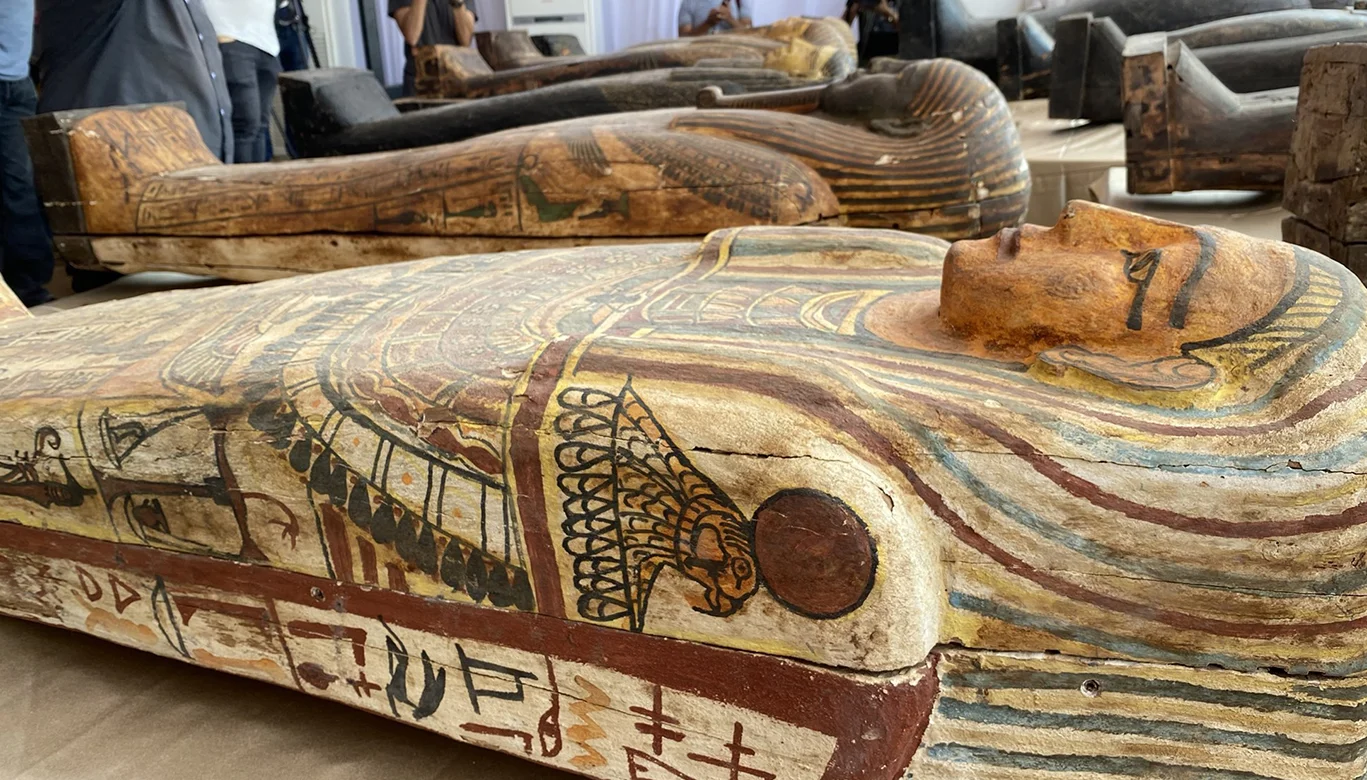
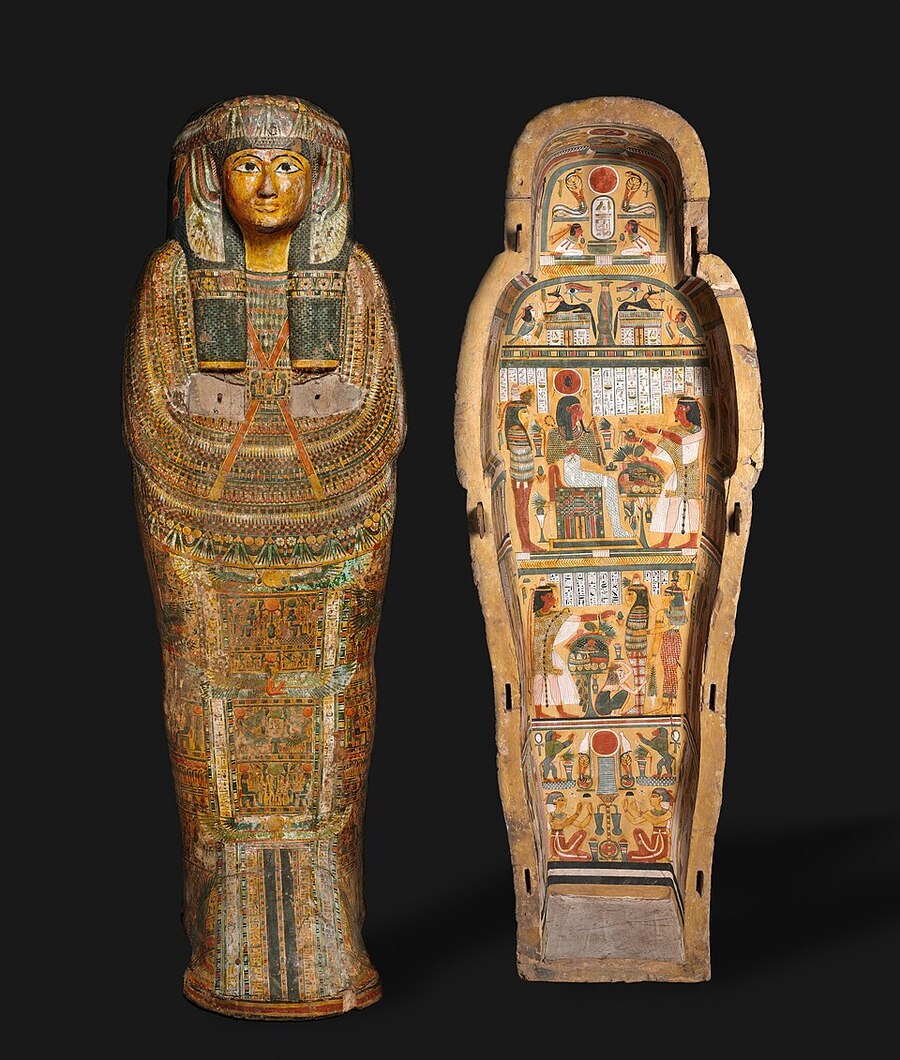
Most often, the purpose of sarcophagus paintings and decorations signified not only belonging to the nobility but also protection from evil spirits and the afterlife transition of the deceased.
When Egypt fell under Roman rule in 30 BCE, following the deaths of Queen Cleopatra VII and Mark Antony, Egyptian sarcophagi abandoned the customary depictions of «deified» the deceased, beginning instead to incorporate realistic portraits with chiaroscuro, presenting the individual as vividly alive.
Later, during the late periods of ancient Greek and Roman culture, the term «sarcophagus» came to refer to all kinds of tombs, regardless of the material they were made from. Roman sarcophagi adopted their form from the Greeks, specifically taking the appearance of marble, porphyry, or other boxes with vertical sides meeting at a right angle or rounded, featuring bas-reliefs on the front and side panels.
The progression from the flat engravings found on Egyptian sarcophagi to the three-dimensional reliefs depicting entire historical epochs can be compared to the transition from Italian Gothic to the Renaissance, where flat and heavy walls finally achieved the illusion of three-dimensionality through an emphasis on bodily dynamism and an emotional engagement with the architecture.
Italian Traditions: Discipline in the Face of Art
The Gothic style first emerged in Italy in the 12th century, thanks to monks of the Cistercian and Franciscan orders. However, the Cistercians prohibited any form of artistic expression, including sculpture and stained glass. The architecture consisted only of what held significant practical value.
The Cistercians were proponents of a stricter adherence to the rules of Saint Benedict, which is the monastic rule encompassing labor, obedience, and independence from material needs. The first Gothic structures in Italy were the Cistercian churches of the Fossanova Abbey and the Casamari Abbey.
The Church in Kazamari was originally built as a Benedictine monastery but was later completely reconstructed in accordance with the standards of simplicity and asceticism adopted from the Cistercians.
The new element introduced by Cistercian architecture was the absolute rigor with which the Benedictine idea of the monastery as an exemplary «City of God» was rendered into architectural form—a form stripped of everything extraneous and unnecessary, expressed through simple volumes and the swift dynamism of its lines. At the core of Cistercian architecture, which tended to transform volumes into symbols and imagery, was the preservation of the constructive and semantic significance of all forms, a clear structuring of architectural modules, and meticulous proportional balance.
The lack of pretension—simplifying and minimizing all superfluous details that did not serve the primary function—facilitated construction and reduced the building’s cost.
Gothic sculpture first appeared in the southern part of Italy—Apulia and Sicily—which were hereditary royal domains of the German Emperor Frederick II. He invited French, German, and local sculptors and artists to his court.
Volume History
Early Christian art quickly adopted the sarcophagus, which became the most common form of early Christian sculpture—evolving from simple, symbolic examples to complex compositions, often featuring small scenes from the life of Christ arranged in two tiers within architectural framing.
It is also worth noting the cheerful influence of the Etruscans, a pre-Roman civilization from the 1st century BCE, who practiced both cremation and inhumation (burial in a tomb). This influenced the formation of subsequent imagery on sarcophagi. Like the Romans, the Etruscans frequently depicted scenes of love and hunting, banquets, and human figures. Thanks to new modeling techniques and methods on sarcophagi, the masters learned to tell independent narratives through recognizable characters from myths and tales. These depictions included erotes, nereids, Bacchic scenes, and episodes from stories about gods and heroes—predominantly those expressing ideas about the transience of human life and the afterlife.
Prominent characteristics of volumetric illustration can already be traced in early Egyptian sarcophagi.