Tex Avery
Navigator
Concept
Introduction
Analysis Methodology: A System of Aspects — Plastic Grotesque and Anatomical Deformation — Bodily Expression of Extreme Emotions — Interaction of Character Bodies with the Environment, and Their Transformation into Objects — Use of Stylized Devices
Film Analysis by Aspects 2.1. Red Hot Riding Hood (1943) 2.2. Northwest Hounded Police (1946) 2.3. The Cat That Hated People (1948) 2.4. Bad Luck Blackie (1949) 2.5. Symphony in Slang (1951)
Conclusion Bibliography
Concept
Tex Avery’s animated films from the golden age of Metro-Goldwyn-Mayer (MGM) represent a unique phenomenon of popular culture, brimming to the extreme with eccentric «gags.»
The director’s signature comedic techniques are immediately recognizable to the viewer and differ radically from the canonical animation of that era—which was built on Walt Disney’s school of principles: «the illusion of life,» natural plasticity, sentimentality, and adherence to the physical laws of the real world, as well as their imitation. Tex Avery and his animated films are celebrated for radical, grotesque deformations that serve not merely as visual ornamentation, but as the primary tool for expressing the characters' extreme, peak emotions.
The study material consisted of a chronological sequence of eight short animated films from MGM studio: «Red Hot Riding Hood» (1943), «Northwest Hounded Police» (1946), «Lucky Ducky» (1948), «The Cat That Hated People» (1948), «Bad Luck Blackie» (1949), «Little Rural Riding Hood» (1949), «Ventriloquist Cat» (1950), and «Symphony in Slang» (1951).
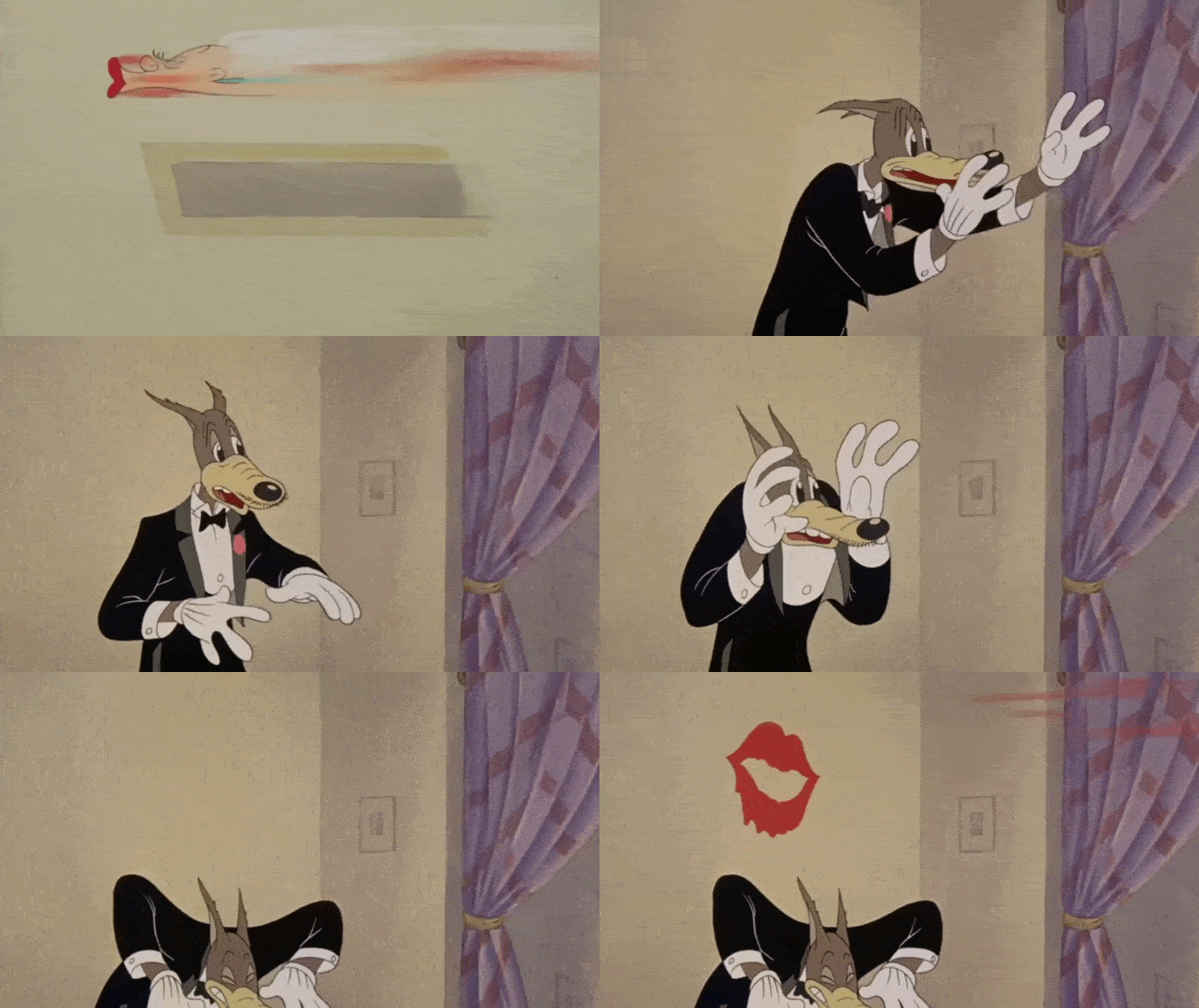
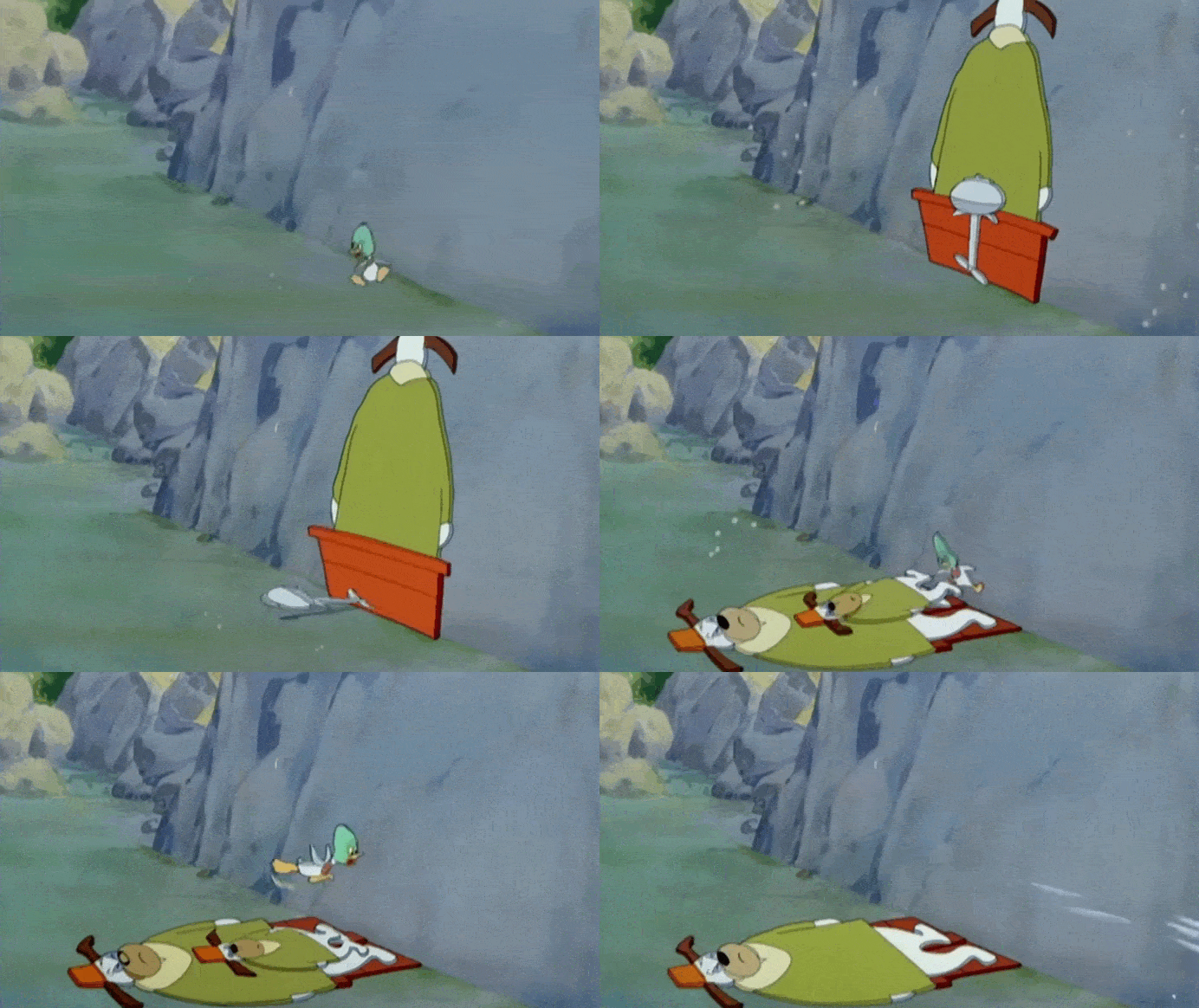
1. «Little Red Riding Hood» / Red Hot Riding Hood (1943) 2. «Lucky Ducky» (1948)
While working in the MGM studio, Tex Avery ultimately abandoned the creation of deep, psychologically complex characters that demand emotional resonance from the viewer. He stripped the characters of biological substance, transforming them into abstract forms capable of endless transformation, and he converted the cartoon itself into a continuous visual spectacle governed by a unique, authorial «gag-centricity.»
His approach is based on three interconnected elements. First and foremost, Avery utilizes short animation phases—preparation for action is no longer gradual and measured; events happen instantaneously, in one or two frames. As a result, the character’s body explodes, changes shape, and reassembles at a speed that the human eye can barely track during casual viewing.
The dynamism of this process is directly dictated by the extreme escalation of comedic stunts. Avery structures the composition of her short films on a principle of continuous escalation, where each subsequent gag and its accompanying anatomical deformation is larger, more absurd, and visually crazier than the last. In this artistic system, grotesque becomes a universal language for conveying internal states. The director substitutes conventional facial expressions with total physiological distortion: shock, fear, rage, or passion are no longer «played» through facial expressions but are transmitted through the literal destruction, objectification, and geometric bending of the entire character’s anatomy.
It is precisely due to this approach that, during her time at MGM, Avery creates her main iconic characters—the melancholic dog Droopy, the hyperactive squirrel Scruby, as well as the Wolf and the Bulldog.
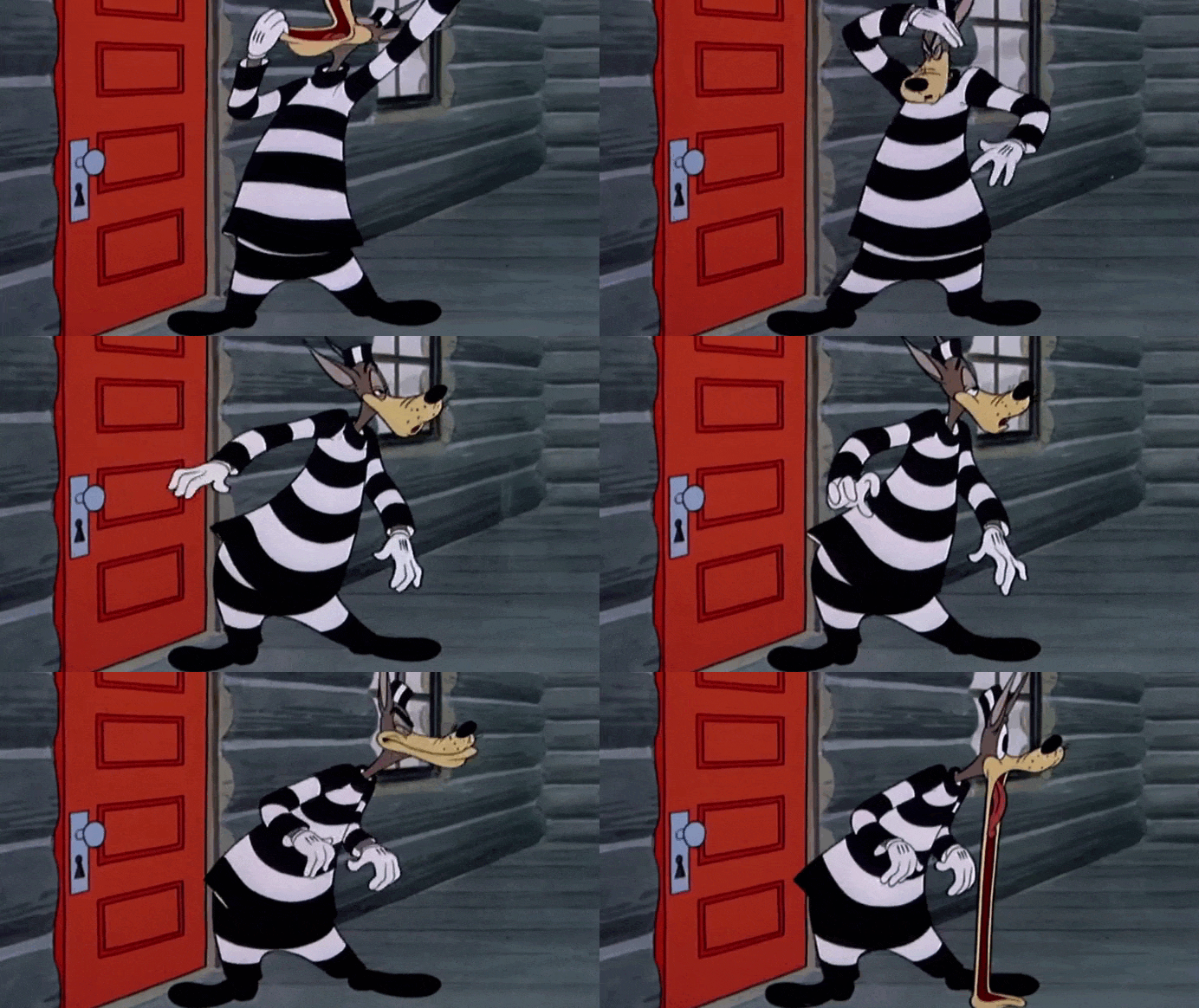
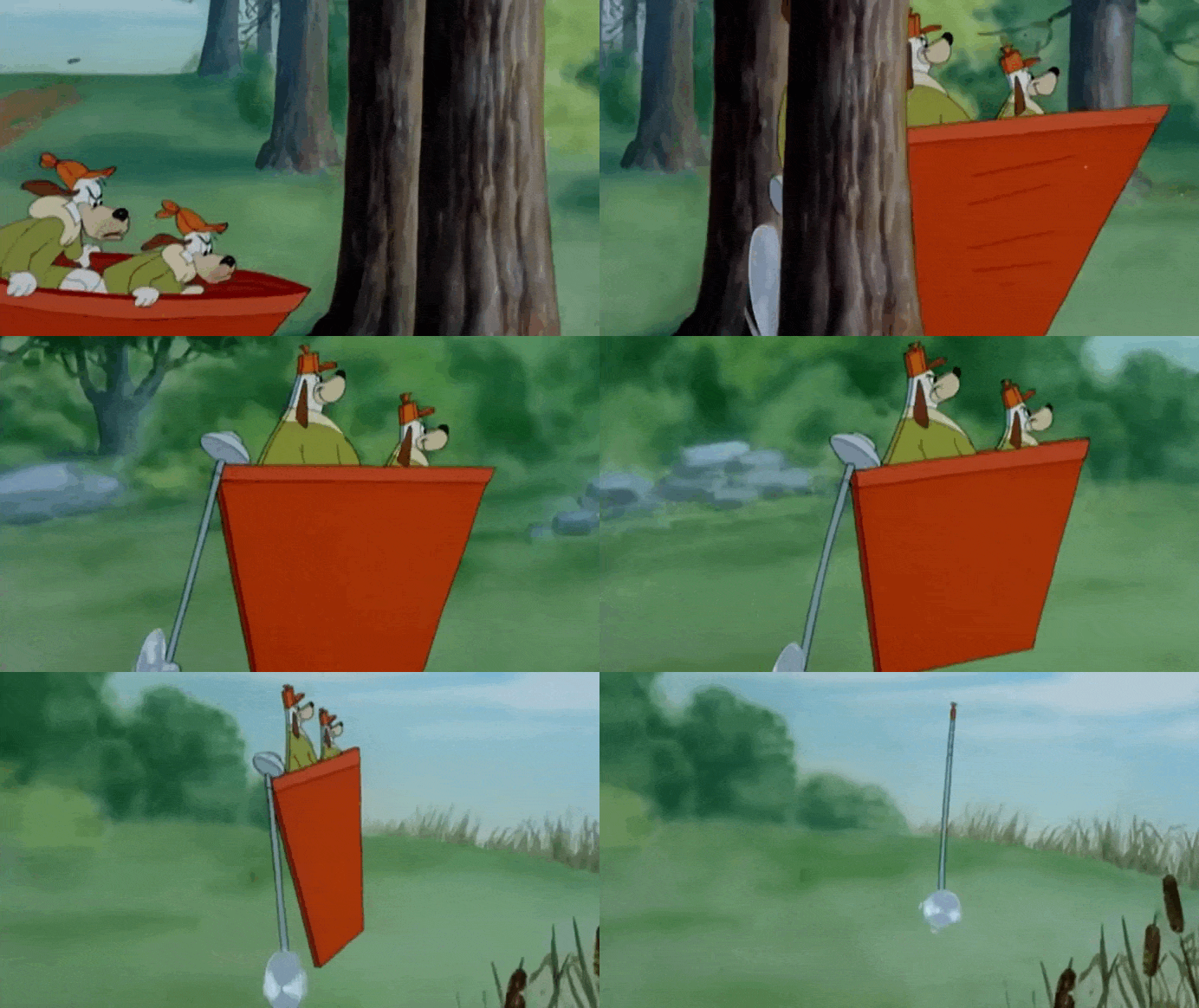
1. «Northwest Hounded Police» / Northwest Hounded Police (1946) 2. «Lucky Ducky» / Lucky Ducky (1948)
Key Question:
Through what graphic and plastic means does Tex Avery realize the extreme deformation of the drawn body to express the characters' peak emotions in MGM films from 1943–1951, and how does this anatomical grotesque become the main structuring element and defining characteristic of his eccentric artistic world?
Thus, the hypothesis is that filmmaker Tex Avery constructed his animated works around the idea of total graphic dominance over narrative and the destruction of the animation canon of that time. He created films that demonstrated a unique auteur method of eccentric «gagging, ” where lightning-fast timing, bodily distortion, and visual shock are inextricably linked to reveal a singular aesthetic concept—transforming the hero’s anatomy into an absolute plastic medium.
Introduction
Studying this material allows us not only to document the external features of the author’s style but also to reveal the very mechanisms of its creation. Through frame-by-frame analysis of the films, we can isolate key aspects of the research and reconstruct the foundational visual image on which Avery based his work. This image is built upon the deliberate dismantling of anatomical stability: the character ceases to be a unified whole and transforms into a dynamic construct. Identifying these aspects helps us trace how the director dissects form and discover the stable visual codes that underpin his eccentric language. Analyzing such grotesque deformations vividly demonstrates how Avery manipulated the viewer’s attention through the intentional disruption of familiar cinematic forms.
Analysis Methodology: Aspects System
— Plastical grotesque and anatomical deformation — Bodily expression of extreme emotions — Interaction of character bodies with the environment, and their transformation into objects — Playfulness of the techniques
Anatomical Grotesque
The first aspect of this study focuses on analyzing the purely graphic, frame-by-frame changes in form that Tex Avery’s characters undergo. In the traditional animation school, body deformation was always strictly confined by the «Squash and Stretch» rule—any change in a character’s shape (such as during a jump or a hit) meant their visual volume adhered to the laws of physics.
However, Avery sabotages this limitation. In his work, anatomical deformation ceases to be soft and elastic and transforms into radical, destructive grotesque. The character is no longer perceived as a singular biological organism; their body becomes a conditional set of graphic elements that Tex Avery can separate, elongate, shatter, and reassemble according to the dramatic requirement.
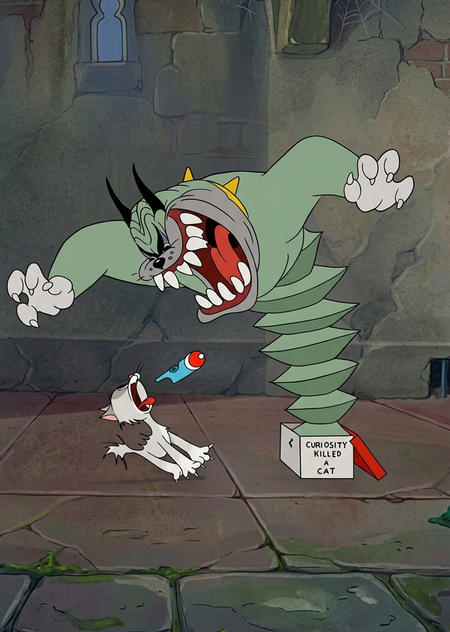
«The Cat That Hated People» / The Cat That Hated People (1948)
In frame-by-frame analysis of MGM-era films, this aspect is revealed through three key technical devices that formed the basis of Avery’s signature visual code:
Extreme «Wild Reactions»: Moments of peak emotional intensity where specific parts of a character’s body (most often the eyes, tongue, or jaw) are enlarged and «launch» into the frame space, violating all laws of proportion. The scale of this deformation deliberately contradicts the boundaries of the screen itself.
Frame-by-Frame Blur: Intermediate frames where the trajectory of a character or their limbs in rapid motion is distorted into a solid, elongated patch of color or a chaotic graphic streak. Tex Avery uses blur to convey superhuman, shocking velocity of change.
Skeleton Super-elasticity and Viscosity: The abandonment of rigid biological structure. The director replaces conventional anatomy with the body’s capacity to stretch and bend in any direction. This «viscosity» allows the character’s skeleton, during peak reactions, to instantly knot up, coil into rigid spirals, or fold in zigzags—all without the character breaking down, but instead transforming into a unique form.
Tex Avery Archive Animatics
Embodiment of Extreme Emotion
Based on an analysis of the selected material, three dominant emotions can be identified around which Tex Avery constructs his most radical comedic gags: Passion, fear, and anger.
- Carnal Desire and Passion
A sudden rush of emotion instantaneously transforms the character’s body into a pulsating mechanism. This is expressed through the eyes, a dropped jaw, and a heart that pushes the chest cavity outward, turning it into a giant piston in «Little Red Riding Hood.» The Wolf’s wild rapture manifests as total deformation, where his body stretches into a rigid string, and his eyes shoot forward from their sockets, filling the entire frame.
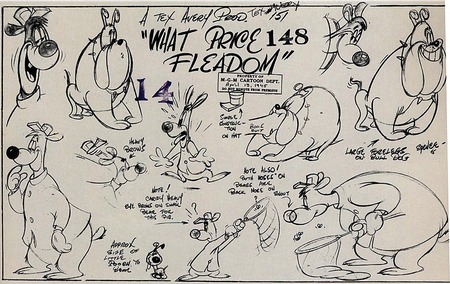
Tex Avery Animation Archive
- Fear and Paranoia For Avery, fear isn’t just fright; it’s a terror that forces the character to physically lose their stability and literally disintegrate.
The body coiling into a spiral while trying to flee, the character «exploding» out of their own skin, or the face shattering into fine shards like broken glass. In the animated film «The Northwest Chase, ” the escalating paranoia of the Wolf, who encounters the unflappable dog Drupe anywhere on the globe, is conveyed through extreme visual markers. The character’s horror is so monumental that in moments of shock, their head explodes and their body flattens into a pancake. This technique of total fright and shock is also clearly visible in „The Talking Cat.“
«Northwest Hounded Police» (1946), Tex Avery
- Rage and Aggression
In the film «The Cat Who Hated People, ” during the dynamic clashes in „Unlucky Blackie, ” anger and irritation are not merely „played with“ through facial expressions—they are transmitted through sharp, geometric fractures across the hero’s entire figure, distorted by his rage.
By isolating the aspect of bodily expression of emotions, we can explore how Avery transforms emotion into a visual technique. Using our sample, we analyze the specific graphic tools the director uses to make the hero’s body momentarily become a direct, exaggerated projection of his subconscious fears and desires.
«Bad Luck Blackie» (1949)
Object Transformations
Where Walt Disney’s classical animation always kept the character rigidly separate from the background, and where the body always retained the properties of soft, living tissue regardless of the circumstances, in Tex Avery’s artistic world, the boundaries of materiality are completely blurred. This aspect focuses on analyzing two unique auteur techniques: the «materialization» of character flesh and its absolute plastic dependence on the surrounding environment.