Concept
Documentation as a medium—an examination of the process and outcome of capturing an artwork’s action through its inherent capacity to transform the original work and the fact of that act’s relationality. The relational nature of art, as one of its most crucial functions, originates from Nicolas Bourriaud’s concept and his book, «Relational Aesthetics.» From an art critic’s perspective, «relational art» is «a set of artistic practices whose starting point is the sphere of human relationships» [14]. Regarding the documentation of art, we encounter a volatile field of intersecting mediums where the captured referent act and the method of its documentation form a complex relationship, calling into question definitions of authorship, copyright, the transfer of information between mediums, and the artwork itself.
Burriao also emphasized that «the artist is no longer a demiurge… they become a ‘semi-author’ charting routes between all existing signs. The scope of their work has shifted from production to postproduction.» This points us toward the concept of the «co-creation» of a work and the related derivative works branching from it: when documenting artistic actions, we are compelled to use photo/video documentation, textual records, and descriptions—in each case, emphasizing a specific aspect of the original gesture by translating it into a sign and then back into an artistic image [14].
In the 1950s and 1960s, most artists developing new art forms positioned their work in opposition to the commercialized art world. Creating a piece that could not be bought, sold, or otherwise integrated into the market was one of the motivations behind the emergence of happenings and performances. Maintaining institutional independence was also underscored by refusing to document the work.
However, in the 1960s, the opposing viewpoint began to gain adherents: the emerging documentation was intended to preserve all temporal and ephemeral works and was presented as a purely utilitarian necessity for archival creation. We can look at the work of Michael Kirby, a sculptor, editor, and journalist who worked on documenting Alan Kaprow’s happenings. Kirby found «objectivity» to be the primary factor for successful documentation of action art: both verbal descriptions and photographs should aim to convey the essence without additional interpretation or judgment [1].
Further critical theory is put forth by art critic and curator Amelia Jones in her article, «Presence in Absence: Experiencing Performance as Documentation.» Analyzing the modernist foundation of feminist performances from the 1960s and 1970s, Jones discusses the post-structuralist perception of action art, emphasizing retrospective perception: the reading of the performance occurs post-facto, and in this case, the role of documentation is played by the viewer’s memory of what they witnessed [15].
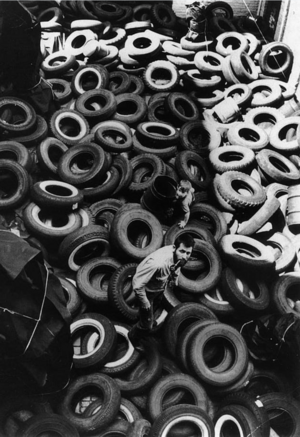
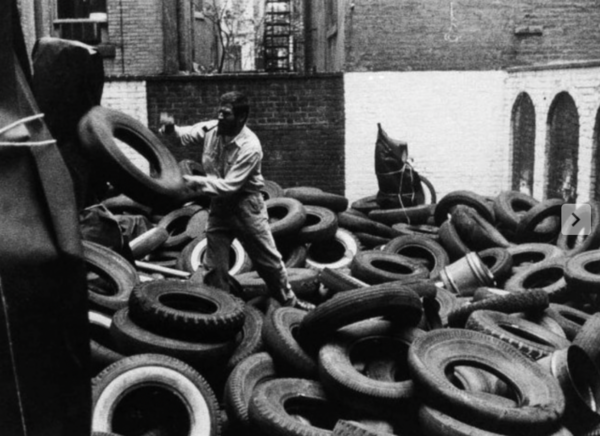
Alan Kaprow, Happenings «Yard, ” 1961
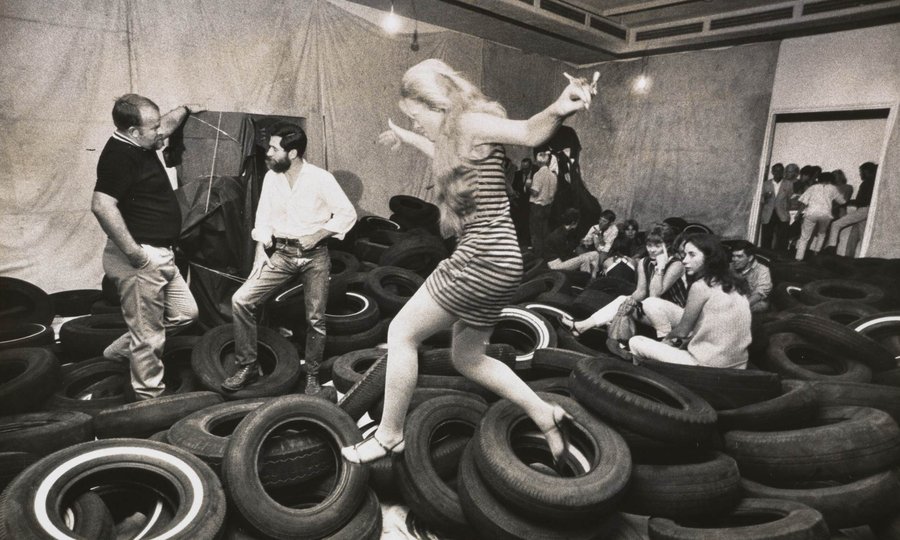
Allan Kaprow, Happening «Yard, ” 1961
For Johns' body (feminist performance placed the position of the «deviant"—that is, the female/decentered subject—at the center), it is placed in context and tends toward a symbol inscribed within the sign system of relations. Thus, having a live event defined by duration, co-presence, corporeality, relationality, and material testimony of that event, we mark its different denotations. For a further informed comparison, we find it necessary to examine them through the Sign—a common point of intersection between the semantics of the action and its photograph.
Another concept was examined by Philip Auslander. He proposed a division of performative documentation into «documentary» and «theatrical.» The former correlates with the original action as a fixed testimony; however, Auslander critically views the absolute neutrality in this type, referencing Roland Barthes' theory of the exaggerated «effect of reality» in the camera lens, which allows one not only to not see the photograph of the performance or happening itself in the photo-documentation but also to perceive it as a «message without a code,» referring to the recorded event without further imbuing it with meaning.
In the category of «theatrical» documentation, Ausländer includes works created for documentation pertaining to «performative photography"—such as works by Cindy Sherman, Marcel Duchamp, and the films of Matthew Barney. «The documentation space thus becomes the only space in which the performance occurs”[2].
Cindy Sherman Untitled Film Stills #45, 1979
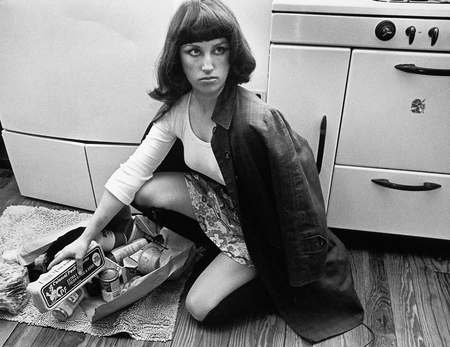
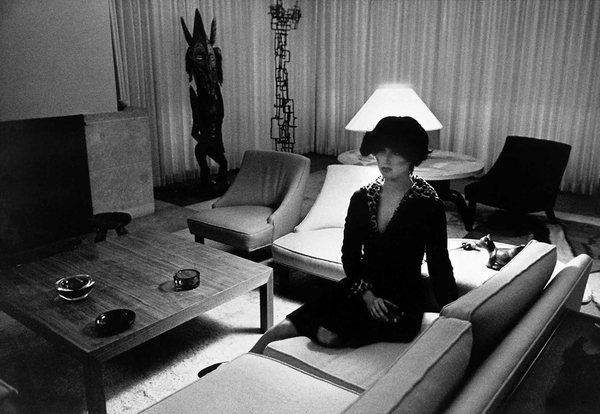
Cindy Sherman Untitled Film Stills #10, 1978; Untitled Film Stills #50, 1979
In turn, Erika Fischer-Lichte and Peggy Fleming argue for the lesser significance of documentation relative to the «live format.» In Fischer-Lichte’s book, Aesthetics of Performativity, we encounter the idea of the importance of the physical presence of participants during the action, determined by «the exchange of roles between actors and audience members, the transformation of actors and audience members into a community, the physical contact between them.» Fleming, on the other hand, speaks to the impossibility of preserving, recording, and transmitting a performance, as well as its inability to be reproduced—a condition inherent to the conceptual idea of action art [3].
Yoko Ono, performance «Light: a match and watch it burn out, ” 1955
It is also worth noting that performance and its documentation imply different modes of entry into the artwork. Most works from the 1950s–1970s demand that the viewer engage with the work through heightened, conscious perception, self-reflection during the viewing, or an understanding of the «other» upon encountering the happening. While video documentation can use the camera lens to «hyperrealize» the event during post-perception and provide a relatively complete understanding of the work’s internal dynamics, photography necessitates a greater degree of interpretation from the viewer, opening up a wider field of signs and personal associations. Documentation through text is entirely dependent on individual experience and has frequently been reflected in minimalist score-based works, presenting the viewer with only an instructional text rather than the artist’s performance itself. This «death of the author» through impersonal text disrupts the conventional hierarchy of «artist—viewer» on the art market and merges pure documentation with the artwork.
Bruce Nauman, instructions for the performance FOOTSTEPS, 1968
This visual research will examine the variations of documenting art actions through photography, video, and mixed practices, with an emphasis on fixation itself as a complex medium related to «co-creation"—the formation of understanding of artworks through relational post-perception.
Research Structure:
Concept
1// Photographic Documentation
- 1.1/ Photographic Survey
1\.2/ «Co-creation» of Documentation
1\.3/ Deconstruction of Method
2// Video Documentation 3// Experimental Documentation
- 3.1/ Artifacts
3\.2/ Tactical Media
3\.3/ Process-Complex Documentation
Conclusion
List of Sources
1// Photographic Documentation
Photography—one of the crucial threads of visual culture—is integrated into art, daily life, interdisciplinary fields, science, and the business realm. Andre Roye emphasized that the documentary nature, speed of creation, and portability of photography are unique virtues of the medium, «bestowing upon it the role of an intermediary between the world and people—the role of a document adapted to the first stage of industrial society» [15]. For a considerable time, non-art photography served as a reliable source for judgments about reality: in the 1920s, it gained the status of a document (in newspapers, magazines, and other publications), yet its global place in culture was ambiguous because the methods for studying this phenomenon were predominantly borrowed from other fields.
It only gained autonomy in the 1960s, thanks to the efforts of institutionalized humanities research. This is where the «signifying» concept of photographic hyper-reality emerges. This analysis gives rise to practices of analyzing a new form of photography: it ceases to be viewed exclusively as a copy of a real referent and instead becomes the embodiment of a new type of social communication.
1.1/ Photographic Survey
As photography solidifies its position within the field of contemporary art, digital analysis speaks to the power of interpreting objects of visual culture—the intersection of semantic narratives, functions, and systems of interconnections through the photograph.
Frances Alice, documentation of the performance «The Paradox of Practice: Sometimes Creation Leads to Nothing,» 1997
Francis Alice, documentation of the performance «The Paradox of Practice. Sometimes creating something leads to nothing,» 1997
The performance Francis Alÿs’s «Paradox of Practice: Sometimes Creation Leads to Nothing», like many of his works, is exhibited through photographic documentation. The performer’s distinctive simplicity of gesture allows his actions to be compiled into photo-comics, where subsequent viewing does not present significant difficulty because his practices develop in a recognizable, graded progression. Even though Alÿs also provides video documentation of his performances, the photographic artifacts possess a remarkable retention of informational and symbolic substance. It is worth noting that this occurs through the presence and combination of multiple frames that follow an A-B-C sequence, creating a unified «semiotic» field.
«Thin slices of photography are more memorable than a stream of moving images» [5].
— Susan Sontag
Denis Oppenheim, documentation of the performance «Reading in the Position for Second-Degree Burn,» 1970
Here we can also examine the works of Dennis Oppenheim, whose «photo-comics» are even more concise and framed than those of Alice. Oppenheim’s work is presented as «theatrical» documentation due to its editing, perspective, and framing: the action is reduced to a simple fixation that, by removing the initial processuality, leaves a clear, self-contained image.
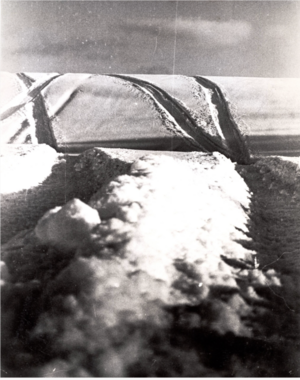
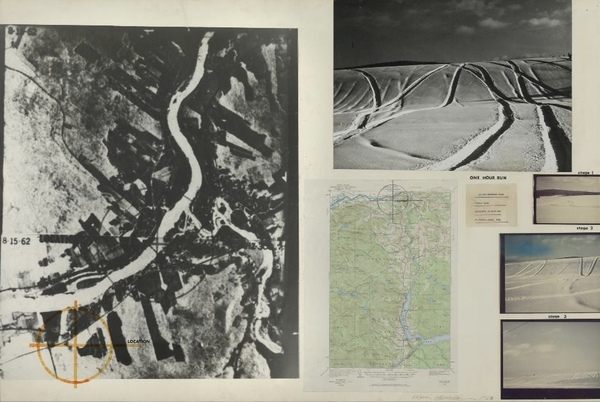
Dennis Oppenheim, documentation of the performance One Hour Run, 1968
1.2/ Documentation Co-Creation
When considering the immediate «co-creation» within the field of documentation, a logical question arises regarding the division of authorship between the performance and its resulting documentation. In 2019, Petr Pavlensky made all archives of his 2010s actions publicly available on his social media page: