Depiction of humans and animals in Mad Lean period art
Rationale for Topic Selection
When first engaging with Mad Lean-period art, the distinction between depictions of animals and humans is striking. Animals are often recognizable by characteristic features of their appearance, whereas human figures appear more stylized and varied. I became curious as to how this impression holds up when comparing specific works. To explore this, it is important to examine not only the resemblance of the images to real people and animals, but also the methods used to convey form, proportion, detail, and movement—as well as how the medium and technique influence the final image.
Research Subject
Marl period art in Western Europe, approximately 21,000–14,000 years ago. The subject is a broad area of prehistoric art in which methods for depicting humans and animals were developed: small portable objects featuring images carved onto bone, horn, mammoth tusk, and stone, as well as cave wall engravings.
Subject of Study
Depictions of humans and animals in Madlean art. This study compares specific visual characteristics: how the head and face or muzzle, the body and its proportions, posture, and movement are conveyed. It also examines how the material, technique, and condition of the object affect the recognizability of the image.
The core research question
How do the ways of depicting humans and animals in art from the Madeleine period differ, and how do these differences manifest visually?
Research Hypothesis
I surmise that animal representations in Mad Lean period art tend to retain distinctive characteristics that make them easily recognizable, whereas the depiction of the human figure may be more diverse and conventionalized.
Research Objective
Compare the ways humans and animals are depicted in Mad Lean period art and determine which visual characteristics influence their recognizability.
Research Objectives
- Select images of humans and animals from the Madeleine period for comparison.
- Compare the ways human heads and animal heads are depicted.
- Examine the anatomical details used in the depictions of humans and animals.
- Compare the methods of rendering the body and its proportions.
- Consider how posture, movement, and action are conveyed.
- Compare works created using different materials and techniques.
- Investigate how the material, technique, and condition of an object can influence its contemporary perception.
- Find examples that do not align with the initial hypothesis and use them to refine the study’s conclusions.
Material Selection Principle
For the study, works from the Magdalenian period featuring humans and animals were selected. I made an effort to choose pieces with varied methods of depiction to allow for comparison. Key selection criteria:
- The ability to examine and compare the visual characteristics of the images.
- The diversity of materials and techniques.
- The presence of both whole figures and separate body parts, especially heads.
- The varying degrees of detail and visual recognizability of the images.
- The availability of reliable information regarding the object in museum or scientific sources.
Why are there exceptions in the sample?
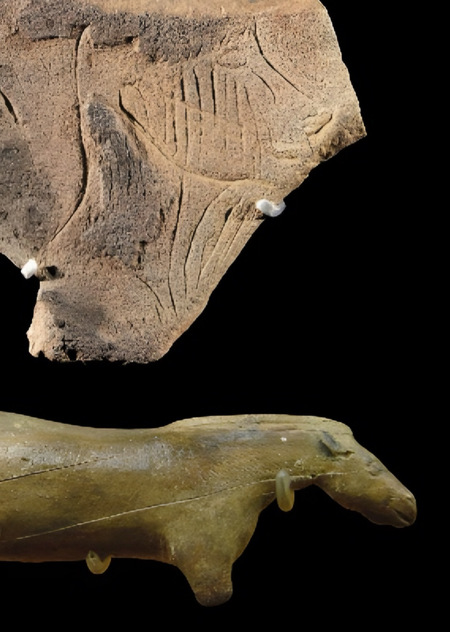
«Unchaste Venus.» Loire-Bas, Les Eyzies, France. Middle/Upper Magdalenian. Mammoth tusk. «Little Horse of Lourdes.» Espacelle Cave, Lourdes, France. Middle or Late Magdalenian, circa 18,000–14,000 years ago. Mammoth tusk.
The sample also includes works that do not entirely align with the initial hypothesis. For instance, among the human figures, there are highly recognizable and relatively detailed depictions, while the animal illustrations feature altered proportions and ambiguous details. I deliberately included these varied objects in the sample to prevent forcing the material to fit the initial assumption, thereby making the research more objective. Furthermore, the sample contains pieces that can be compared based on material or technique. For example, «Innocent Venus» and «Little Horse from Lourdes» are both rendered in mammoth ivory. Such a comparison helps determine whether the differences between the human and animal figures can be attributed solely to material characteristics.
The principle of rubrication
I decided to compare the works not individually, but based on common visual characteristics found in images of humans and animals. This approach allows me to examine the same objects from multiple perspectives and gradually test a hypothesis. The material is divided into five sections:
- Human and Animal Head — head shape, face and snout, eyes, nose, mouth, ears.
- Body and Anatomical Details — body shape, proportions, limbs.
- Pose, Movement, and Action — how body position, movement, or action is conveyed.
- Influence of Material and Technique — engraved versus volumetric images, works made from different materials.
- Exceptions and Boundaries of Differences — works that do not fit the hypothesis.
This structure enables a transition from individual features to a comprehensive comparison, allowing me to determine which differences are truly recurring and which depend on the specific object, material, or technique.
Principle of Selecting and Analyzing Textual Sources
For this study, I primarily utilize museum catalogs, official museum websites, and scholarly publications dedicated to Madlean-period art and the specific works in the selection. These textual sources help to:
- Refine the dating and discovery location of the artwork.
- Determine the material and execution technique.
- Verify the condition of preservation and identify any damaged or missing parts.
- Ascertain whether the form of the original material may have influenced the depiction.
- Compare my own observations with scholarly descriptions and interpretations.
In this process, I separate what can be observed directly in the image from information found in external sources. If researchers propose a specific interpretation of the work, I treat it strictly as an interpretation—not as an established visual fact.
Research Methodology
The study employs three methods. 1. Comparative visual analysis. Works are compared based on the same criteria: head and body shape, anatomical details, proportions, pose, movement, and visual recognizability. 2. Analysis of museum and academic sources. Museum catalogs and scientific publications are utilized to refine the dating, material, execution technique, and state of preservation of the works. 3. Verification of visual observations. Initially, the artwork is examined in isolation, without reference to any description. Subsequently, the preliminary observations are cross-referenced with information from the sources and refined as necessary—for example, checking whether an unusual shape is related to damage to the object or the original material.
Concept
From the initial comparisons, it became clear that we cannot simply state: «the animals are depicted realistically, while the humans are represented schematically.» An animal can remain recognizable even with altered proportions and limited detail, and a volumetric human figure is not necessarily clearer to the contemporary viewer. Therefore, recognizability, the number of details, proportions, and volume are considered separately. Furthermore, an unusual form of depiction may be related to the shape of a bone, horn, or stone, and the absence of a body part may indicate damage to the object. Consequently, material and preservation status are taken into account during comparison.
Materials for Visual Research
The study utilizes images of human and animal figures from the Magdalene period, rendered in various materials and techniques. These are examined not as a discrete catalog of works, but in comparison to one another across several visual attributes.