Table of Contents
Introduction
Discomfort as a Privilege
16th–17th Centuries
The Body Submits to Form. 18th–19th Centuries
New Form—New Constraints. Early 20th Century
When Comfort Becomes More Important Than Fashion. 1920s–1960s
Visible Discomfort. Late 20th–21st Century
Conclusion
Introduction
When we choose shoes, clothing, or furniture, comfort usually becomes one of the main criteria. Yet, design history features items that restricted human movement while remaining highly desirable.
I became interested in why this occurred. Venetian women in the 16th and 17th centuries wore footwear on such high platforms that they might have required assistance while walking. Such items could underscore the wearer’s social standing [1, 2].
Initially, I associated this exclusively with wealth. Perhaps a high-end item doesn’t necessarily have to be practical because its owner can afford discomfort. However, this explanation doesn’t fit all examples. Sometimes a design element emerged purely for a fashionable silhouette, and other times it solved a practical problem.
A good example is the Venetian chopines. The high platform protected the feet from dirty streets but simultaneously increased the woman’s height. This presents a peculiar situation: the footwear was supposed to aid locomotion, yet it could make walking less stable. The Metropolitan Museum of Art notes that women might have needed assistance while walking in them [1].
No less interesting are the court gowns of the 18th century. The pannier created a wide silhouette, and the corset shaped the torso. The figure acquired an almost geometric form. This design was connected to contemporary ideals of fashion [2].
It seems important that it’s not just the discomfort itself. The object compelled the person to move differently, to maintain posture, and to account for their surroundings. In other words, the clothing altered both appearance and behavior.
One of the starting points was Thorstein Veblen’s book, The Theory of the Leisure Class (1899). In the chapter on clothing, he explains that an elaborate garment can signal wealth and the exemption from manual labor [3]. Clothing that made work difficult could communicate the owner’s lifestyle to observers.
However, not every uncomfortable item can be explained by status. For instance, in the 19th century, the cage crinoline allowed for a voluminous skirt without needing numerous heavy petticoats. What appears cumbersome today could have actually made wearing clothing easier back then [4].
Therefore, I want to investigate which limitations arose for the sake of beauty or status, and which resulted from other needs. And why something that seems like a drawback today might have been perceived as an asset in another era.
Discomfort as a Privilege
16th–17th Centuries
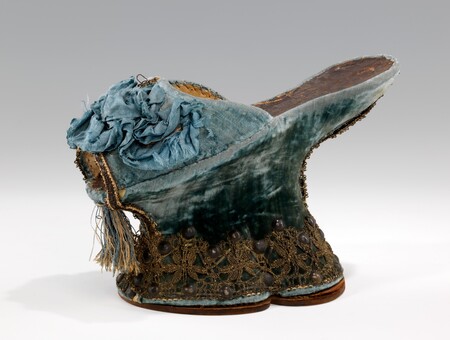
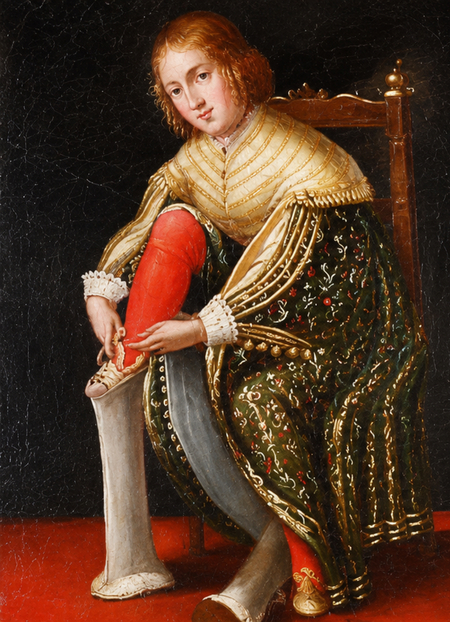
One of the most unusual footwear examples from the 16th century was the Venetian chopine. These were high-platform shoes worn primarily by women. Unlike modern heels, where only the heel is raised, the entire sole rested on a wooden or cork base. Some surviving examples reached heights exceeding 30 centimeters, although much lower models were also found [5].
Initially, this construction was quite practical. Venice’s streets were often wet and muddy, so the high sole protected the footwear and long gowns from contact with the ground. However, over time, they acquired a different function. The height of the platform allowed a person to literally elevate themselves above others and could also accentuate their social standing.
Please note the surviving examples. Their construction appears unconventional: a small foot platform rests on a massive wooden support that can taper significantly in the middle. Some models are covered in velvet and adorned with metal lace, embroidery, and decorative elements. Thus, footwear intended to protect against dirt itself becomes a luxury item requiring careful handling.Furthermore, the high platform noticeably altered gait. Harold Koddy’s article for the Metropolitan Museum mentions that women wearing such shoes typically traveled accompanied by attendants upon whom they could lean. The higher the platform, the more difficult it became to maintain balance [5].
Furthermore, the increase in shoe height also affected the length of the dress. To conceal the platform or maintain the desired silhouette proportions, more fabric was required. Consequently, a single design element could lead to increased costs for the entire costume [6].
However, one cannot assert that Chopins were worn exclusively by high-born women. They were also seen on the wealthy courtesans, and distinguishing their clothing was quite difficult externally. The Venetian authorities even imposed restrictions on luxury, attempting to regulate the appearance of different social groups [5].
It turns out that the high platform did not always accurately indicate a person’s origin; rather, it helped create an image of wealth.
A similar connection between footwear and social status can be observed in France during the second half of the 17th century. At the court of Louis XIV, shoes with red heels—talons rouges—became fashionable. This trend became particularly noticeable in the 1670s–1680s before spreading to other European courts [7].
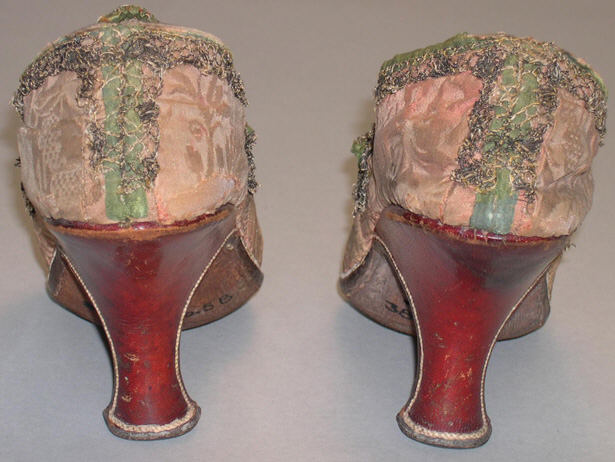
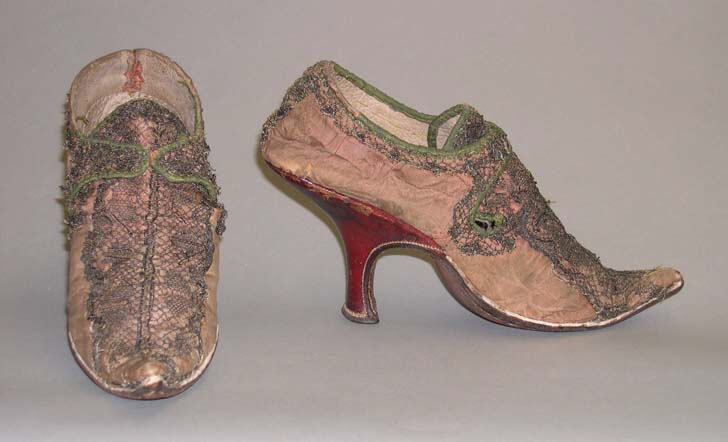
Here, the decoration of the footwear matters more than its height. Red color transforms into a recognizable detail of court attire. In formal portraits of Louis XIV, you can see that the shoes are not hidden beneath the clothing. On the contrary, the heels become part of the monarch’s overall image, alongside stockings, lace, and elaborate costume.
Red heels weren’t necessarily as uncomfortable as extreme stiletto heels. Therefore, I wouldn’t directly compare the degree of mobility restriction. However, both examples show how footwear can acquire additional social significance that is no less important than its practical function.
The body submits to form. 18th–19th Centuries
In the 18th century, women’s clothing became exceptionally complex in its construction. To achieve a fashionable silhouette, a single dress was insufficient. It was worn over a corset and special frameworks that altered the body’s proportions. For instance, in court attire, a narrow bodice was paired with a wide skirt, giving the figure an almost geometric shape [10].
One such device was the panier. It was a hoop frame attached at the waist that widened the skirt on the sides. The Metropolitan Museum of Art holds a court dress from around 1750 with a width of approximately 140 centimeters. Yet, from the side, it appeared much narrower than from the front. A woman wearing such a dress had to pass through doorways sideways [11].
Interestingly, this type of clothing not only reshaped the figure but also demanded specific behavior. One had to account for the skirt’s width, monitor one’s movements, and maintain an elegant posture. Furthermore, the ability to appear effortless in such a structure was considered a mastered skill, which signaled high social status [12].
The corset played at least as crucial a role. In the 18th century, it created a rigid, conical silhouette, supported the bust, and shaped the torso. Later, its construction evolved alongside fashion. In the 19th century, there was an increasing focus on a defined waist and graceful body curves. This was achieved using metal elements and complex tailoring that allowed for tighter compression of the torso [10, 13].
When comparing corsets from different periods, one can observe that they did not merely replicate the body’s natural shape; rather, they constructed the silhouette deemed beautiful during that specific era. This suggests that societal perceptions of beauty directly dictated the garment’s design.
In my view, this subtly alters the initial perception of status symbols. Inconvenience was not always their primary goal. Sometimes it became a byproduct of a shape that society deemed appealing. The more complex the silhouette, the more significant the materials, construction, and the skill required to wear the garment properly became.
However, not all such contraptions made life more difficult. In the mid-19th century, the cage crinoline appeared—a structure made of metal hoops connected by fabric tapes. Previously, women had to wear several heavy petticoats to achieve a voluminous skirt. The new design allowed the volume to be maintained while significantly reducing the weight of the garment [14].
In the 1860s, women used special ribbons to lift their skirts, preventing the fabric from dragging on the ground. This created voluminous drapes at the back, which gradually became a part of the fashionable silhouette [22].By the late 1860s, the volume of the skirt began to be specifically shifted backward, and bustles (tournures) emerged to support this structure. While the crinoline previously expanded the skirt around the entire body, the front became flatter, and a projecting structure formed at the rear.I find it interesting that a solution originally intended to improve mobility eventually transformed into an independent fashion element. In the 1880s, bustles grew so large they could impede a woman from sitting down. To solve this issue, even foldable structures were created [23].It appears that a practical technique gradually evolved into a decorative one, and subsequently required new technical solutions to restore comfort to the garment.
New form—new constraints. Early 20th Century
In the early 20th century, women’s fashion underwent a noticeable transformation. Heavy, multilayered constructions gradually disappeared, and the silhouette became more straight. Designers began experimenting with tailoring and offered clothing that no longer required the waist to be emphasized so heavily. One of the leading figures in this movement was the French couturier Paul Poiret [15].
Poiret rejected the conventional corseted silhouette, creating dresses that hung more loosely on the body. Instead of a defined waist, a lengthened, vertical form emerged. However, what is interesting is that alongside this, the designer proposed a completely different construction that also restricted movement. This refers to the hobble skirt—a narrow skirt that became popular around 1910. Its characteristic feature was a severely tapered hem. In some designs, the fabric was so tightly wrapped around the legs around the ankles that the woman could only move in small steps [16].
If one examines the dresses of this period, they can notice how drastically the silhouette changed compared to the nineteenth century. Instead of a voluminous skirt that took up a lot of space around the person, an almost straight shape emerged. However, this didn’t necessarily mean greater freedom of movement. Previously, clothing was restrictive due to its width, whereas now the limitation arose from the overly narrow hemline.
This clearly demonstrates that abandoning one uncomfortable construction does not always result in more comfortable clothing. The Poiret sought to change the traditional female silhouette, but to achieve this, he proposed a form that hindered normal walking.
However, the hobble skirt was not exclusively a runway experiment. Similar skirts appeared in everyday fashion, and their unusual shape even became fodder for caricatures. In the early 1910s, artists depicted women who had to take small steps or struggled to navigate obstacles due to the narrow hemline [17]. Some manufacturers attempted to solve this issue without sacrificing the silhouette itself. Small slits and pleats appeared in the skirts, allowing for freer movement.