Navigation
- Concept
- Research Hypothesis
- Buddhism as a Cultural and Visual Phenomenon in the West during the Second Half of the 19th Century
- Western Artists and Buddhism: Individual Approaches a) Paul Gauguin b) Odilon Redon c) Vasily Vereshchagin d) John La Farge e) Robert Gill f) Felix Regame g) Unknown Author
- Conclusion
Concept
In the latter half of the 19th century, Western artists developed a significant interest in Eastern philosophies and religions, particularly Buddhism, which manifested in their work. In this study, I will examine how representatives of Western culture perceived and depicted Buddhist identity in their paintings, merging Eastern motifs with Western artistic traditions.
Buddhism offered new symbols, narratives, and aesthetic principles that inspired artists to create original works. This visual study will analyze the work of artists such as Paul Gauguin, Odilon Redon, Vasily Vereshchagin, John La Farge, Robert Gill, and Felix Regame to identify the various visual approaches to depicting Buddhism in their creative output.
Research Hypothesis
In Western painting of the second half of the 19th century, Buddhism is presented not as a unified religious phenomenon, but as a complex visual and philosophical construct, reflecting the individual perspectives, aesthetic strategies, and cultural contexts of the artists. Buddhist imagery, ranging from ethnographic accuracy to mystical symbolism, serves as a mediator between East and West, and as a visual projection of the authors' personal spiritual quests.
Buddhism as a cultural and visual phenomenon in the West during the latter half of the 19th century
In the second half of the 19th century, Buddhism in the West became not only a subject of religious studies but also a powerful visual and cultural phenomenon. The expansion of colonial borders, the development of Oriental studies, and the publication of translated Buddhist texts (including those from the Pāli Canon) contributed to the popularization of Buddhism as both a philosophy and a way of life. Due to the growing interest in alternative forms of spirituality, Buddhism was presented to Western elites and artists as a path to move beyond rationalism—a return to inner harmony and contemplation. Simultaneously, Buddhism was viewed as a part of an «exotic» East—mysterious, aesthetically compelling, and culturally distinct. Its architecture, sculpture, and rituals were becoming not merely religious objects, but a new cultural code for the West.
Western Artists and Buddhism: Individual Approaches
Paul Klee
Great Buddha. Paul Klee. 1899
In Ilya Goghen’s «The Great Buddha, ” Buddhism is depicted as an element of a mythological world lacking documentary precision. His palette is rich with exotic tones (raspberry, yellow, ochre, and turquoise), symbolizing the spirituality, the „sacredness“ of the Buddha’s image, and the warmth of the Polynesian landscape. In this painting, the Buddha is not sacred in the traditional sense, but rather serves as a universal symbol of harmony and tranquility. The canvas is executed in a Post-Impressionist style, characterized by technical decorative qualities and simplified forms.
Odilon Redon
Buddha. Odilon Redon. 1895
The Death of Buddha. Odilon Redon. 1899
Odilon Redon interprets Buddhism in a different light: it is a path to inner enlightenment. Light emanates from the Buddha’s figure in the paintings, emphasizing a state of inner clarity and stillness. The Buddha does not simply «exist» in space; he is «felt» through light and void. In «Death of Buddha, ” the violet-blue color palette alludes to a spiritual, transcendent experience. Stylistically, both works belong to Symbolism. „Buddha“ was executed in black lithography on corrugated paper, while „Death of Buddha“ was created with pastel. The image of the Buddha is static, devoid of specificity, and dissolved in light, reflecting his isolation from the external world.
Vasily Vereshchagin
Unlike the previous two creators, Vasiliy Vereshchagin’s realistic painting aims to convey Buddhism as an observable social and cultural phenomenon. His interest in Buddhist culture was not theoretical, but deeply practical: the artist personally visited Central Asia, India, and Tibet, where he made sketches, observed rituals, and conversed with monks. These expeditions formed the basis of several of his works dedicated to Buddhist themes.
The Kalmyk Prayer House. Vasiliy Vereshchagin. 1869–1870
Kalmyk Lama. Vasili Vereshchagin. 1869–1870
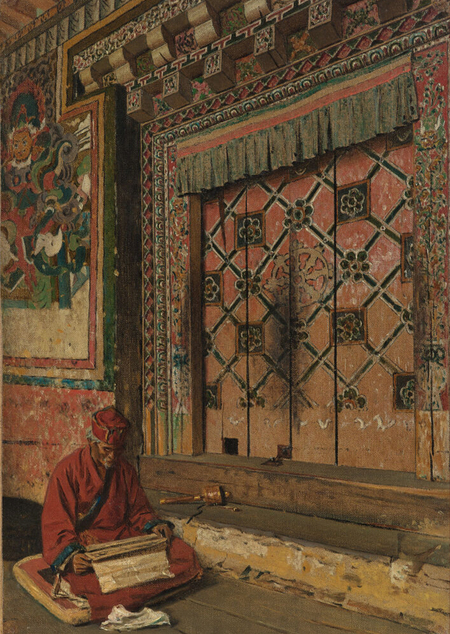
Portico of the temple in the Tasing monastery. Sikkim. Vasily Vereshchagin. 1875.
Buddhist Prayer Machine. Vasili Vereshchagin. 1875
Three principal deities in the Buddhist monastery of Chinguaching in Sikkim. Vasily Vereshchagin. 1875.
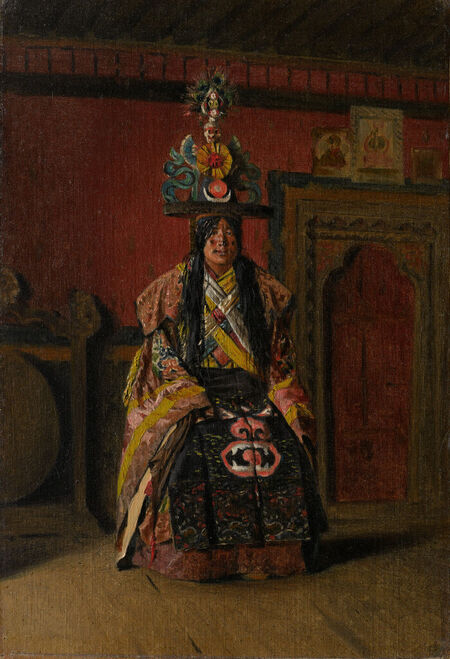
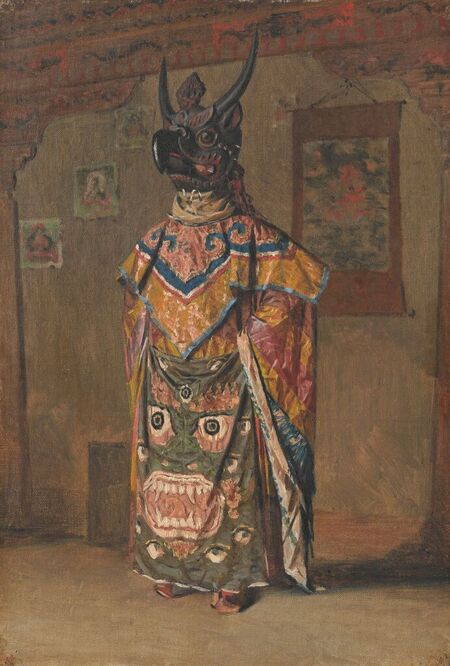
(a) A Buddhist lama in the costume of the main deity at a festival in Pemionchi Monastery. Sikkim. V. Vereshchagin. 1875. // (b) A Buddhist lama at a festival in Pemionchi Monastery. Sikkim. V. Vereshchagin. 1875.
Vasily Vereshchagin’s works are precise in detail—almost documentary. The colors are natural: earthy, gray-green, and terracotta. The figures of the monks, the architecture and interiors of the monasteries, and the ritual implements are rendered without distortion. The artist acts as an observer, a researcher, a traveler.
Buddhist Temple in Darjeeling. Sikkim. Vasily Vereshchagin. 1874.
The main temple of the Tasing monastery. Sikkim. Vasily Vereshchagin. 1875.
Hemis Monastery in Ladakh. Vasily Vereshchagin. 1875
Vereshchagin approaches Buddhism as a subject for visual study and respectful artistic contemplation. He strives to reflect Buddhist imagery within its own cultural and spiritual reality. In these paintings, Buddhism is presented as an integral part of the culture, not as a metaphor or a philosophical allegory.