Categories
✤ Concept
✤ 1. Light, Not Color
✤ 2. The Golden Page
✤ 3. How the Gold Background Was Created
✤ 4. From Icon to Altar Image
✤ 5. Siena: «Maestà» and Simone Martini
✤ 6. Florence: Gold or Sky
✤ 7. International Gothic and Northern Europe
✤ 8. The Sunset of the Gold Background
✤ Conclusion
Concept
In medieval painting, gold served a different function than paint. Paint depicts an object; gold signifies the space in which the object exists. Gilding, miniatures, icons, and panel altarpieces belong to a shared tradition where a sheet of metal is understood as a sign of divine radiance. Therefore, the gold in medieval painting cannot be considered a background in the modern sense of the word. It is not located «behind» the figures; rather, it surrounds them, elevating the depicted event beyond earthly time and space.
The gilded background is conventionally viewed as a convention that painting shed during the Renaissance. This perspective overlooks two crucial aspects. First, gold was a complex technology. Details concerning bolus, gold leaf, stone polishing, punches, sgraffito, and plaster relief are thoroughly described in the treatise by Cennino Cennini and can be traced through the technical-technological analyses of surviving monuments. Second, the rejection of gold was gradual. While Alberti urged the imitation of gold’s brilliance with pigments in 1435, gilded backgrounds continued to be painted throughout the mid and late 15th centuries, as demonstrated in the works of Giovanni di Paolo (1445), and Carlo Crivelli, who saturated his paintings with gilded details in 1473. For a designer, this theme holds practical significance: the gilded surface shifts with the lighting, and medieval masters consciously utilized this property, anticipating the flickering of candles within church interiors.
The objective of this study is to trace the evolution of gold’s functions in medieval painting from the 11th to the 15th centuries: from a symbol of divine light to a medium of courtly luxury, and finally to a color rendered by the painter’s brush. To achieve this goal, the following objectives have been set: ✤ To define the symbolic foundations of the gold background in Byzantine and Western traditions; ✤ To describe the gilding technique based on medieval treatises and museum research data; ✤ To select works of illuminated manuscript painting, iconography, and altarpiece painting in which gold plays a leading role; ✤ To analyze the interaction of gold with the figure, space, and light in works by Chimabue, Duccio, Simone Martini, Lorenzetti, Giotto, Gentile da Fabriano, and masters of Northern Europe; ✤ To identify the causes and stages of abandoning the gold background in the 15th century.
Research subject: Medieval painting—book miniatures, icons, and painted altarpieces. The object of study is gold as a material, a symbol, and a compositional element. The chronological scope covers the period from Ottonian miniatures of the early 11th century to the end of the 15th century. Italian painting of the 13th–14th centuries occupies a central place, where the gold ground achieved its most developed forms. Northern Europe and Byzantium are included for comparative analysis. Methods: formal-stylistic and iconographic analysis of images, comparison with Cennini’s technical treatise, Alberti’s theoretical treatise, and data from museum technical and technological research. The final outcome of this work should be the justification of the thesis: gold in medieval painting is not merely a decorative ground but an active component of the image, and the history of its disappearance reflects a shift in the understanding of what a painting should depict.
Light, not color
In the icon painting tradition, the gold background was originally called «light, ” and its coloring was determined by the concept of light; it becomes the color dominant of the entire icon. M. V. Nikolsky notes that icons were often first completely gilded and then „painted on gold, ” so the figures seem to emerge from a radiance.
L. D. Raigorodsky connects the gold background to the designation of a space „not of this world, ” in which objects are constructed in reverse perspective. The National Gallery of Art in Washington offers a similar interpretation: in a Byzantine icon, the background „dematerializes“ with shimmering gold so that the image does not refer to a specific place or time.
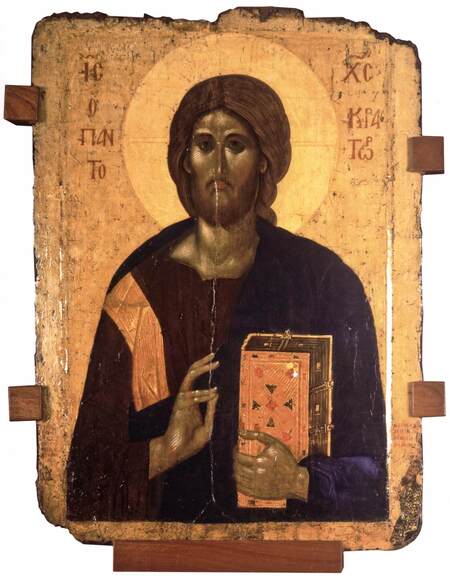
Unknown Greek icon painter. «Christ Pantocrator.» 1363. Wood, egg tempera, gold, 106 × 79 cm. State Hermitage Museum, Saint Petersburg
The background and halo form a unified, luminous plane. The volume of the face and garments is constructed with paint, while the space surrounding the figure is indicated with metal. This functional division between paint and gold was maintained in Italian painting of the 13th–14th centuries.
In the West, the theme of light is associated with Abbot Suger, who rebuilt the choir of the Basilica of Saint-Denis in the 12th century. E. Tune demonstrates that the emphasis on light in the choir’s inscription stems not only from the metaphysics of light by Pseudo-Dionysius the Areopagite but also from an older tradition of inscriptions on Roman apse mosaics. For the history of the golden background, this conclusion is significant: the image of a radiant altar area was a consistent element in Latin culture long before altar figures appeared on panels.
Golden Page
Gold-leaf miniature—a medieval miniature characterized by a gold background symbolizing divine radiance. It was most prominent in Anglo-Saxon art (the Stockholm Golden Codex, mid-8th century), during the Carolingian and Ottonian eras (the Lorch Golden Codex, the Echternach Golden Codex), and in Byzantine art (The Menologion of Basil II). Gold leaf was applied to the parchment after the text was written and the outlines were marked, but before the colors were applied. This sequence is indicative: in the manuscript, gold is not a finishing decoration, but rather the foundation upon which the image is built.
Ehrenhausen Abbey Workshop. «The Golden Codex of Ehrenhausen»: Evangelist Matthew and his symbol (fol. 20r–21v). c. 1030. Parchment, tempera, gold, 446 × 310 mm. German National Museum, Nuremberg
The manuscript is opened to a two-page spread featuring an evangelist and his symbol. Gold and purple in the background unify both pages into a sacred space, separating it from the parchment of the margins.
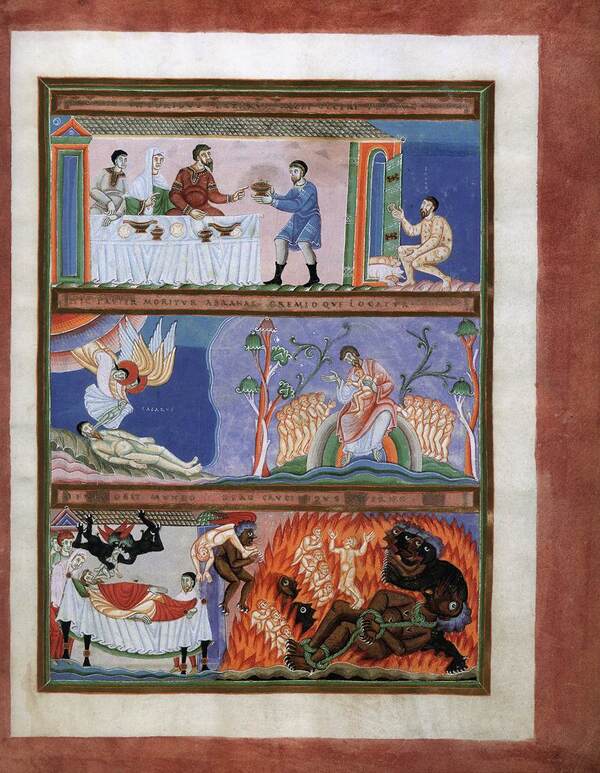
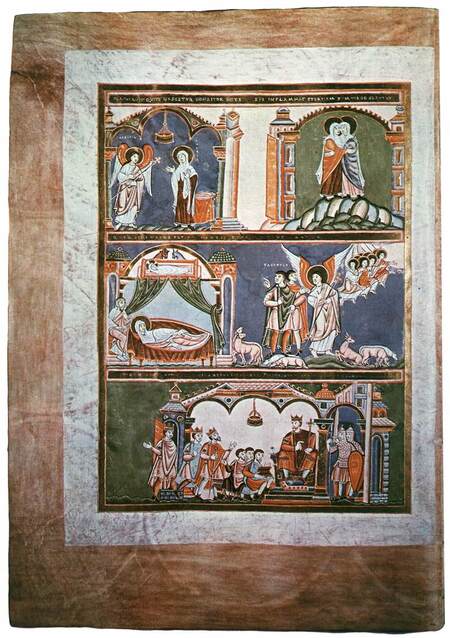
Abbey Workshop of Echternach. «Golden Codex of Echternach, ” manuscript leaf. c. 1030. Parchment, tempera, gold. German National Museum, Nuremberg.
The narrative sheets are built in three tiers. Scene backgrounds are composed of colored bands, and gold is concentrated in borders, halos, and details. Comparison with the evangelist’s spread shows that the solid gold field in the manuscript was not intended for every page.
How the golden background was made
The most detailed description of gilding the board is found in the «Book of Art» by the Florentine painter Cennino Cennini. An Armenian bole, ground from whipped egg white, was applied in several layers onto a gypsum-primed board. Then, in damp weather, sheets of gold were laid onto the moistened surface with a slight overlap and pressed down.
The gold was polished with hematite, a precious stone, or an animal’s tooth; Cennini noted that a well-polished sheet becomes almost dark from its own brilliance. For flat areas, he advises using denser gold, while for profiles and mordant ornament—a thinner gold.
After burnishing, the master used a compass to mark the halos and then embossed the pattern with punches so that the surface sparkled like millet grains; the punches were used on the illuminated areas and avoided shadows. Puncheon finishing transformed the smooth sheet into a relief that reflected light differently. The Metropolitan Museum, in its description of «Saint Catherine,» notes that the gold and silver surfaces with punchwork were designed to shimmer in the reflected candlelight of a church interior.
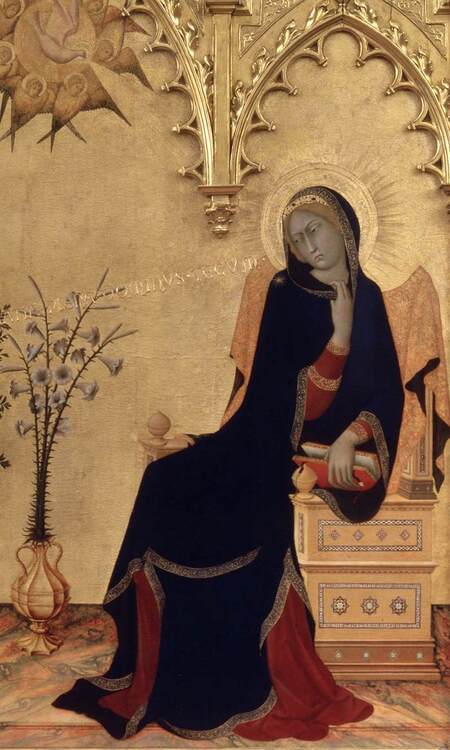
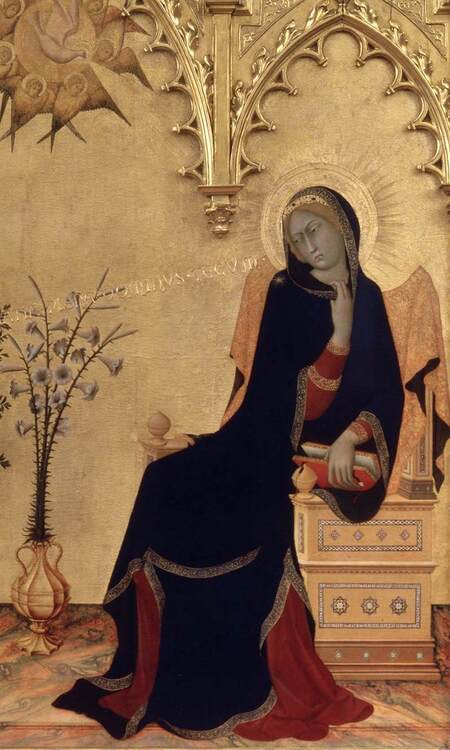
Simone Martini, Lippo Memmi. «The Annunciation,» fragment. 1333. Wood, tempera, gold. Uffizi Gallery, Florence.
The halos are encircled by several concentric bands of punson ornamentation. Each band reflects light at a different angle, causing the halo to «flash» in sections as the viewer moves.
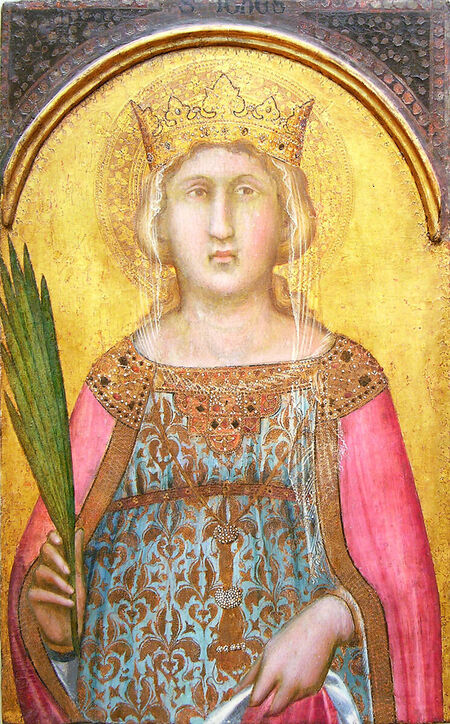
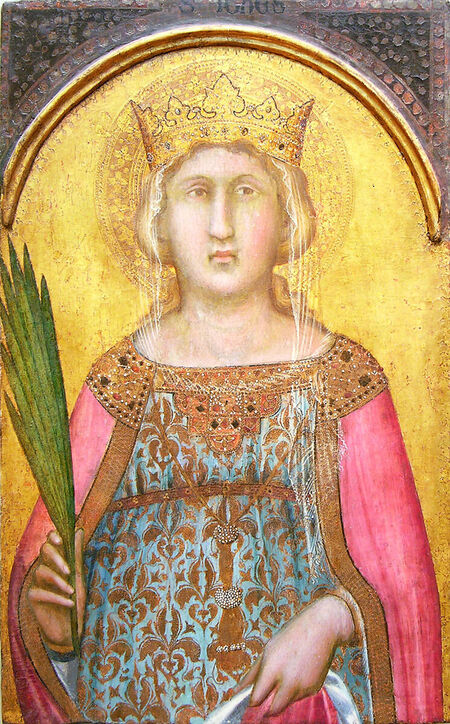
Pietro Lorenzetti. «Saint Catherine of Alexandria.» c. 1342. Wood, tempera, gold, and silver, 66 × 41.3 cm. Metropolitan Museum of Art, New York
A combination of gold and silver leaf is featured in a single panel. The punson pattern creates a fine mesh of highlights on the background and clothing, which is particularly noticeable with side lighting.
«The Wilton Diptych» (c. 1395–1399) displays an almost complete set of techniques. According to National Gallery research, it utilizes gold, silver, and «semi-gold”—a leaf made from a gold and silver alloy. The backgrounds and frames are executed with aqueous gilding over a red bole and polished, while the raised details—the collars, the white deer emblems, the crowns—use mordant gilding, which is not polished. Richard II’s attire is first gilded and then covered with cinnabar, which was partially scratched back to the gold (sgraffito). The punch tool was applied more heavily to the projecting folds and less so in the depressions, allowing the gold itself to model the volume.
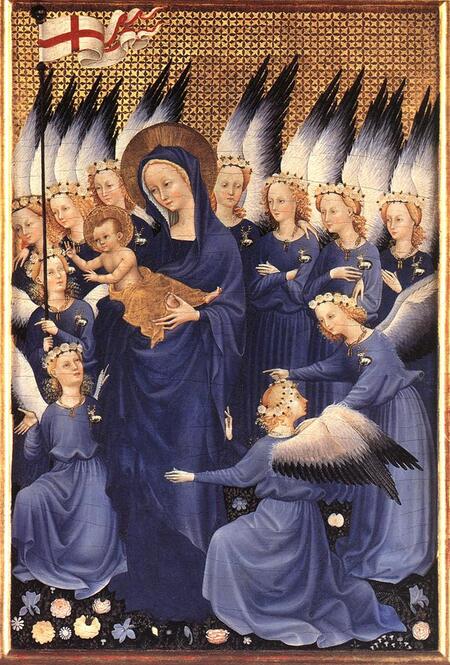
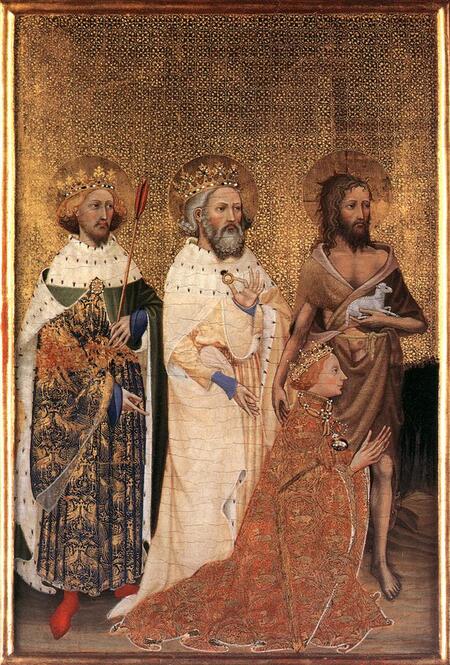
Unknown English or French Master. «Wilton Diptych»: Richard II and Patron Saints. c. 1395–1399. Oak, egg tempera, gold, silver. National Gallery, London. Unknown English or French Master. «Wilton Diptych»: Madonna and Child with Angels. c. 1395–1399. Oak, egg tempera, gold, ultramarine. National Gallery, London.
The King and saints stand against a golden background overlaid with a fine punchwork pattern. The pattern on Richard II’s clothing is achieved by scratching through the pigmented layer to reveal the gold. Eleven angels in natural ultramarine garments form a dense blue field against the gold. The contrast between the blue and the gold becomes the primary color accent of the diptych.