Abstract
This research examines Soviet architectural housing projects for nomadic and semi-nomadic peoples from the 1920s through the 1980s. The focus is on the shift in approaches to organizing daily life amidst state policies promoting settlement, the modernization of agriculture, and the development of industrial construction. Through examples of stationary homes, modernized yurts, and prefabricated mobile dwellings, we explore how architects attempted to integrate traditional living forms with new requirements for comfort, hygiene, technological efficiency, and labor organization.
Concept
Addressing the history of the yurt in the 20th century, it became important for me to understand to what extent modern yurts (stationary, with metal frameworks, tourist installations) remain heirs to the nomadic dwelling, and whether they should be viewed as a distinct phenomenon arising from state planning and tourist demand. During this process, I was guided by the understanding that for nomads, the yurt was not a return to tradition, but a relevant way of life: a collapsible dwelling adapted to seasonal migration. It is described as an ethno-cultural phenomenon linked to spiritual beliefs, social organization, and symbolic space [1]. However, the modern yurt, especially the tourist one, is often created as an image: it may remain in one place for an entire season, have a foundation, electricity, and a metal frame.
Furthermore, I considered the knowledge that the state’s attitude toward nomadic housing in the 20th century was ambivalent. Initially, the yurt served as a tool: in the 1920s, the «Red Yurt» was incorporated into the system of cultural and educational institutions, alongside reading rooms and mobile schools [2]. Then came the period of sedentarization: Sergey Weinstein noted that in Tuva, in the 1950s, «the collectivization and transition to a settled lifestyle for the Arabs were completed» [3]. Theoretically, the position of Caroline Humphrey and David Snyder is important to me: pastoralism in Inner Asia, for them, is «not timeless nomadism”—that is, not an eternal, unchanging way of life, but rather techniques and knowledge tied to specific historical circumstances [4]. This allows us to view yurt modifications as part of its history rather than as its loss.
The Yurt as an Exemplar
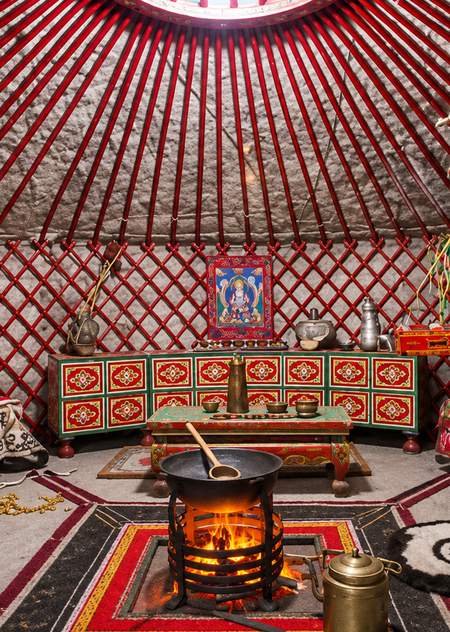
A yurt is understood as a round, collapsible nomadic dwelling featuring folding walls, a frame made of poles, and a felt covering. Among Kazakhs, it is called a kіiz үй; among Kyrgyz, it is boz үй; and among Tuvan people, öğ. Technically, the yurt is characterized by a light, lattice-like system: foldable wall grids (kerege), the dome poles (uyuq), and the top ring (shanyrak) upon which the poles rest. The structure does not require a foundation; it can be assembled and disassembled within a few hours and transported by pack animals.