i. Media Concept
you do you — a media platform about fashion as a space for self-discovery and self-expression. It helps you explore your own preferences and build a personal style through understanding fashion, reflection, and creative experimentation with clothing.At the core of you do you is the freedom from a single formula for a «correct» wardrobe. The main value of the media is the ability to autonomously shape your personal style and express yourself through clothing.
ii. Data Sources for Media
i. Social Media and Visual Platforms Themes for posts and examples of inspiration on how people wear things.TikTok, Pinterest, Instagram*ii. Fashion House Archives, Museums, and Specialized Media — Official websites, such as Prada, Maison Margiela — show photos and videos, collection descriptions.— Palais Galliera, Victoria and Albert Museum, The Metropolitan Museum of Art — online clothing collections, museum descriptions of garments, and exhibition materials.— Vogue Runway — runway archive and collection reviews; The Blueprint — fashion materials, interviews, and critical analyses.iii. Editorial Materials Try-ons, photos, videos, and notes. The editorial team experiments with items from its own wardrobe and documents what changes: how the garment fits, whether it’s comfortable to move in, or if they want to wear it that way again. These observations form the basis for the «Wardrobe Possibilities» series.iv. Community Materials Comments, poll responses, outfit photos, and participants' personal stories. These offer insights that a single image cannot provide: why a person chose that specific combination, how they felt throughout the day, and what they decided to incorporate into their personal style. These materials become the foundation for the «Personal Experience» series, and questions in the comments become topics for future publications.
iii. Data schema with separation for human and machine processing
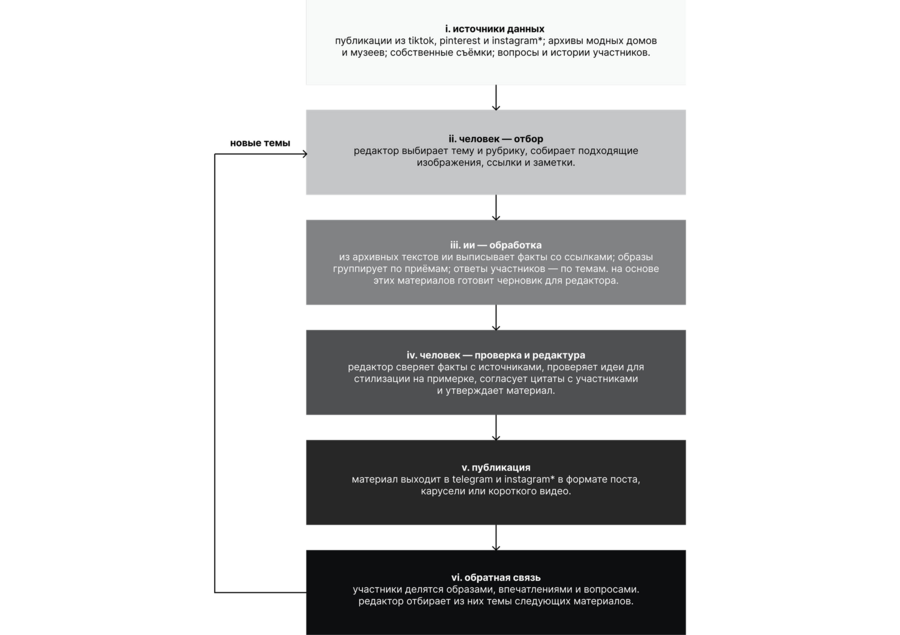
v. Guidelines for automated services
He receives a topic, a section title, and selected materials from the editor. The result of his work is a draft that includes source links and notes on what needs to be verified.
v. System work example. Scenario: «A full closet, but I still go to school with the same clothes.»
i. Input Data — Participant The participant sends photos of the outfits she wears to school and writes: «Besides jeans and a sweater, I hardly ever wear anything else. I have a favorite satin skirt, but every morning I set it aside. It feels like I’m overdressed.»ii. Machine Processing — AI The AI compares the photos and notes which items are repeated in the participant’s everyday looks. Considering her request, it suggests styling variations: for example, pairing the satin skirt with her usual sweater and flat shoes, or trying the same look with the sweater partially tucked in.iii. Variation Review — Editor The editor reviews the options and displays them side-by-side in a carousel. In the caption, the editor explains what has changed and prompts the participant to compare the looks on herself.iv. Outcome — Participant After trying them on, the participant might notice: «I like it with the sweater. I always somehow tried this skirt with a blouse, even though I never wear blouses to class.» The result of the experiment is her own observation regarding how her favorite item fits into her daily routine.
*Instagram belongs to Meta, a company recognized as an extremist organization, whose activities are banned in Russia.