Review of Irina Ivannikova-Davadova and Vasilia Kononova-Gradina exhibition on surfaces and spaces. Moscow Museum of Modern Art 26.12.2025 — 15.02.2026 curator: Victoria Vasiliev


Types of exposure
Within the framework of the cooperation programme of the Moscow Museum of Modern Art and the Centre for Art Production, the HES-2 Cultural House opened a remarkable exhibition-dialogue «On Surfaces and Spaces» at MOMMA in Ermolaevsk. The project brings together two artists, Irina Ivannikov-Davidova and Vasilia Kononova-Gradina, who study the concept of «home» in polar but interspersive registers, from an intimate home that includes the human body and physical habitat to the impersonal space of megapolis.
The exhibit handler emphasizes that the boundaries between personal and public spaces are quite volatile: the sense of home can range from a cozy room to an entire country; the question is how we interpret and perceive this paradoxical notion. The exhibition takes place on the fourth floor of MOMMA. The work of artists, almost without physical contact, is engaged in intense conceptual discussions about how the surfaces shape our reality, the categories of aesthetics, the cultural features. The surfaces (walls, floors, ceilings, daily items invoices, fences, etc.) are understood as bearing not only traces and invoices, but also the spirit of reality.
Type of entry group


The graffiti «You are not a body» is a phrase that appears on the back of the fence. In the context of the exhibition, it is read as a manifesto. By placing this message, once seen in reality, on the surface of a dusty fence, the artist affirms the sovereignty of the inner world, the spiritual dimension of the human being — as opposed to the body as a shell, a commodity, or a set of biodata in a dehumanizing digital urban environment.
Irina Ivannikova-Davidova acts as a thorough anthropologist and archaeologist, drawing on years of experience in the real estate agency and an impressive archive gathered in the process. She sees the apartment as a product and a commodity. Its installation and objects are decrypting the post-Council interior unconscious end of the 1990's to the early 2000's. The dominant multi-complicated Peresset systematization (2025) systemizes the key aesthetic categories of this time through the shape of children’s wooden cubes, from which you can gather a whole image of the home: cheap paintings of old artists, maps of the world on scheming walls, whipping wallpapers, carpets, and so on. These are «dreams» landscapes turned into products for public demonstrations on social media and advertising sites.


Irina Ivannikov-Davadova. Reassembly, 2025. Mixed equipment
The artist works with model materials, converting them: engraving images on wooden cubes and balls, incubating the skin of couchs. Scattered floor balls with embroidered plant matters (Rai, 2025), prayerable figures (Molars, 2026) are symbols, signs of private stories that have become a cliché from the interior context.


Irena Ivannikova-Davadova Image 1: The Moles, 2025. Mixed equipment / Image 2: Paradise 2025. Mixed equipment
The hunting line (2025) and Storm (2025), where visual codes of typical urban interiors of the early twenty-first century are used, are based on the stories of paintings of little-known class masters whose reproductions were widely hung in apartments. By engraving them on daily media — skin, rubber — Ivannikova-Davidova raises the question of forming the taste of the 2000s.
Irina Ivannikov-Davadova. Hunting, 2025. Leather, laser engraving


Irina Ivannikov-Davadova. Storm, 2025. Mixed equipment
The Lebedi station (2025) is made up of wooden bars found on the street, blackboards from cupboards and tables. She brings the idea of finding a new life in a new home to the limit, talking about a fragile dream inside concrete boxes. The space of the installation, lit by warm light, seems to be alive, but with close consideration is a museum of unfulfilled promises, the only owners of which are the surfaces of which it is made up.


Irina Ivannikov-Davadova. «Lebedi,» 2025. Mixed equipment
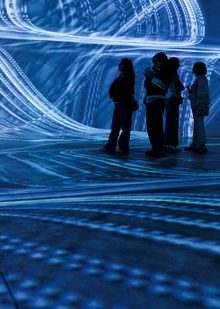
The exhibition «On Surfaces and Spaces» of Kononov-Gradina and Ivannikov-Davadova is constructed in contrast: warm «home light» against cold «city light», intimate against public, kitch against glitch.
But these contrasts come together in the main: for both surface artists, these are the carriers of the mental codes of the era. The interior patterns and urban inscriptions are the languages in which time speaks, leaving traces of our collective desires, frustrations, and the search for ourselves. A house that grows from body to city is not a shelter, but a text that is constantly — and often unsuccessfully — translated and absorbed. The exhibition invites the audience to look closely at this text, read its hidden history, and — perhaps — find in this reading act a new sensitivity to their presence here and now.
P. S. How do other artists learn about the relationship between the city, home and other spaces? You can learn by moving by reference. BRND.RU is an online store that contains local brands and young authors' works. Zines, graphics, paintings, carpets, sculptures — using different psychics — artists share their extraordinary reflections on the spirit of time.

Xenia Annenko Highway to… 2024 Painting. Halst, acryl 160×160 cm (dispt) Further

Jaroslav Antonov «City at Different Times of the Year», 2023 Series of Graphics. Carcase, colour pencil Further

Yuri Gordon «Sleep of Chairs», 2025 Coverer. Jaccardic tape, cotton thread 215×155 cm Tyrag: 33 Further

Lena Borisova «Dessure», 2025 Zin 48 pages, 14,8 × 21 cm Further

Alina Svetkina «The Club. Moscow, 2023 Painting. Halst, acrylic 130×180 cm Further
Author: Michael Arutyunyan on the cover: type of exhibit «On surfaces and spaces» by Irina Ivannikova-Davadova and Vasilia Kononova-Gradina in MOMMA (2026)