Concept.
The first conscious application of the stop-motion technique by the Edison film company while shooting the scene of Mary Stuart’s execution (placing a mannequin’s head on a neck), Méliès' serendipitous discovery during an urban shoot (after stopping filming of a passing crowd, the camera, once repaired, captured a hearse, resulting in an unexpected but effective splice), and Alice Guy-Blaché's bold experiment, where she created the one-minute fantasy film «The Cabbage Fairy» despite her superiors’ objections—who saw no prospects in theatrical approaches to filmmaking—all these events, occurring independently in the late 19th century, document the moment when the young art form, which had previously been used for documenting real-life events, opened up the possibility for directors to construct a new reality using scripting and the cutting-edge special effects of the time.
Early experiments with stop-motion and multiple exposures—which resembled circus tricks and were more perceived as a new spectacle—combined with the developing narrative structure to give birth to cinematic games and shape the familiar «formulaic» plots we know: from comedies featuring a protagonist whose rash actions lead to a humorous resolution [the head of a careless neighbor bursting in Méliès' Le Manuscrit de Méliès], to classic horror stories where characters suffer from supernatural forces [the company hiding from the rain in a sinister haunted house in Sugando de Chomón’s namesake film]. Adaptations of Jules Verne’s books, Lewis Carroll’s Alice in Wonderland, and visualizations of subjective perception (dreams in Méliès’ A Trip to the Moon or memories in Fernand Zekka’s History of a Crime) consequently forged the science fiction, fantasy, and dramatic cinematic traditions, respectively.
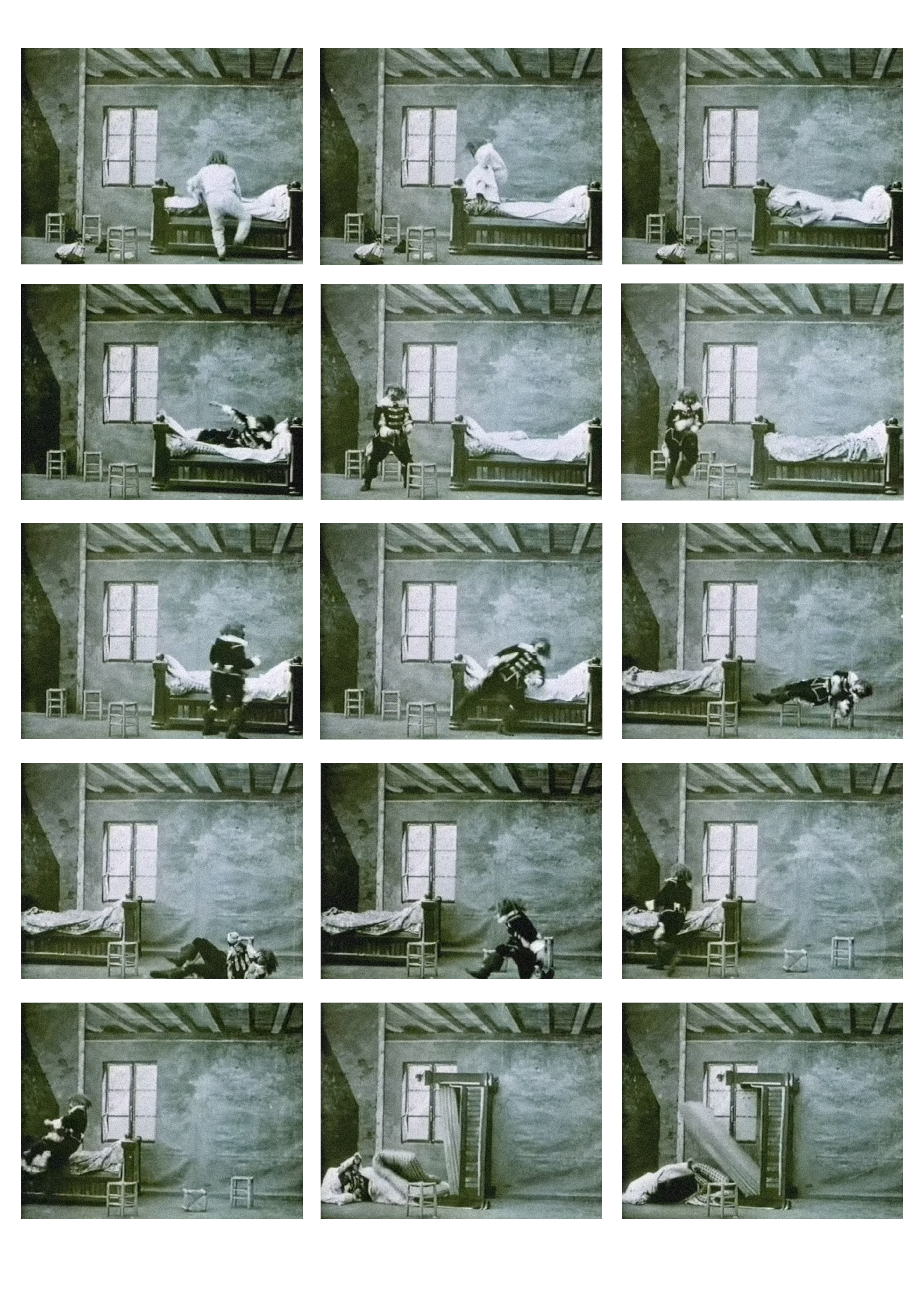
However, despite their obvious influence on modernity, in many early silent films featuring special effects by Méliès, Segundo de Chomón, Fernand Zeckis, and Alice Guy-Blaché, the dynamism of the action does not escape the frame—the camera remains static, and rare cuts, which facilitate scene changes, do not allow for a clear demarcation between a theatrical stage and the cinema. Inheriting the qualities of pageantry—its elaborate set design, the world of the scenery, costumes, and abundance of visual effects—the filmmakers strive not to convince people of the reality of what is happening, but to captivate them with an incredible spectacle and tricks, sharing with the audience the unvarnished wonders of cinematography and creating a sense of magic—a phenomenon that is the subject of this study.
Navigation
- Wish Fulfillment.
- Magician Directors.
- Fantasy Worlds.
- Living Set Design.
- Anthropomorphic Environments.
- Sorcery.
- Immersive Storytelling and Canonical Subversion.
Conclusion.
Chapter 1. Fulfilling Wishes.
Female characters play a significant role in the festivities: patronesses of the arts, sciences, and seasons—descended from theatrical muses, adorned in elaborate gowns or attire resembling ancient Greek sculptures, holding scepters, crowned with wreaths, or displaying planetary symbols. The heroines appear on stage unexpectedly (through a freeze-frame), assisting characters engaged in science or art who require patronage—such as an artist unable to afford lodging, a family struggling to conceive, or an astronomer devoured by the Moon.
«Spring Fairy,» Fernando Zeca, 1902
«Fairy of Spring, ” Fernando Zekka, 1902
«Gold Obsession, ” Segundo de Chomon, 1906
«Obsession with Gold,» Segundo de Chomón, 1906
«The Dream of the Astronomer, ” Georges Méliès, 1898
«The Dream of the Astronomer, ” Georges Méliès, 1898
Chapter 2. Illusionist Directors.
Beyond musicians, the marvels are also shaped by scientists, magicians, and the creators who direct living theater—the self-portraits of filmmakers [cameos]. Their magic forms the central theme of many of Shotmont and Méliès' short films, reflecting how directors overcame the physical limitations of human ability through cinema and special effects—reducing or enlarging people, or using chroma key or multiple exposures for fire tricks. The characters in these brief, yet narrative, stories are not merely creators but inventors, as all their tricks involve the use of mechanisms [a bellows mechanism for inflating a head, an egg-box, a giant fan], akin to the directors' interaction with the camera.
«Easter Eggs,» Segundo de Schomon, 1907
«Easter Eggs, ” Segundo de Chomón, 1907
«Man with a Rubber Head, ” Georges Méliès, 1901
«The Man with the Rubber Head, ” Georges Méliès, 1901
«Wonderful Living Fan, ” Georges Méliès, 1904
«Wonderful Living Fan, ” Georges Méliès, 1904
«Japanese Butterflies, ” Sugundo de Shomon, 1908
«Japanese Butterflies,» Segundo de Shomon, 1908
Chapter 3. Fantastical Worlds.
Improving the capabilities of the film camera and their own mastery in stop-motion, colorization, and frame layering, directors transport the action of the images from the prototype of their own workshops to a real space—but one populated with fantastic props—in space, designing its environment as a combination of a hyper-exaggerated Earth setting [enlarged flora] and factual knowledge of the Moon [craters and mountains].
«Le Voyage dans la Lune,» Georges Méliès, 1903
«Voyage to the Moon, ” Segundo de Chomón, 1908
«Le Voyage dans la Lune, ” Georges Méliès, 1903
«Journey to Jupiter, ” Segundo de Chomón, 1909