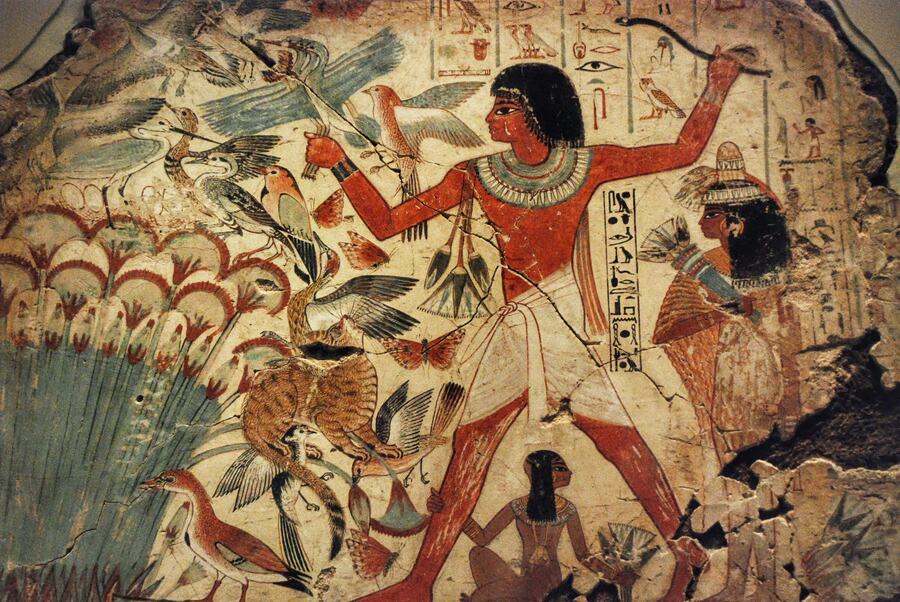
Визуальная иерархия в стенописи фиванских гробниц Нового царства
Concept
During the 15th–13th centuries BCE, monumental funerary painting flourished in the Theban Necropolis: large-scale murals were created in the royal tombs of the Valley of the Kings and the Valley of the Queens, as well as in the tombs of high officials in Sheikh Abd el-Qurna, primarily featuring ritual and daily life subjects. However, despite adherence to a unified iconographic canon, the depiction of various characters on these walls varied dramatically. Gods and rulers were rendered monumentally, statically, and isolatedly, evoking a sense of eternal peace and grandeur, whereas the subjects, servants, and captives appeared diminished, dynamic, and densely arrayed.
When compared, the difference in artistic approach to depicting members of different social strata becomes particularly pronounced.
What were these differences, and how did they encode a character’s status in New Kingdom painting generally? What visual problems did the masters set for themselves when constructing compositions, and how was this expressed?
The principles of visual hierarchy developed in ancient Egyptian wall paintings remain relevant even today, as this system was one of the first models of graphical navigation in world art—understandable to the viewer without reading text. Therefore, I wanted to look back at the origins of this visual system to see exactly how the division between the divine and the terrestrial was constructed within a single artistic space. For this purpose, I selected one region and a period of peak funerary painting—the Theban necropolis of the XVIII–XIX Dynasties (15th–13th centuries BCE)—where images of gods, rulers, and subjects collide within a single wall.
The key question I set for myself is: what compositional, plastic, and spatial techniques did the wall paintings of the New Kingdom Theban tombs use to construct a visual hierarchy among the gods, the ruler, and the subjects?
Among the monuments of the Theban necropolis, the most expressive and well-preserved murals were selected—those where the interaction between different social strata is most clearly visible (the tombs of Nefertari, Nebamon, Rekhmire, Ramose, Amen, Nakht, Huiu, and Kenamon).The research is divided into chapters that allow for a stage-by-stage examination of the paintings from various perspectives, highlighting key techniques for establishing hierarchy. The first chapter analyzes the scale and proportions used by the artists to differentiate the status of the characters. The second chapter analyzes the specifics of working with posture, angle of inclination, and silhouette geometry. The third chapter reveals the characteristics of working with spatial isolation, the rhythm of the crowd, and the register grid.
The key parameters for selecting information sources were their authority, scholarly accuracy, and depth of thematic exploration. I utilized both foundational texts on the history of Ancient Egyptian art to acquire basic knowledge, as well as contemporary research and museum catalogs (from the British Museum, the Metropolitan Museum of Art, and the Getty Conservation Institute). Consequently, I was able to conduct the most precise visual analysis of this material.
Chapter 1. Scale as a Measure of Status.
In the art of Ancient Egypt, the size of a figure on the wall plane has no connection to optical perspective or the physical distance of the character from the viewer. Scale functions here as the primary tool for visual navigation: the higher the sacred or social rank of the figure, the greater the area of the wall they occupy.
Scale—the first thing the viewer registers when glancing at the tomb wall: the equality of the figures' height signifies the equality of their divine nature.
At the highest tier of the hierarchy, the frescoes depict the visual equalization of the earthly ruler with immortal gods. In scenes of ritual greeting, the figures of the deity and the queen are constructed using a single proportional module. The lines of their eyes, shoulders, belts, and knees align horizontally, graphically affirming the ruler’s status as an equal participant in the sacred space, rather than a petitioner.
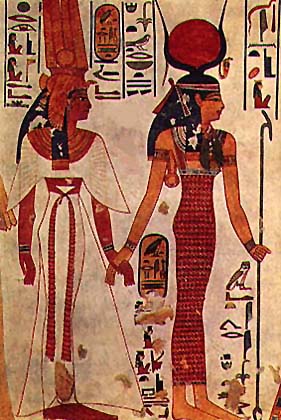
«Богиня Исида ведет царицу Нефертари» ок. 1255 г. до н. э.
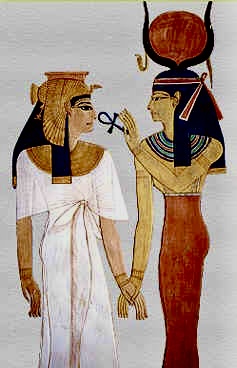
«Царица Нефертари перед богиней Хатхор» ок. 1255 г. до н. э.
Upon closer inspection of the silhouettes of gods and rulers, it becomes evident that their vertical presence is further elongated by their elaborate headwear. Amun’s ostrich plumes, Hathor’s horns adorned with a solar disc, Osiris’s Atef crown, and the Pshent double crown artificially increase the figure’s height by 25–30%. Because of these attributes, the divine figures reach the upper frieze of the wall, while the heads of ordinary people remain far below.
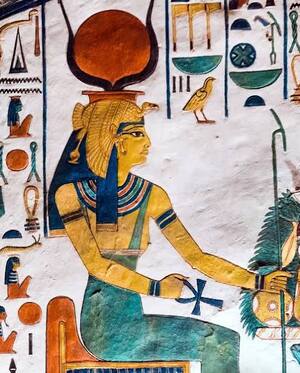
Фрагмент головы богини Хатхор в короне с солнечным диском и перьями (гробница Нефертари QV66, XIII в. до н. э.)
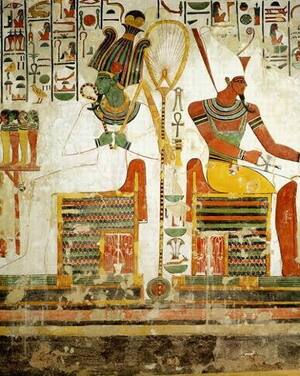
Фрагмент головы Осириса в высокой короне атеф (гробница Нефертари QV66, XIII в. до н. э.
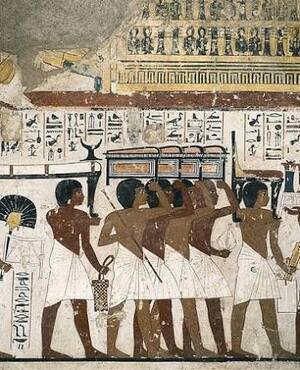
Фрагмент непокрытых голов придворных из гробницы Рамосе (TT55, Фивы, XIV в. до н. э.).
Details of the headdresses of the gods from the Nefertari tomb (QV66, 13th century BCE) in comparison with the silhouettes of subjects from the Ramose tomb (TT55, 14th century BCE).
When transitioning from dialogues of the gods to scenes of the ruler interacting with court officials and dignitaries in wall paintings, there is a sharp shift in scale (a 2:1 or 3:1 ratio). To establish this sense of distance, the masters employed three consistent techniques: • The figure of the pharaoh or tomb owner occupies the entire height of the composition, from the bottom border to the upper frieze; • The dignitaries, scribes, and priests standing before him are reduced in size—their heads barely reach the level of the seated ruler’s chest or waist; • The figures of the entourage are arranged in several tiers stacked one above the other to fill a height equal to that of a single ruler.
«The Viceroy of Nubia Hapu with his retinue before Tutankhamun’s throne,» Hapu’s tomb, Thebes, 14th century BCE.
The maximum panoramic distortion (reaching a 4:1 ratio) is evident in scenes of triumph and the reception of foreign tribute. Here, the figure of the ruler on the throne transforms into something akin to a monumental architectural column, at the base of which are placed miniature figures of bound captives and bearers of gifts. A single human silhouette occupies an area larger than an entire group of secondary characters.
«Pharaoh Amenhotep II on the throne above vanquished enemies,» Kenamon’s Tomb, Thebes, 15th century BCE.

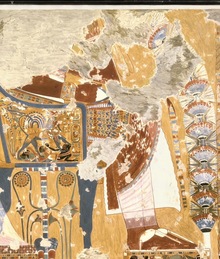
Scale comparison within a single scene: the Pharaoh’s foot is comparable in height to the entire figure of the captive (Karnak Tomb, 15th century BCE).
To emphasize the ruler’s superiority even while seated, New Kingdom artists employed the technique of the «double pedestal.» The throne was placed on a tall, stepped dais and was enclosed within the frame of a columnar pavilion canopy. The ground level beneath the ruler’s feet was physically elevated above the floor where his subjects walked.
«Osiris on a Throne Under a Baldachin, ” Senegem Tomb, Deir el-Medina, 13th century BCE.
The monumental frieze serves as an example of the master rule of proportion: the artist deliberately deprives the subjects of individual height, transforming their scale into a direct measure of their subservience.
Thus, the varied scale in the wall paintings of the Phidian tombs completely replaces perspective and functions as a fail-safe visual filter. The viewer does not need to study the characters' titles—at first glance at the wall, the figure’s size unequivocally dictates whether they are the eternal bearer of divine power, its high-ranking intermediary, or an anonymous functionary.
Chapter 2. The Plasticity of Submission.
If scale establishes the initial distance between characters, the geometry of the body itself reveals the internal mechanics of power and submission. In the wall paintings of New Kingdom Theban tombs, the body’s plasticity functions as a strict indicator of rank: the higher a hero’s status, the closer their posture approaches a static, symmetrical architectural monolith.
A straight spine and symmetrical shoulders are the visual privilege of power; a lean, twist, and dynamism signal submission.
The figures of gods and rulers are constructed upon a rigid orthogonal grid. The shoulder girdle is oriented strictly frontally, the head and legs are shown in a pure profile, and the spine forms an impeccable right angle with the ground line. Even in scenes of ritual procession, the ruler’s stride remains measured and stable, entirely devoid of emotional agitation or tension.