Introduction
This work analyses the communication strategy of PIMS, a Russian to-go beverage brand built around fermented tea, fresh fruit, berries, tapioca, and signature cream. PIMS is a suitable case for visual research because its popularity is connected not only to the taste of the product, but also to its media potential: the recognizable cup, lifestyle aesthetics, social media visibility, influencer marketing, and user-generated content. The research question of this project can be formulated as follows: How did the visual aesthetics of PIMS help the brand quickly build recognition, and why did its dependence on visual and peripheral persuasion make the brand vulnerable during a reputational crisis? PIMS positions itself as a new format of to-go drinks and a strong alternative to coffee. Unlike traditional coffee brands, PIMS sells not only a beverage, but also a lifestyle image: a stylish cup, a bright taste, urban mobility, visual attractiveness, and a sense of belonging to contemporary youth culture. The idea of the brand began to take shape in 2018, when Arthur Shusteriovas and Gleb Golubev started developing the concept of a new drink inspired by Asian street beverage culture. However, PIMS became visible as a restaurant and beverage project in 2020. Its first popular location near Patriarch’s Ponds quickly became a point of attraction for young urban consumers, and long queues for the drinks became part of the brand’s public image. The product idea behind PIMS is based on a combination of fermented tea, fruit, berries, tapioca, and signature cream. However, in public communication, the brand sells not only the composition of the drink, but also an experience: walking through the city with a stylish cup, taking an aesthetic photo, belonging to a trend, and participating in the visual culture of social media.
Positioning and Target Audience
Several meanings are especially important in the brand’s communication:
- a new beverage format
- an alternative to coffee
- naturalness and fruitiness
- energy and refreshment
- to-go aesthetics
- belonging to youth urban culture
- visual attractiveness for social media
The target audience of PIMS consists mainly of young people living in big cities who are actively involved in social media culture, visual consumption, trends, and lifestyle communication. This includes not only Gen Z, but also a wider young audience: students, young professionals, visitors of shopping malls, urban spaces, festivals, and popular city districts. It would be inaccurate to describe this audience as «easy to manipulate by marketing.» A more precise formulation is that this audience is highly responsive to visual codes, social proof, and trends. For them, the taste of the product matters, but so does the way the product looks in a photo, who consumes it, where it appears, and what social image it creates.
For the PIMS audience, the cup becomes a symbol of a certain lifestyle: mobile, contemporary, visual, urban, and slightly status-oriented.
Brand Communication Channels
First, the official website performs an informational function. It presents the menu, explains the concept of the drinks, helps users find locations, and provides information about partnership opportunities. The website is important for the central route of persuasion because it gives users more rational information about the product: ingredients, formats, flavors, franchise opportunities, and brand geography.
Second, social media plays a crucial role. Instagram*, TikTok function as visual platforms where PIMS presents the lifestyle image of the brand: cups, drinks, color combinations, trending videos, influencers, urban scenes, and user-generated content.
*Facebook, Instagram, a organization and its products are recognized as extremist and banned in the Russian Federation.
—
Third, the Telegram channel PIMS CLUB and the VK community are important for news, promotions, communication with the audience, announcements of new locations, and maintaining a sense of community.
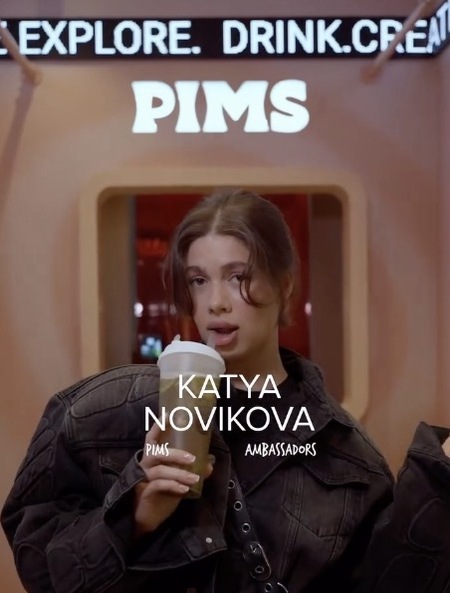
Fourth, influencer marketing has played a significant role in the brand’s growth. At the early stage of promotion, PIMS actively used bloggers and visual content to trigger imitation and social desire. When the drink appears in the hands of opinion leaders, it begins to be perceived not only as a product, but also as a sign of relevance and status.
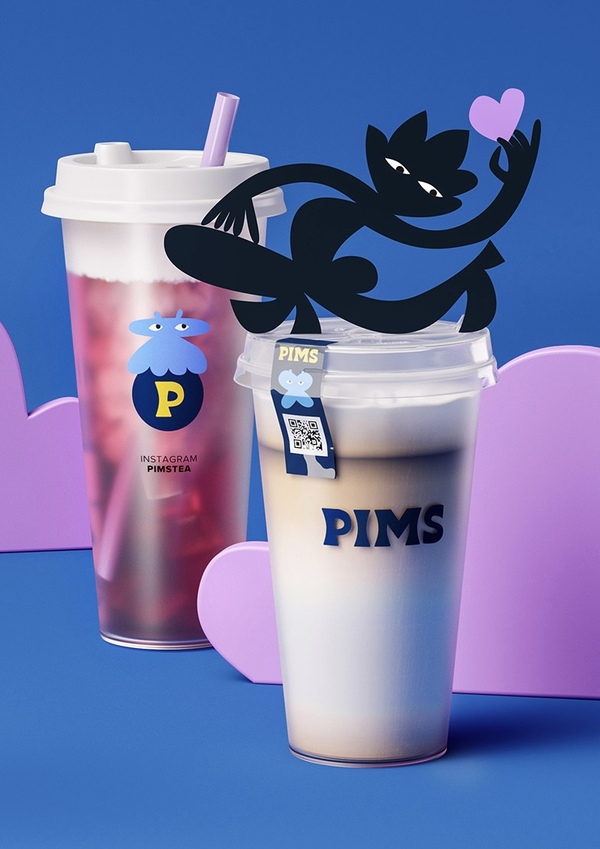
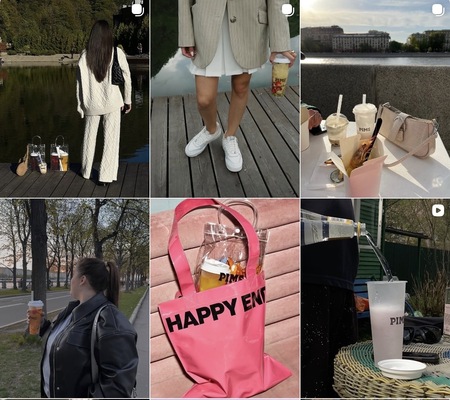
Fifth, the packaging itself became an important communication channel. The PIMS cup can be understood as a media object. It does not simply contain the drink; it functions as a visual carrier of the brand. Due to its minimalistic design, recognizable logo, and photogenic appearance, the cup encourages users to photograph it, post it in stories, and include it in their personal visual content.
Marketing and PR Strategies of PIMS
User-Generated Content and the «Media Potential» of the Product
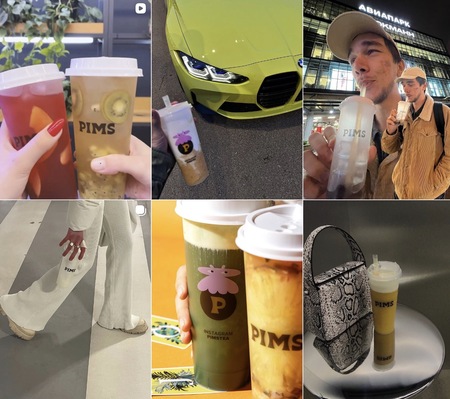
One of the main strategies of PIMS is the creation of a product that naturally encourages social media publication. The PIMS cup became a visual trigger for UGC — user-generated content. The consumer buys not only a drink, but also an object that looks good in a photo. The cup can easily be photographed in someone’s hand, on the street, in a café, next to clothes, a bag, a laptop, or an interior. Through this, PIMS becomes part of everyday visual culture. This is especially important for a to-go brand. Unlike a traditional café, where users may remember the interior, PIMS needs to remain recognizable outside its physical locations. The packaging becomes a mobile advertising surface: a person leaves the café, walks through the city with the cup, posts a story, and spreads the brand further. Thus, UGC around PIMS did not emerge by accident. It was connected to the deliberate visuality of the product: the shape of the cup, the logo, the color of the drink, the cream on top, the straw, and the overall aesthetic of a fashionable urban beverage.
—
Influencer Marketing
PIMS has also used influencer marketing. Bloggers and opinion leaders helped the brand create the effect of social proof: if the drink appears in the hands of people followed by the audience, it begins to seem desirable and culturally relevant. In this case, the influencer functions not only as an advertising channel, but also as a source of symbolic status. They move the drink from the category of «just tea» into the category of «something fashionable to consume right now.» For PIMS, this is especially important because the taste of the drink cannot be evaluated through a screen. The user only sees visual signals: the cup, the influencer, the queue, and other people’s reactions. Therefore, influencer marketing strengthens the peripheral route of persuasion: the audience makes judgments based on external cues rather than a deep analysis of the product.
Cross-Branding and Lifestyle Partnerships
After gaining recognition, PIMS began developing itself as a lifestyle brand. This was supported through collaborations, partnerships, events, merchandise, seasonal launches, and participation in youth-oriented urban culture. This strategy helps the brand avoid being perceived as a short-lived trend. PIMS aims to be not just a place where people buy drinks, but part of a broader youth and urban agenda. Visually, this is expressed through events, collaborations with fashion brands, branded merchandise, limited-edition launches, and communication with the community. The strength of this strategy is that it expands the meaning of the brand. PIMS becomes not only a product, but also a cultural marker. The weakness is the risk of identity dilution: if the brand relies too much on hype and trends, it may lose its connection with product quality.

The PIMS Police Reputational Crisis
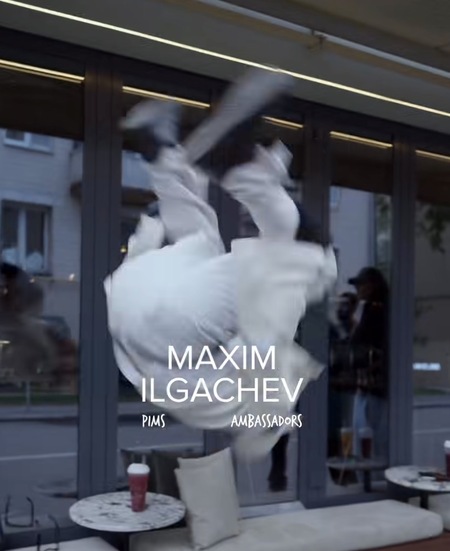
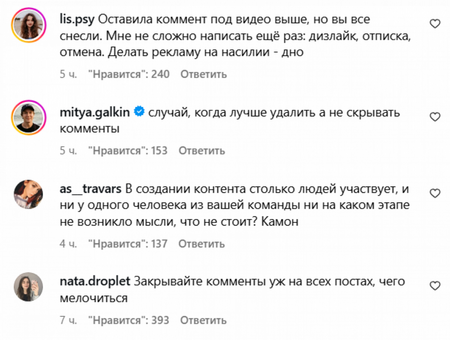
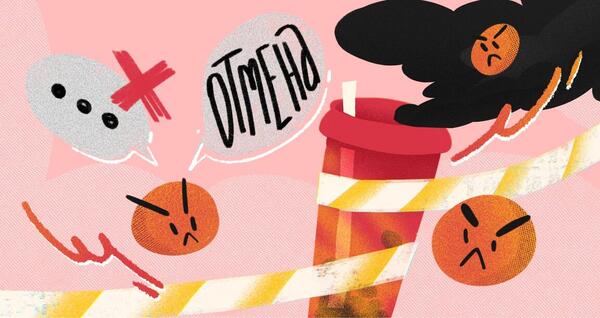
In June 2025, PIMS faced a reputational crisis after publishing the advertising video «PIMS Police.» In the video, a man aggressively searches a woman in front of a café window. In the caption, the brand presented the idea as a joke about people trying to make PIMS at home and added the phrase «No harassment.» However, the audience interpreted the video differently. Many users saw it as sexualized violence, harassment, and an inappropriate provocation. The negative reaction was intensified by the broader social context: at the same time, public discussions about harassment and pickup courses were highly visible in the media. As a result, the visual signs of the video were not decoded as a «local joke, ” but as an exploitation of a painful social issue. In addition, users compared the PIMS video to a similar video by the Spanish fashion brand Cold Culture. This added accusations of plagiarism to the ethical criticism. As a result, the brand faced not only accusations of insensitivity, but also criticism for a lack of originality. The brand’s response worsened the crisis. After the first wave of criticism, PIMS published a second similar video, this time with a man being searched. Instead of softening the situation, this step created the impression that the brand had not understood the audience’s criticism. Later, the videos were deleted and comments were closed. From a communication perspective, this was not simply an unsuccessful creative idea. It was a crisis of mismatch between the brand’s intended message and the audience’s interpretation. PIMS intended to create a provocative inside joke, but the audience decoded the video through the current social context — as a normalization of aggressive behavior and harassment.
Theoretical Framework
Two theories are used to analyze the visual and PR communication of PIMS: the Elaboration Likelihood Model and Dialogic Theory. This choice corresponds to the research focus because PIMS is interesting both as a visual brand and as a brand that experienced a crisis of feedback and audience trust. The Elaboration Likelihood Model helps explain why visual aesthetics, bloggers, packaging, and social proof became strong tools of persuasion. Dialogic Theory helps evaluate how the brand built relationships with its audience and why its communication became insufficiently dialogic during the crisis.
Elaboration Likelihood Model
The Elaboration Likelihood Model, developed by Richard Petty and John Cacioppo, explains that persuasion can happen through two routes: the central route and the peripheral route. The central route is connected to deep processing of arguments. A person carefully evaluates facts, product quality, ingredients, evidence, comparison with competitors, and rational advantages. The peripheral route is connected to external cues and heuristics. A person does not analyze the message deeply but relies on quick signals: beautiful packaging, popularity, influencers, likes, queues, style, recognizability, source authority, or emotional impression. This theory is especially relevant to PIMS because the brand became popular largely through peripheral cues. The user often first sees not the ingredients of the drink, but the cup, a queue, a blogger’s story, or an aesthetic video. At this stage, the logic works as follows: beautiful cup → «this is fashionable»; blogger drinks PIMS → «I want to try it too»; queue near the location → «the product must be worth it»; many stories → «this is part of a trend»; aesthetic image → «I want this experience too.» However, it is important not to claim that PIMS does not use the central route at all. The brand does have central arguments: fermented tea, fresh fruit, natural ingredients, an alternative to coffee, and a refreshing effect. The problem is not the total absence of the central route, but the fact that in public visual communication, peripheral signals are much more visible than rational arguments. This is precisely why PIMS became vulnerable during the crisis. If a brand builds audience attachment mainly through aesthetics, status, and trendiness, then a reputational blow to the visual image can quickly damage trust. After the PIMS Police scandal, the same peripheral mechanisms began to work against the brand: instead of «fashionable and beautiful, ” part of the audience began to decode the brand as „unethical, ” „toxic, ” and „associated with harassment.“ Therefore, the Elaboration Likelihood Model reveals the dual nature of PIMS’s strategy: the peripheral route helped the brand grow quickly, but the weak visibility of central arguments reduced the brand’s resilience in a crisis situation.
Dialogic Theory
Dialogic Theory, developed by Kent and Taylor, views PR communication as a process of building relationships between an organization and its publics. In this theory, the central issue is not the brand’s monologue, but the possibility of feedback, mutual recognition, and continuous interaction. For the digital environment, Kent and Taylor identify five principles of dialogic communication: dialogic loop — the opportunity for the audience to ask questions, express opinions, and receive a response; usefulness of information — the usefulness of information for the audience; generation of return visits — creating reasons for users to return to the brand’s communication channels; ease of interface — clarity and usability of the interface; conservation of visitors — keeping visitors within the brand’s communication space. Before the crisis, PIMS appeared to be a relatively dialogic brand. Social media, the Telegram channel, UGC, reposts, influencers, and community practices created the feeling of horizontal communication. It seemed that the brand was in constant contact with its audience and spoke the same language. However, the PIMS Police crisis revealed the limits of this dialogic image. At the moment when the audience began to express criticism, the brand failed to preserve an open dialogic loop. Closing comments became a symbolic break in communication: the audience received the signal that its reaction was not accepted as meaningful feedback. From the perspective of Dialogic Theory, the main mistake of PIMS was not only the video itself, but also the response that followed. The brand did not immediately acknowledge the problem, published a second similar video, deleted the posts, closed comments, and formulated its position in a defensive tone. Instead of dialogic communication, the brand produced defensive communication. The phrase that the video was an «inside joke within the community» and that the brand was «not for everyone» could be perceived as distancing itself from critics. In dialogic communication, the audience should not be divided into «those who understood» and «those who did not.» Even negative reactions are part of feedback, especially when the issue concerns a sensitive social topic.
Applying the Theories to the Visual Communication of PIMS
The PIMS Cup as a Peripheral Cue
The PIMS cup is the key visual element of the brand. It functions not only as packaging, but also as a sign of belonging to a specific urban culture. In terms of the Elaboration Likelihood Model, this can be explained through the peripheral route of persuasion: the user does not necessarily analyze the taste, ingredients, and quality, but instead reads visual cues. The cup communicates: «this is fashionable, ” „this is aesthetic, ” „this is popular, ” and „this can be shown in stories.“ It becomes not just a container for the drink, but a media object. From a theoretical perspective, this works as an attractiveness heuristic: if the product looks visually appealing and is connected to a desirable lifestyle, the audience can transfer this positive impression onto the brand itself. Therefore, packaging becomes a powerful tool of persuasion.
Queues and Social Proof
Queues near PIMS locations can also be analyzed through the Elaboration Likelihood Model. A queue works as social proof: if many people are willing to wait for the drink, the product appears valuable. For an audience that sees a queue in real life or in social media videos, this becomes a peripheral heuristic. A person may not know how PIMS differs from other drinks, but the queue creates a sense of popularity and scarcity. This mechanism is especially effective in urban culture, where trends spread quickly through visual signals. The queue itself becomes part of the brand’s advertising image.
The queue functions as social proof and strengthens the perception of PIMS as a trendy product.
Influencers and the Imitation Effect
Influencer posts strengthen the peripheral route of persuasion. When the audience sees PIMS in an influencer’s content, the drink gains additional symbolic status. What matters is not only what the influencer says, but also the fact that the product appears in their visual field. In the Elaboration Likelihood Model, this is connected to the heuristics of authority, liking, and social approval. If a person trusts the influencer or wants to be similar to them, the product becomes more desirable. However, this strategy has a limitation: if the brand’s reputation worsens, influencers may distance themselves, and the formerly positive signal can quickly turn into a reputational risk.